Commerce Department Reviews AI Software Guardrails
Restricting China's Access to US Advanced Technology
Commerce Secretary: "US Capital, China Investment Restrictions to be Completed Within the Year"
The Biden administration is considering establishing guardrails to block China’s access to core AI software such as 'ChatGPT,' following restrictions on AI semiconductors. The introduction of regulations limiting U.S. capital investment in advanced technology targeting China, announced last year, is also planned to be completed within this year.
According to major foreign media on the 8th (local time), the U.S. Department of Commerce is reviewing export control measures that include restrictions on the export of proprietary and non-public source AI models. The countries likely to be subject to the new AI export controls include China, Russia, North Korea, and Iran.
This move is part of the U.S. efforts over the past two years to block China’s advanced technology development citing national security threats. After previously restricting exports of advanced AI semiconductors such as Nvidia products to China, the U.S. now aims to control the export of AI software to China.
Currently, American companies such as Microsoft (MS), OpenAI, Google, and Anthropic, which have developed powerful proprietary AI models, can sell AI models to any country worldwide without government oversight. In this regard, government and private experts express concerns that countries hostile to the U.S. could use AI to carry out cyberattacks or produce powerful biological weapons. MS released a report in February stating that hacking groups linked to China, North Korea, Russia, and Iran attempted to exploit large language models (LLMs) for hacking.
The U.S. is expected to apply the standards included in the AI executive order announced in October last year regarding the new AI model export control measures. According to this executive order, when the computing power required for AI model training reaches a certain level, developers must report their AI model development plans and test results to the Department of Commerce. Sources indicate that AI models subject to export restrictions may be determined based on computing power.
However, there are also concerns that, given the rapid evolution of AI technology, the U.S. government’s export control measures may not strongly suppress advanced technology development in China and other countries.
Peter Harrell, a former official of the U.S. National Security Council (NSC), said, "As the Biden administration examines competition with China and the risks of advanced AI, AI models are clearly one of the obvious tools and potential gateways to consider," adding, "Whether it can be turned into a controllable gateway through export controls remains to be seen."
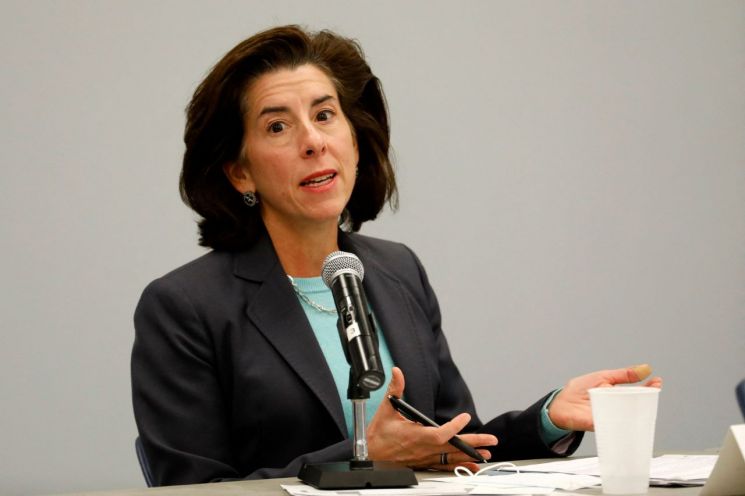
Meanwhile, U.S. Secretary of Commerce Gina Raimondo expressed her determination to continue export controls on China during her appearance before Congress on the same day.
At a House hearing, Secretary Raimondo emphasized, "We are taking all necessary measures to prevent China from acquiring advanced technology," adding, "We are focusing on controlling core technologies. We aim to protect technologies we possess but to which China cannot gain access, and we are cooperating with allies such as Japan and the Netherlands to that end."
Regarding restrictions on U.S. capital investment in advanced technology targeting China, she explained, "The Treasury Department is leading this effort," and "The regulations are expected to be completed within this year."
© The Asia Business Daily(www.asiae.co.kr). All rights reserved.
![Clutching a Stolen Dior Bag, Saying "I Hate Being Poor but Real"... The Grotesque Con of a "Human Knockoff" [Slate]](https://cwcontent.asiae.co.kr/asiaresize/183/2026021902243444107_1771435474.jpg)
















