"I believe the type of weight loss is more important than the amount." (Matthew Ro, Vice President of Early Cardiovascular, Renal, and Metabolic (CVRM) Development at AstraZeneca (AZ))
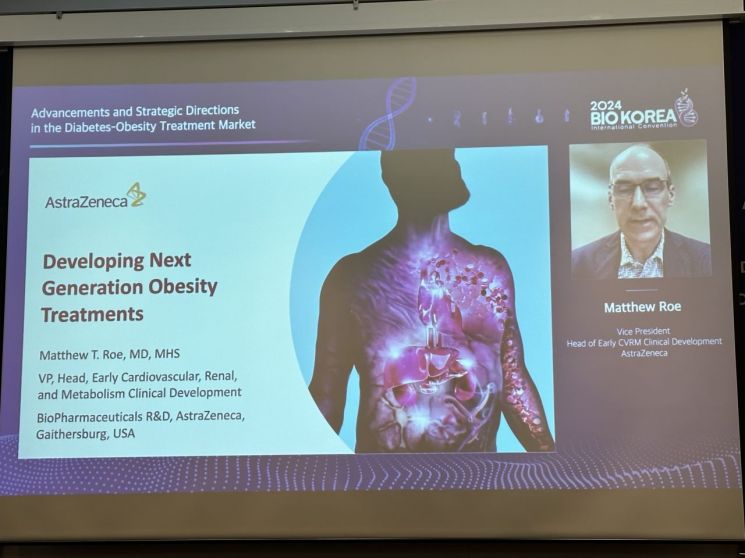 Matthew Ro, Vice President in charge of early cardiovascular, renal, and metabolic (CVRM) development at AstraZeneca (AZ), is presenting at the Bio Korea Conference held on the 8th at COEX, Gangnam-gu, Seoul.
 [Photo by Lee Chunhee]
As glucagon-like peptide (GLP)-1 class obesity treatments boasting 'over 20% weight loss' rapidly rise, there are calls to evaluate not just simple weight loss but how much 'quality' weight loss is actually achievable.
On the afternoon of the 8th, during the 'Potential Development and Future Strategies of the Obesity Treatment Market' session at Bio Korea 2024 Conference held at COEX in Gangnam-gu, Seoul, a discussion was held to assess the current state of obesity treatments. Key speakers at the event noted that since GLP-1 class treatments have secured significant weight loss effects, going forward, quality weight loss is needed by suppressing muscle loss while lowering glycated hemoglobin, a key indicator of diabetes.
Matthew Ro, Vice President at AZ, said, "During weight loss, lean body mass such as muscle decreases," adding, "This can be a significant problem for patients with underlying conditions who have sarcopenia." He emphasized that focusing solely on the amount of weight loss is not enough. "The type of weight loss is more important than the amount," he said, stressing, "The key is to reach appropriate weight loss." Currently, AstraZeneca holds multiple obesity drug candidates in clinical phases 1 and 2.
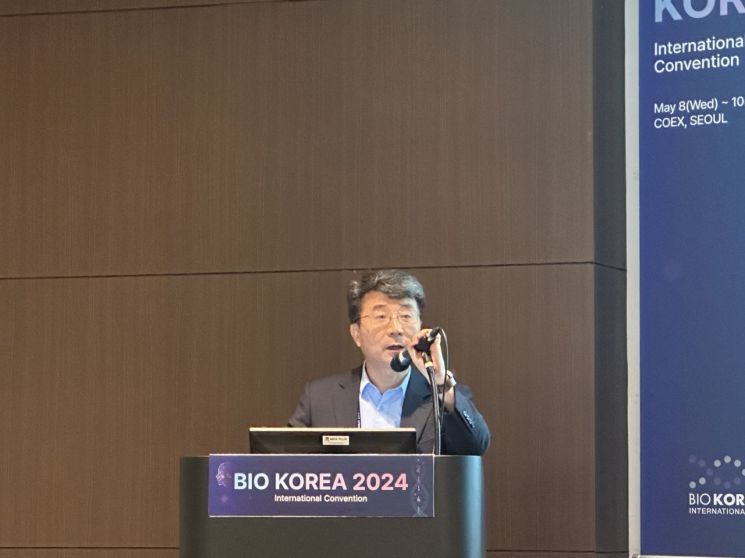 Kim Jong-gyun, CEO of Progen, is giving a presentation at the Bio Korea Conference held on the 8th at COEX in Gangnam-gu, Seoul.
 [Photo by Lee Chun-hee]
Progen, with Yuhan Corporation as the largest shareholder, is developing PG-102, a dual agonist combining GLP-1 and GLP-2. GLP-2 has traditionally been used to treat short bowel syndrome, a condition where more than 60% of the small intestine is lost congenitally or surgically, impairing digestion and absorption. Progen aims to enhance drug efficacy through dual action by leveraging GLP-2’s effects in preventing intestinal leakage and reducing systemic inflammation.
Kim Jong-gyun, CEO of Progen, also emphasized, "In the future, the quality of obesity treatments will become more important," highlighting that developers must consider various side effects, lean body mass loss, and rebound effects. Currently, PG-102 has demonstrated superior weight loss effects compared to existing obesity treatments in preclinical studies using rat models. In particular, regarding the 'quality of weight,' the fat loss effect relative to lean body mass, which was previously about 2.9 times, has been increased to 6.4 times. Additionally, high efficacy was confirmed in improving glycated hemoglobin.
Existing GLP-1 class obesity treatment developers are also following this trend. Eli Lilly, the developer of the obesity drug Zepbound, acquired Versanis for $1.93 billion (approximately 2.63 trillion KRW) last year to develop the obesity drug Vmaglubab, which reduces weight without causing muscle loss. Hanmi Pharmaceutical is also set to release next month preclinical research results confirming minimal muscle loss and high weight loss efficacy for the obesity drug HM15275, which recently received approval for a phase 1 clinical trial in the United States.
© The Asia Business Daily(www.asiae.co.kr). All rights reserved.
![Clutching a Stolen Dior Bag, Saying "I Hate Being Poor but Real"... The Grotesque Con of a "Human Knockoff" [Slate]](https://cwcontent.asiae.co.kr/asiaresize/183/2026021902243444107_1771435474.jpg)

















