Average 100.7mm Rainfall Over Two Days on 5-6th in Jeonnam
Damage to Barley, Oats, and Vegetables Like Aehobak
"Affects Prices... Careful Management Needed"
Jang Young-gi (62), who has been cultivating zucchini in Jinsang-myeon, Gwangyang-si, Jeollanam-do for 10 years, sighed deeply. The 1,400-pyeong (approximately 4,628㎡) zucchini greenhouse he operates was flooded by heavy rain that poured down over two days starting from the 5th. The fruits, which were originally scheduled to be harvested from mid-month, were all submerged in water.
This is the second time this year that Jang’s zucchini greenhouse has been flooded due to heavy rain. After suffering damage from heavy rain at the end of February, he drained the rainwater and replanted the crops, but just three months later, the carefully restored farmland was swept away by water once again.
Jang said, "With just a month left until harvest, the entire year’s farming has been completely ruined. The damage amounts to over 100 million won. About 3,500 pyeong (approximately 11,570㎡) of farmland across four nearby farms were flooded, and everyone is at a loss, feeling hopeless about what to do."
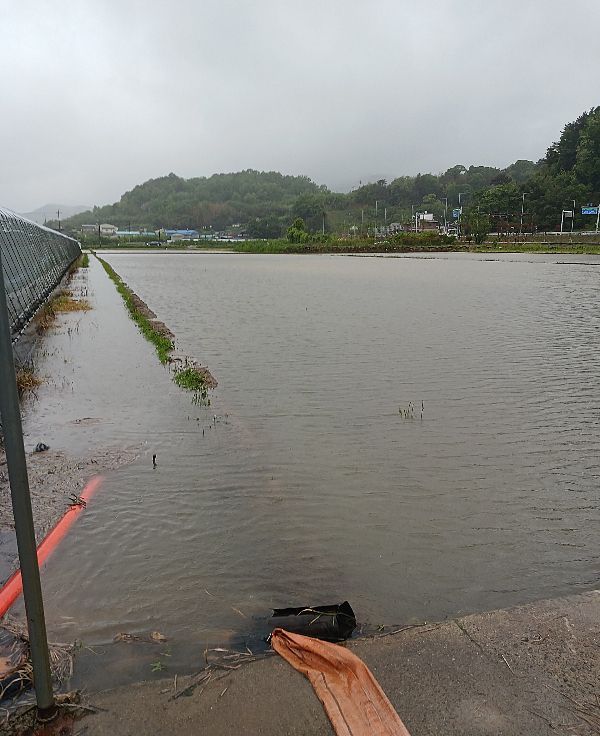 Since the heavy rain that started on the 5th, the zucchini greenhouse in Jinsang-myeon, Gwangyang-si, Jeollanam-do has been submerged in water.
 [Photo by Jang Young-gi]
Severe damage to farmland has occurred mainly in the southern regions where heavy rain fell over two days during the Children's Day holiday on the 5th and 6th. Local governments are currently investigating the damage to farmland, and the scale and cost of the damage are steadily increasing. Some experts point out that since even small changes in vegetables and fruits can affect consumer prices, measures to stabilize prices are necessary.
According to Jeollanam-do on the 8th, property damage occurred on 1,719 hectares of farmland in the province due to rain starting from the 5th. The area of lodging (falling caused by rain or wind) is 1,370 hectares, and the flooded area is 349 hectares. The damage is estimated at about 1.75 billion won. A Jeollanam-do official said, "The damage scale is continuously being investigated through the offices of each eup, myeon, and dong," adding, "Support measures will be prepared based on the damage situation once the investigation is completed."
On the 5th, Children's Day, an average of 100.7 mm of rain fell over two days in Jeollanam-do, setting the highest daily rainfall record for May. In particular, Boseong received a cumulative rainfall of 267.5 mm over two days, and Gwangyang also experienced heavy rain of 265 mm. This rain caused farmland damage in various places including Haenam, Gangjin, Suncheon, Boseong, and Gwangyang. Barley and oats accounted for the largest proportion of damaged crops, along with tomatoes and zucchini.
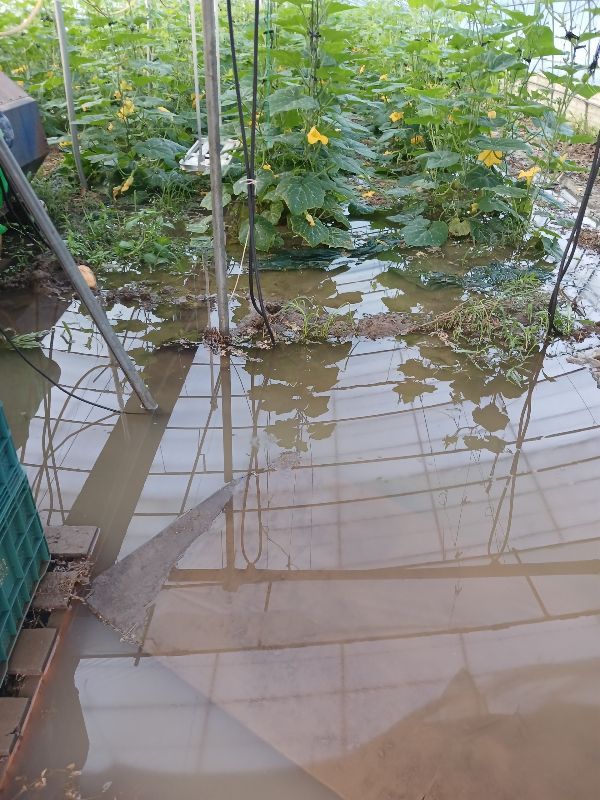 Since the heavy rain that started on the 5th, the zucchini greenhouse in Jinsang-myeon, Gwangyang-si, Jeollanam-do has been submerged in water.
 [Photo by Jang Young-gi]
Concerns have been raised that the increase in farmland damage just a month before harvest could affect vegetable prices. Although barley and oats, which suffered the greatest damage from this heavy rain, have a relatively small impact on consumer prices, vegetables like zucchini tend to cause sensitive price fluctuations even with small changes in supply. According to the Korea Agro-Fisheries & Food Trade Corporation (aT), as of the 7th, the wholesale price of zucchini (20 pieces) was 16,130 won, which is 10.8% cheaper than last year but 36.7% higher compared to the average price.
Amid ongoing high inflation, experts suggest that responses should be made to prevent the heavy rain damage from becoming a burden on ordinary citizens.
Kim Han-ho, professor of Agricultural Economics and Sociology at Seoul National University and chairman of the Agriculture and Fisheries Subcommittee of the Special Committee on Agriculture and Fisheries, said, "Barley and oats rely heavily on imports and are not directly linked to daily life, so there is no immediate need to worry about their impact on prices. However, vegetables and seasonings can cause price movements even with small supply changes. It is necessary to restore the damage as quickly as possible and for the government to carefully manage the situation by preparing measures to stabilize prices."
© The Asia Business Daily(www.asiae.co.kr). All rights reserved.
![Clutching a Stolen Dior Bag, Saying "I Hate Being Poor but Real"... The Grotesque Con of a "Human Knockoff" [Slate]](https://cwcontent.asiae.co.kr/asiaresize/183/2026021902243444107_1771435474.jpg)
















