Russian President Vladimir Putin, who has entered his fifth term in office, expressed his ambition on the 7th (local time) to grow Russia's economy to rank among the world's top four by 2030.
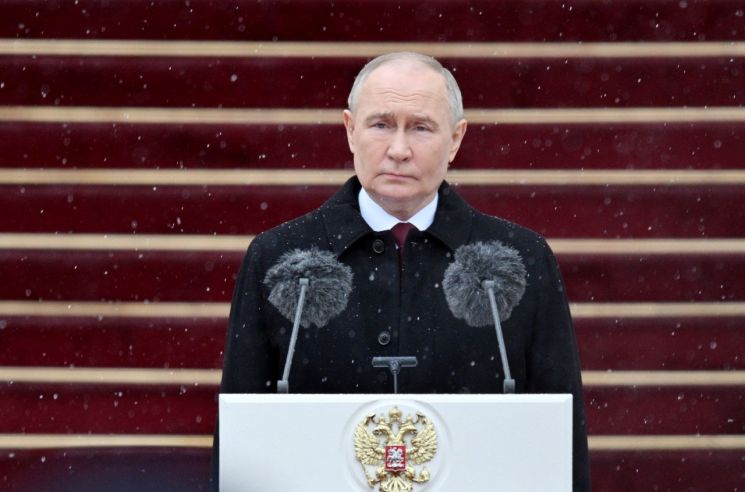
According to the Kremlin, President Putin, who began his fifth term through the inauguration ceremony on this day, signed the "Presidential Decree on National Development Goals" (May decree), which outlines the state policy tasks for the new six-year term. The goal is for Russia to achieve the world's 4th largest GDP based on purchasing power parity (PPP) by 2030.
President Putin pledged to increase research and development (R&D) spending to 2% of GDP by 2030, aiming to rank within the top 10 globally in terms of R&D expenditure relative to economic size. He also plans to reduce the share of imports in GDP to 17%. The share of the tourism industry and other sectors will be expanded. The decree also includes goals to reduce the poverty rate to below 7%, attract more than 500,000 foreign students, and provide citizens with a minimum housing area of 33 square meters per person.
Having secured a fifth term in the presidential election last March, President Putin extended his rule until 2030 through the inauguration ceremony on this day. In his speech after taking the oath, Putin justified the invasion of Ukraine (special military operation) by saying, "The people of Russia have confirmed the correct direction of the state," and "I see a shared understanding of historical goals, our choices and values, freedom, and a firm resolve to defend Russia's national interests."
Regarding the West, he said, "We do not avoid dialogue with the West," adding, "The choice is theirs." While less threatening than previous hardline remarks that mentioned the use of nuclear weapons, he continued to warn the West. Kremlin spokesman Dmitry Peskov confirmed that President Putin personally wrote the inauguration speech. Pro-Kremlin analyst Alexei Chesnakov summarized Putin's message in a Telegram post with three words: "Sovereignty, Development, Unity."
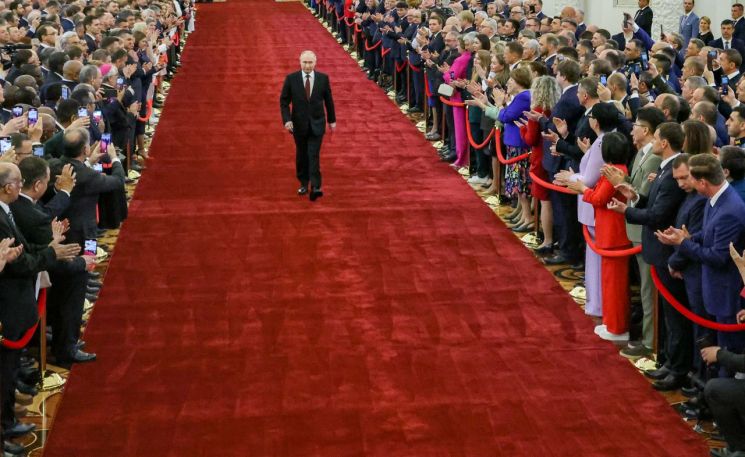
Western ambassadors from the United States, the United Kingdom, Germany, Canada, Italy, and others did not attend the inauguration ceremony, refusing to recognize the legitimacy of the Russian presidential election. U.S. Ambassador to Russia Lynne Tracy is temporarily out of the country. Among European Union (EU) member states, only France, Greece, Malta, Cyprus, Slovakia, and Hungary sent ambassadors to the ceremony. South Korea, classified as a non-friendly country by Russia, sent Ambassador Lee Do-hoon to attend after careful consideration.
The Kremlin regarded President Putin's inauguration ceremony as a "domestic event" and did not send invitations to foreign heads of state, but invited all heads of diplomatic missions stationed in Russia. Major foreign media pointed out that "despite Western boycotts of the inauguration, Russian propagandists note that Western media continue to report on the ceremony," and welcomed this as "evidence of Putin's stature despite his international isolation."
Meanwhile, Ukraine announced on the same day that it thwarted an assassination attempt by Russia targeting President Volodymyr Zelensky and other senior military and political officials.
The Security Service of Ukraine (SBU) confirmed in a statement that a network related to the Russian Federal Security Service (FSB) was involved in the assassination attempt on President Zelensky, and that two colonels were arrested on charges of treason for their involvement. They claim that Russia intended to assassinate President Zelensky as a "gift" for President Putin's inauguration. Earlier, President Zelensky had revealed that there had been about ten assassination attempts against him since Russia's invasion of Ukraine last year.
© The Asia Business Daily(www.asiae.co.kr). All rights reserved.
![Clutching a Stolen Dior Bag, Saying "I Hate Being Poor but Real"... The Grotesque Con of a "Human Knockoff" [Slate]](https://cwcontent.asiae.co.kr/asiaresize/183/2026021902243444107_1771435474.jpg)
















