Water Supply Cut Off for One-Third of Southern Population
Recent Simultaneous Heavy Rainfall Occurs Worldwide
In the southern Brazilian state of Rio Grande do Sul, half of the city has been submerged due to heavy rain, and the death toll from the flooding has risen to 83. On the 6th (local time), CNN Brazil reported that since the torrential rains began on the 29th, flooding has affected 345 cities, accounting for 70% of the 497 cities in Rio Grande do Sul, and approximately 850,000 people, or 7.5% of the state's total population, have suffered damage.
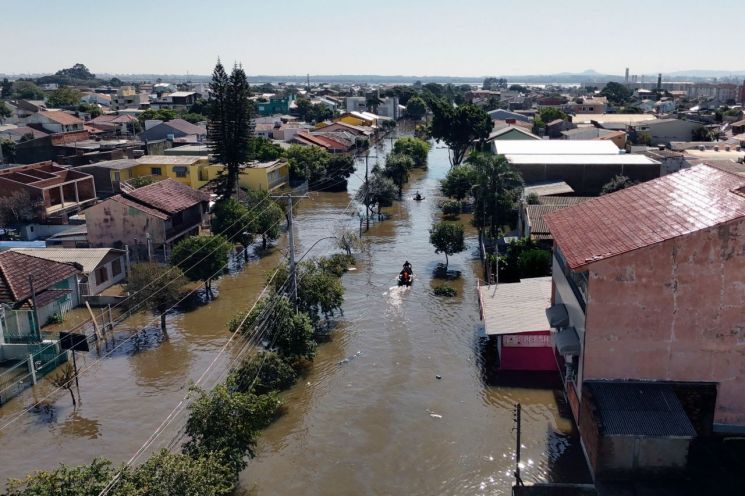 An aerial photo showing rescuers navigating the flooded streets of a village in Brazil by boat.
 [Photo by AFP·Yonhap News]
The Rio Grande do Sul government announced that as of the morning of the same day, the death toll stood at 83, with 111 people missing and 291 injured. Additionally, the number of flood evacuees is about 149,000, of whom 20,000 are in shelters and 129,000 have taken refuge with family or acquaintances. Salgado Filho International Airport in Rio Grande do Sul has been closed indefinitely, and the water level of the Gua?ba River in the state capital, Porto Alegre, rose to 5.26 meters, far exceeding the flood warning level of 3 meters. Furthermore, landslides caused by the heavy rain led to the collapse of dams at small hydropower plants, resulting in power outages affecting more than 400,000 households last night. Currently, water supply has also been cut off for one-third of the population in the southern city.
The National Institute of Meteorology (Inmet) issued a red alert for heavy rain in the southeastern region of Rio Grande do Sul until noon on the 7th. The meteorological agency forecasted more than 100mm of rain and winds exceeding 100 km/h, along with hail, within the next 24 hours. The agency warned of risks including "damage to buildings and farms, power outages, uprooted street trees, flooding, and road traffic disruptions."
Cause of Abnormal Climate and Heavy Rain: Global Warming
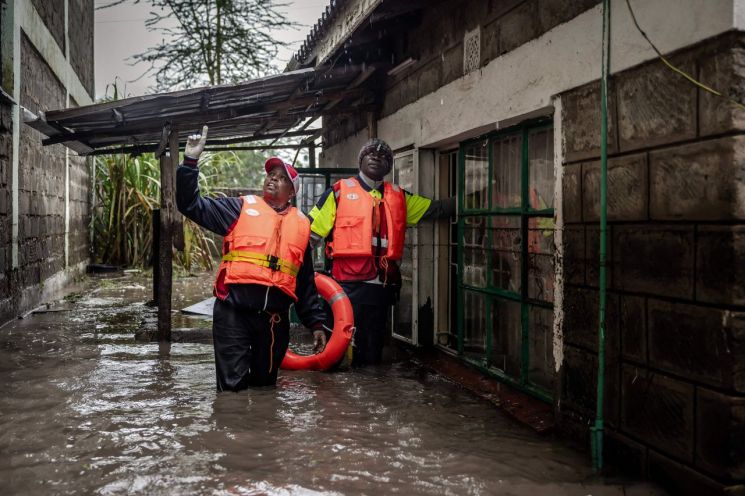 Deadly heavy rains and "killer floods" that have occurred simultaneously around the world recently have caused hundreds of deaths and devastated social infrastructure in many places worldwide. Not only in Brazil, but Kenya, the largest country in East Africa, has lost 228 lives and has 72 people missing due to continuous heavy rains since March.
 [Photo by AFP·Yonhap News]
Deadly heavy rains and "killer floods" have occurred simultaneously worldwide in recent times, causing hundreds of deaths and devastating infrastructure across the globe. Not only in Brazil, but Kenya, the largest country in East Africa, has lost 228 lives and has 72 people missing due to continuous heavy rains since March. In particular, on the 29th of last month, the Old Kijabe Dam in Nakuru County collapsed, killing 58 people at once, and currently, 212,630 people have been displaced.
The Wall Street Journal (WSJ) reported that the simultaneous heavy rains worldwide are due to abnormal high-temperature phenomena caused by global warming. The average global atmospheric temperature has risen for ten consecutive months, and the average global ocean temperature has been increasing for twelve consecutive months. As the Earth's temperature rises, the atmosphere holds more moisture, increasing the likelihood of heavy rainfall.
WSJ also explained that unique weather patterns on each continent have combined to worsen the damage caused by the rain. In particular, the floods in East Africa, including Kenya, were amplified by the "Indian Ocean Dipole." The Indian Ocean Dipole is a phenomenon where sea temperatures alternately rise in the western Indian Ocean (East Africa) and the eastern Indian Ocean (Australia and Indonesia). Meteorologists explained, "This year, the Indian Ocean Dipole phenomenon appeared extremely, and the warmer-than-usual sea temperatures and atmospheric evaporation effects created the massive floods in Kenya."
© The Asia Business Daily(www.asiae.co.kr). All rights reserved.
![Clutching a Stolen Dior Bag, Saying "I Hate Being Poor but Real"... The Grotesque Con of a "Human Knockoff" [Slate]](https://cwcontent.asiae.co.kr/asiaresize/183/2026021902243444107_1771435474.jpg)
















