Analyst Evaluation by Bloomberg-Affiliated Research Institute
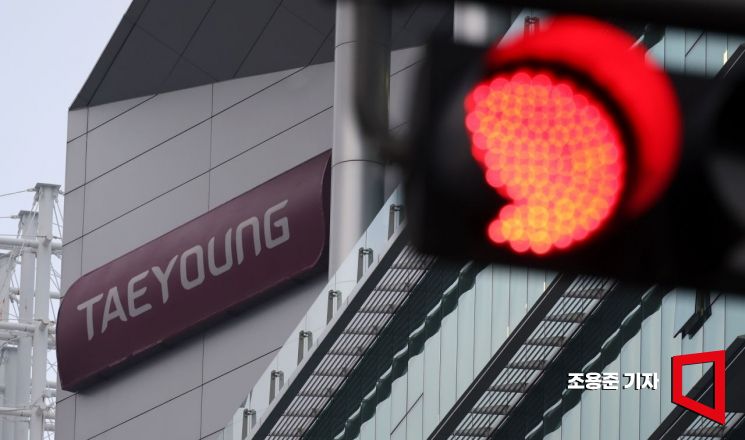 On the 11th, the fate of Taeyoung Construction, which applied for a workout (corporate restructuring) after failing to repay real estate project financing (PF) loans worth around 9 trillion won, is being decided, creating tension at Taeyoung Construction in Yeongdeungpo-gu, Seoul. Photo by Jo Yongjun jun21@
There is an assessment that some non-bank financial institutions and securities firms could be at risk due to the fallout from domestic real estate loan defaults.
On the 6th, Rena Kwok, an analyst at Bloomberg Intelligence (BI), a research institute under Bloomberg, cited the Bank of Korea's Financial Stability Report in a report titled "Will Stress in South Korea's Real Estate Sector Cause Systemic Risk?" and made this evaluation. She viewed that the major sectors, banks and insurance companies, do not have significant real estate exposure and possess loss-absorbing capacity. Therefore, while the real estate loan issues in the non-bank sector are unlikely to escalate into a systemic crisis, caution is advised.
The report emphasized that in the event of financial instability, inter-institutional transactions among financial institutions should be closely monitored to avoid systemic risk. As of the end of June last year, inter-institutional transactions among financial institutions amounted to KRW 3,554 trillion, a 5.3% increase compared to the same period the previous year.
Among these, transactions between banks and non-bank sectors accounted for KRW 1,236 trillion (34.8%), transactions within the non-bank sector were KRW 2,145 trillion (60.3%), and transactions within the banking sector were KRW 174 trillion (4.9%).
The report stated that while the risk of default contagion in South Korea's real estate sector is not high, if risks related to real estate project financing (PF) escalate and impact the broader economy, greater pressure could be faced.
The DebtRank indicator, which measures default contagion risk, recorded 0.34 in the second quarter of last year, down from 0.37 in the same period the previous year. Analyst Kwok expects domestic financial institutions to demonstrate resilience even if shocks occur.
As of the third quarter of last year, the capital adequacy ratios of banks and non-bank financial institutions were sound, and in October last year, the liquidity coverage ratio (LCR) of general banks comfortably exceeded supervisory standards for both Korean won (110.5%) and foreign currency (154.7%).
However, since securities firms’ liquidity response capacity only slightly exceeds supervisory standards, considering the real estate market slowdown and high short-term interest rates, funding pressures could increase.
At the end of the third quarter last year, the adjusted liquidity ratio of securities firms was 104.3%, only 4.3 percentage points above the supervisory standard of 100%.
The adjusted liquidity ratio is calculated as the ratio of liquid assets with a remaining maturity of three months or less to the sum of liquid liabilities and contingent liabilities with a remaining maturity of three months or less. A ratio below 100% means it is difficult to cover contingent liabilities with internal liquidity.
The delinquency rate on PF-related loans by securities firms stands out compared to other financial institutions.
According to data from the Financial Services Commission, the delinquency rate on securities firms’ PF-related loans was 3.37% at the end of 2020, rising to 13.85% at the end of the third quarter last year and 13.73% at the end of the fourth quarter. The use of PF increased during the low-interest and rising real estate price period, and securities firms have been securitizing PF loans and selling them to investors.
Bloomberg previously pointed out last month that South Korea is emerging as a weak link in the shadow banking (non-bank finance) sector that requires close monitoring, noting that some financial institutions such as T. Rowe Price and Nomura Securities have expressed concerns.
Jungwoo Park, an economist at Nomura Securities, said, "The South Korean government will accelerate restructuring in the real estate sector," adding, "The workout of Taeyoung Construction is not the end and may be the beginning of stress on PF debt."
© The Asia Business Daily(www.asiae.co.kr). All rights reserved.
![Clutching a Stolen Dior Bag, Saying "I Hate Being Poor but Real"... The Grotesque Con of a "Human Knockoff" [Slate]](https://cwcontent.asiae.co.kr/asiaresize/183/2026021902243444107_1771435474.jpg)















