Arapood 'Imsabu Jjamppong Powder' 100g
MFDS Orders Sales Suspension and Recall
Powdered seasoning for Jjamppong circulating in the market has been ordered to stop sales due to non-compliance with Escherichia coli (E. coli) standards.
On the 3rd, the Ministry of Food and Drug Safety (MFDS) announced that E. coli exceeding the standard was detected in 100g of 'Imsabu Jjamppong Powder' produced by 'Ara Food Co., Ltd.' (located in Pyeongtaek-si, Gyeonggi Province). The manufacturing date of the problematic product is April 11, 2024, and the expiration date is April 10, 2025. The food type is a composite seasoning product, and the inspection and enforcement agency is ISA Research Institute.
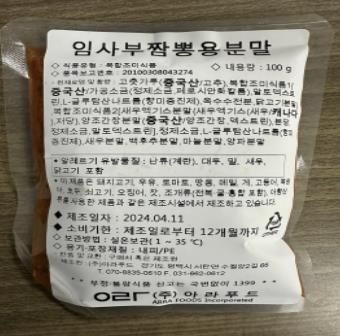 Powder for Imsabu Jjamppong recalled due to non-compliance with Escherichia coli standards. [Image source=Provided by MFDS, Yonhap News]
An MFDS official stated, "The seller of the product must stop sales and return the product to the distributor," and urged, "Consumers who purchased the product should return it to the place of purchase."
Generally, Jjamppong broth is traditionally made by boiling meat or seafood to create stock, but recently, restaurants have been using pre-made powdered seasoning dissolved in water, similar to instant ramen soup, to easily prepare the broth. These products are sold online under names such as Jjamppong powder, Jjamppong dash, and Jjamppong seasoning powder. In addition to powders, highly concentrated liquid products called 'Jjamppong extract' are diluted with water to make Jjamppong broth. These products are promoted with phrases like "easily create the deep flavor of Jjamppong."
Food poisoning caused by E. coli mainly occurs in hot and humid summer conditions and is increasing every year due to the increasingly early arrival of hot weather. Pathogenic E. coli food poisoning is transmitted through contaminated water, vegetables washed with contaminated water, and meat contaminated during slaughter. Vegetables can also be contaminated with pathogenic E. coli if grown using groundwater or river water polluted by feces or livestock wastewater, as well as contaminated meat.
Symptoms of E. coli food poisoning mainly include watery diarrhea, abdominal pain, vomiting, fatigue, and dehydration. To prevent E. coli food poisoning, hands should be washed with soap or hand sanitizer for at least 30 seconds before cooking. When washing poultry such as chicken, seafood, and meat, care must be taken to prevent water from splashing onto raw vegetables or fruits that will not be cooked. To avoid cross-contamination, knives and cutting boards should be used separately for cooked and uncooked foods. Meat, poultry, eggs, and seafood should be thoroughly cooked to the inside. Especially in hot weather, cooked food should not be left at room temperature and should be consumed as soon as possible, no later than within 2 hours.
© The Asia Business Daily(www.asiae.co.kr). All rights reserved.
![Clutching a Stolen Dior Bag, Saying "I Hate Being Poor but Real"... The Grotesque Con of a "Human Knockoff" [Slate]](https://cwcontent.asiae.co.kr/asiaresize/183/2026021902243444107_1771435474.jpg)















