Salt in Ramen Broth Pollutes Soil and Valleys
Ramen Remains Popular Despite 2018 Store Closures
Hallasan, which had suffered from food waste due to its reputation as a ramen hotspot, has succeeded in significantly reducing food waste through a successful campaign.
According to the JoongAng Ilbo on the 5th, the 'Soup Half, Water Half' campaign, which the Jeju Hallasan National Park Management Office began intensively promoting on March 29 this year, has taken root, reducing food waste to about 10% of the previous level.
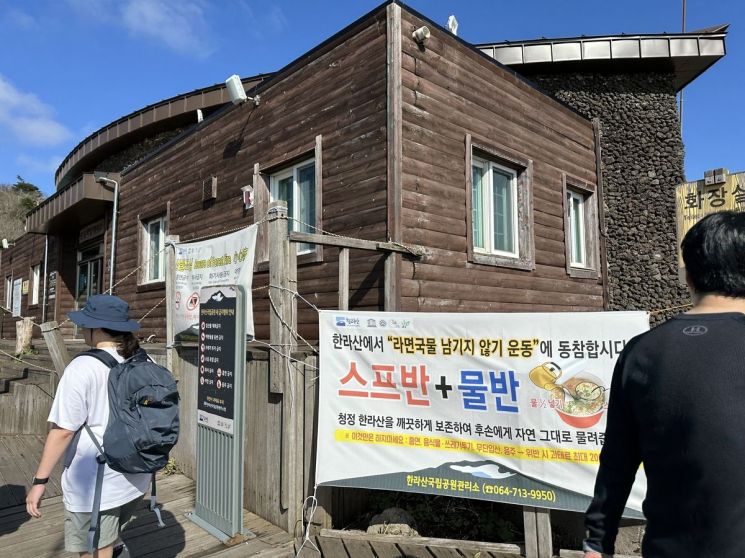 A banner for the "No Leaving Ramen Broth Behind Campaign" hung in front of the Hallasan Azalea Field Shelter.
 [Photo by Yonhap News]
Ha Seong-hyun, head of the Hallasan Park Protection Division, said, "Until February, ramen broth food waste sometimes exceeded 100 liters per day, but recently it has decreased to about 10 liters per day, which is 10% of the previous amount. Even considering that the number of hikers eating ramen has decreased since the winter hiking season ended, almost no food waste is being produced," he said.
The 'Soup Half, Water Half' campaign was started with the intention that those who find it burdensome to finish a whole ramen should put in only half the water and soup powder and try to finish it all, thereby reducing broth and other food waste.
When ramen broth is discarded on Hallasan, the salt in the broth can pollute the soil and valleys, potentially harming endemic plants and insects.
Jeju, which had been troubled by the issue of 'ramen broth disposal' due to word-of-mouth that "ramen tastes good on Hallasan" and social media (SNS) posts, has been able to breathe a sigh of relief as the 'Soup Half, Water Half' campaign increased the number of hikers who do not leave ramen broth behind.
Since January 1990, ramen has become known as 'mountain food' on Hallasan, sold at the Witseoreum and Jindallaebat shelters and the Eorimok store. The 'Hallasan National Park Welfare Association,' which operated the stores, purchased 300,000 cup noodles annually. At that time, it was common to see long lines stretching tens of meters in front of Witseoreum or Jindallaebat shelters where people bought cup noodles and received hot water.
However, in January 2018, it became an issue that the Welfare Association had operated the stores for 28 years without approval from the Cultural Heritage Administration, and after the association was dissolved, such scenes disappeared.
The Witseoreum and Jindallaebat shelters, originally national property owned by the Cultural Heritage Administration, were rebuilt to prevent collapse and accidents, and were returned to the Cultural Heritage Administration in March 2009 and May 2008, respectively.
Even though the stores disappeared, the popularity of Hallasan ramen continues. As issues regarding the disposal of ramen broth and other food waste arose, the management office placed 60-liter leftover food bins at the Witseoreum shelter and other locations in August 2021 to collect leftover ramen broth from hikers, and installed two eco-friendly food waste processors.
Additionally, Jeju imposes a fine of 200,000 won under the Natural Parks Act on those caught secretly dumping ramen broth on Hallasan.
Kim Hak-su, head of the Hallasan Management Office, said, "It is fortunate that a trend has been detected among recent hikers to reduce ramen broth and properly collect and take other trash with them," adding, "Continuous interest from hikers is required to protect the beautiful Hallasan."
© The Asia Business Daily(www.asiae.co.kr). All rights reserved.
![Clutching a Stolen Dior Bag, Saying "I Hate Being Poor but Real"... The Grotesque Con of a "Human Knockoff" [Slate]](https://cwcontent.asiae.co.kr/asiaresize/183/2026021902243444107_1771435474.jpg)















