Seoul Metropolitan Area Apartment Sale and Jeonse Price Change Rates Maintained Last Week
Seoul Gangnam Area Seller Asking Prices Rise, Follow-up Buying Key
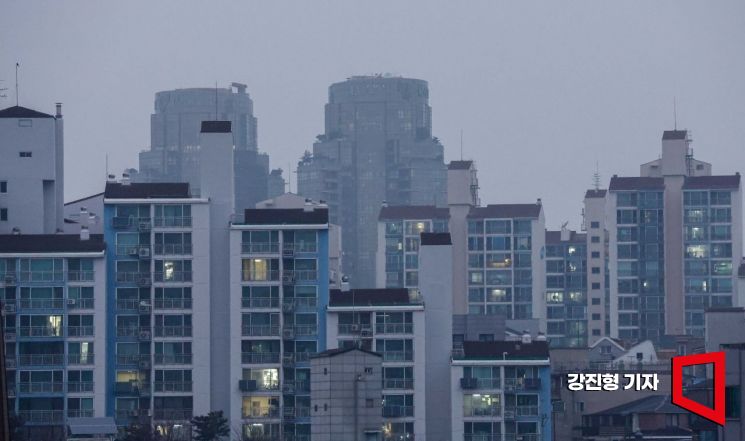
Although the "Special Act on the Maintenance and Support of Aging Planned Cities" was enacted on the 27th of last month, it seems to have had little impact on the weekly apartment market prices this week. According to Real Estate R114 on the 4th, areas such as Bundang, Ilsan, Pyeongchon, Sanbon, and Jungdong in Gyeonggi Province mostly recorded slight declines or remained flat (-0.01% to 0.00%), showing limited price fluctuations.
When the specific scale and criteria for the pilot districts are announced in May, prices and transaction volumes may show temporary movements. However, for now, it appears that subdued demand sentiment due to external factors such as high interest rates, economic recession, and rising construction costs is having a greater influence on buyers' timing decisions than expectations for redevelopment projects.
Seoul apartment sale prices have remained flat (0.00%) for seven consecutive weeks. Both reconstruction and general apartments showed no significant price changes, and new towns also recorded flat prices (0.00%). Gyeonggi and Incheon have shown stagnant movements for 15 consecutive weeks since late January this year (January 26, 0.00%).
Within Seoul, individual areas such as Mapo (0.02%), Dongjak (0.02%), and Yeongdeungpo (0.01%) saw price increases, while Gangnam experienced a 0.01% decline with places like Gaepo-dong’s "The H Honor Hills" and Samseong-dong’s "Raemian Samseong 1st Complex 5th District" dropping by around 50 million KRW, and Seongdong’s Haengdang-dong "Haengdang Daerim" falling by about 25 million KRW.
In new towns, Sanbon (-0.01%) and Jungdong (-0.01%) were adjusted downward, while other areas remained flat (0.00%). In Gyeonggi and Incheon, Goyang (-0.01%) and Gwangmyeong (-0.01%) declined, whereas Osan (0.05%) and Incheon (0.01%) saw increases.
The jeonse (long-term lease) market saw prices rise mainly in small to medium-sized older apartments, with Seoul increasing by 0.01%, and new towns and Gyeonggi-Incheon also rising by 0.01% each. Within Seoul, individual areas such as Seongdong (0.06%), Seodaemun (0.06%), Mapo (0.05%), Nowon (0.05%), Dongjak (0.03%), Gwanak (0.03%), Dobong (0.02%), Gangdong (0.02%), and Gangseo (0.01%) experienced increases. Conversely, Yangcheon (-0.01%) and Yeongdeungpo (-0.01%) saw declines.
In new towns, Jungdong (0.06%) and Sanbon (0.06%) rose mainly in large complexes with over 1,000 households. In Gyeonggi and Incheon, individual areas such as Hwaseong (0.05%), Gunpo (0.05%), Seongnam (0.02%), Gwacheon (0.02%), and Incheon (0.02%) increased, while Osan (-0.07%) was the only area to decline due to the impact of new housing supply.
A Real Estate R114 official analyzed, "In brokerage sites around Gangnam areas such as Seocho-gu and Gangdong-gu in Seoul, cases of raising asking prices after quick sales are increasing," adding, "Especially, inquiries from buyers waiting for newly built apartments continue steadily, and due to rising construction costs and sale prices, homeowners are gradually raising their asking prices, widening the gap between sellers' and buyers' desired prices."
He continued, "With the possibility of interest rate cuts being delayed more than expected and financial burdens not easily alleviated, attention is focused on whether demand in the Gangnam area will pursue buying at higher asking prices or maintain flat levels by postponing decisions."
© The Asia Business Daily(www.asiae.co.kr). All rights reserved.
![Clutching a Stolen Dior Bag, Saying "I Hate Being Poor but Real"... The Grotesque Con of a "Human Knockoff" [Slate]](https://cwcontent.asiae.co.kr/asiaresize/183/2026021902243444107_1771435474.jpg)















