Value-Up Program 2nd Seminar Held
Key Focus on Disclosing Plans to Enhance Corporate Value
Market Says "No Short-Term Impact... Rebound Expected Upon Tax Support Announcement"
Experts evaluated that the government's ongoing 'Corporate Value-Up Program' will help institutional investors and outside directors fulfill their roles diligently. However, since companies are required to voluntarily disclose financial indicators showing their financial status, such as Return on Equity (ROE), they recommended that detailed measures regarding the disclosure methods and frequency should be presented. Companies expressed concerns about the burden of introducing the new disclosure system. In particular, the KOSDAQ sector, which has relatively fewer physical and human resources compared to KOSPI-listed companies, argued that strong incentives should be provided when promoting shareholder return policies, considering the challenging reality of shareholder returns.
On the 2nd, the Financial Services Commission and Korea Exchange held the '2nd Seminar on Corporate Value Support Measures' and unveiled guidelines for corporate value enhancement plans. The main content is for listed companies to autonomously evaluate their corporate value, set value enhancement goals, and inform the market of related plans and evaluations.
Investors, including institutional investors, positively evaluated the opening of a path to more detailed disclosure of corporate financial information, but companies expressed concerns about the burden of disclosing corporate value enhancement plans.
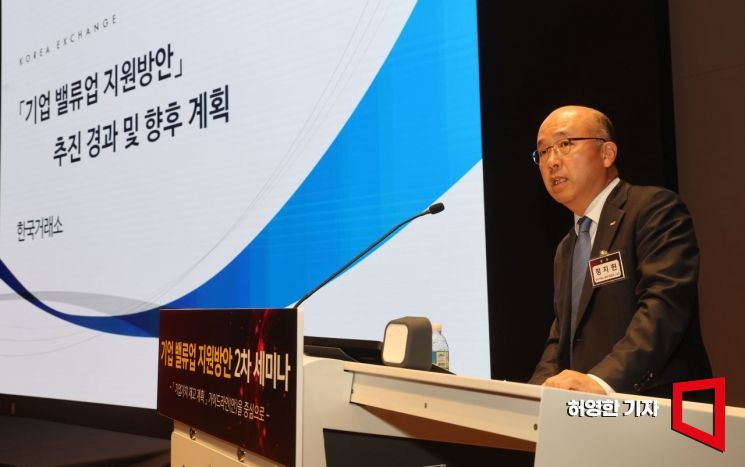 The 2nd seminar on support measures for corporate value-up to boost the Korean stock market was held on the 2nd at the Korea Exchange. Jiheon Jeong, Executive Director of the Management Support Headquarters at the Korea Exchange, is presenting on "Progress and Future Plans for Promoting Corporate Value-Up Support Measures." Photo by Younghan Heo younghan@
Helps Institutional Investors and Outside Directors' Roles... KOSDAQ Companies "Lack of Disclosure IR Specialists"
Kim Hyun-jung, Head of JP Morgan's Equity Division, reported that after the distribution of the first guideline, funds flowed into the Korean capital market from various regions, and investments expanded across diverse industries. Kim said, "The transportation equipment sector index, including automobiles and shipbuilding, rose 28% since the end of January, and the financial sector index, including insurance and banking, increased by 19.7%. We expect long-term investment demand in the stock market to grow."
She emphasized that to attract active participation from institutional investors, close communication with them is necessary. Kim stated, "There needs to be a communication channel to discuss efficient capital utilization that overseas investors can relate to, such as changes to the ISA system. Overseas institutional investors expect extensive communication with exemplary companies following the introduction of the Value-Up Program."
Institutional investors evaluated that the Value-Up Program will greatly assist in future fiduciary responsibility activities and the roles they must fulfill as outside directors. Lee Seung-geun, Team Leader of Shareholder Rights Exercise 1 at the National Pension Service, said, "It will help determine whether dividend policies are reasonable in the mid-to-long term," adding, "It will be used to judge whether decisions on important matters such as mergers and splits contribute to mid-to-long-term value."
Professor Park Sun-young of Dongguk University's Department of Economics said, "Pension funds themselves found it difficult to communicate with companies and felt it was challenging to induce substantial behavioral changes from the fiduciary perspective. I think it is good that shareholder communication plans are included in the guidelines," and added, "It is also positive that the guidelines provide grounds for board members to request management to implement corporate value enhancement plans." She viewed this as establishing a foundation for outside directors, who are responsible for checking management and enhancing shareholder interests, to demand efforts to increase shareholder value from management.
Lee Wang-gyeom, Head of Responsible Investment Strategy Center at Mirae Asset Global Investments, said, "For the corporate disclosure system to operate smoothly, it is necessary to minimize the burden of duplicate disclosures by companies and include effective information from the user's perspective," adding, "Measures regarding disclosure methods and frequency should also be prepared." He further expressed, "If voluntary disclosure is left entirely to companies, there may be issues with reliability. I hope the guidelines can be supplemented enough to consider board responsibilities, approvals, and decisions."
Companies requested measures such as segmenting evaluations of corporate value enhancement efforts by industry and establishing stronger incentive plans. Cheon Ki-seong, Vice President of Finance at CJ CheilJedang, said, "Unlike the financial industry, manufacturing involves capital investment and R&D, so it should be evaluated differently," and added, "It is burdensome to do all ESG disclosures, so I hope disclosure integration is implemented." He conveyed the difficulty that shareholder return rates may be low due to the necessity of investment in manufacturing. He also expressed concerns that overemphasizing financial indicators in corporate value enhancement plans could stigmatize companies.
Park Hyun-soo, Head of Corporate Planning at KoYoung Technology, stated, "The KOSDAQ market has smaller physical and human resources compared to KOSPI, so strong incentives should be given if efforts are made toward shareholder returns," and added, "Although disclosure education is said to be strengthened, there is a need to supplement disclosure IR specialists." He further argued, "KOSDAQ companies that are not covered by reports are not properly evaluated in reality," and claimed, "If securities firms' research centers analyze many companies, communication for value-up will become smoother."
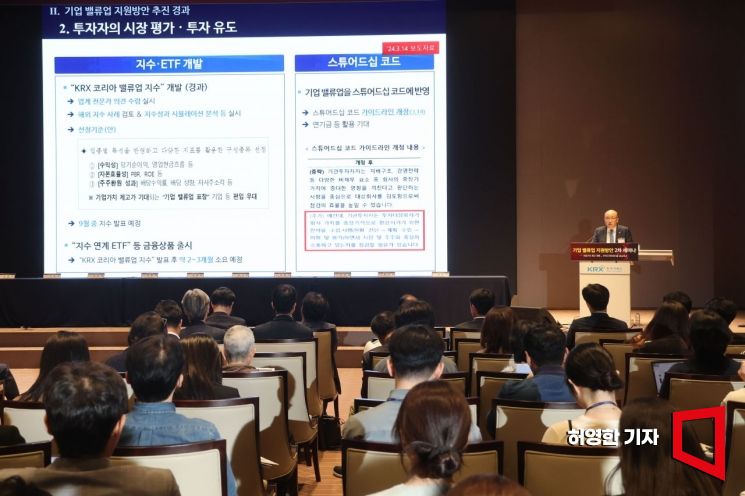 The 2nd seminar on support measures for corporate value-up to boost the Korean stock market was held on the 2nd at the Korea Exchange. Jeong Jiheon, Executive Director of the Management Support Headquarters at the Korea Exchange, is presenting on "Progress and Future Plans for Promoting Corporate Value-Up Support Measures." Photo by Heo Younghan younghan@
Will Act as an Incentive for the Value-Up Index... Government to Specify Tax Support
Concerns were also raised that corporate participation might be low because the guidelines focus on autonomy. Regarding this, Lee Hyo-seop from the Financial Industry Office of the Korea Capital Market Institute said, "Strengthening communication to reduce information asymmetry is positively evaluated," and added, "The media is worried about the lack of penalties, but future incentives such as separate taxation on dividend income and the Value-Up Index will act as sufficient incentives."
The government announced plans to specify tax support in the future. Choi Sang-mok, Deputy Prime Minister and Minister of Strategy and Finance, stated in April that they are considering easing corporate tax burdens on increased shareholder returns and separate taxation on dividend income for shareholders of companies expanding dividends. Park Min-woo, Director of the Capital Market Bureau at the Financial Services Commission, said, "We will collaborate with other ministries to specify tax support."
The market did not expect the Value-Up Program announced that day to influence short-term movements, unlike the first program announcement. However, if the Value-Up Program eventually leads to a virtuous cycle of corporate value enhancement and stock price increases, it is expected to have a positive impact on stock prices in the mid-to-long term.
Lee Kyung-yeon, Senior Researcher at Daishin Securities, said, "The stock market showed a slight decline early in the day due to foreign and institutional selling, reflecting concerns that detailed contents might not be announced," and predicted, "If tax support incentives related to the Value-Up Program are announced separately, the market will show a rebound."
Kim Ho-jung, Researcher at Yuanta Securities, said, "Rather than short-term stock price rises, it will be positive for stock price trends from the perspective of long-term structural improvement when shareholder value is enhanced," and added, "From this perspective, attention should be paid to the stewardship code among the Value-Up support measures, as the revision of the stewardship code is expected to positively affect long-term corporate value through governance improvement."
© The Asia Business Daily(www.asiae.co.kr). All rights reserved.


















