April Sales of Top 100 Real Estate Companies Down 46.8%
City Government Repeatedly Eases Regulations to Encourage Purchases
Real Estate Also 'Iguhwanshin'...Conditions Removed and Vouchers Provided
Despite a series of regulatory relaxations by the authorities, the Chinese real estate market shows no signs of recovery. The performance of the top 100 real estate companies has plummeted to an all-time low, raising the possibility of further restructuring.
According to data released on the 1st by Chinese market research firm CRIC, the sales of the top 100 real estate companies last month amounted to 312.17 billion yuan (approximately 59.5464 trillion KRW), down 12.9% from the previous month and 44.9% year-on-year. In terms of monthly performance scale, this is the lowest ever recorded.
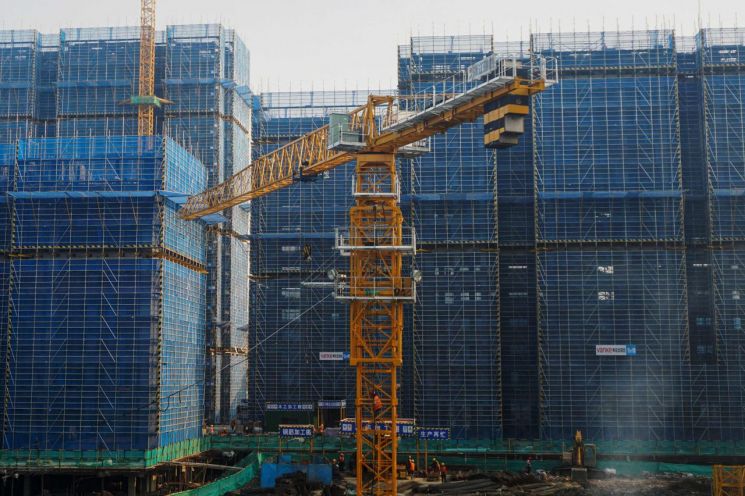
On a cumulative basis from January to April, sales totaled 1.09141 trillion yuan, a 46.8% decrease compared to the same period last year. In particular, the poor performance of small and medium-sized companies stands out even more. According to Chinese real estate consulting firm E-House China, the sales decline over the past four months was only 37.8% for the top 10 companies, 46.3% for the top 50 companies, and 48% for the top 100 companies.
However, local experts have expressed a positive outlook, citing recent active regulatory easing and risk management intentions by the authorities. Lin Zhenhong, UBS Greater China Real Estate Research Analyst, told local media Yicai Global, "After more than three years of weakness, government support measures have made the industry optimistic," adding, "After several years of turbulence, the market will gradually recover."
In fact, the Chinese Communist Party emphasized at the Central Political Bureau meeting held on the 30th of last month that "risks in key areas must be continuously prevented and resolved," and mentioned that local governments, real estate companies, and financial institutions should effectively carry out housing guarantees and delivery tasks. They also stressed the need to minimize inventory real estate and optimize new supply through policy measures, and to quickly establish a new real estate development model.
Some in the industry evaluated that the Party's recent emphasis on managing real estate inventory is the first in 10 years since 2014. Yicai Global interpreted this new announcement as indicating that the focus of real estate policy will shift to inventory elimination.
Regulatory easing is also accelerating by city governments. On the 30th of last month, Beijing announced the "Notice on the Optimization and Adjustment of the City's Housing Purchase Restriction Policy," allowing the purchase of commercial housing (including new and second-hand homes) outside the 5th Ring Road. Since 2011, Beijing had restricted married households with Beijing hukou (residency registration) to owning two homes and single-person households to one home. However, this restriction was eased for the first time in 13 years to encourage purchases. On the same day, Tianjin lifted purchase restrictions on new homes over 120㎡ in six districts within the city.
Additionally, various cities have introduced measures to support urban settlement when buying homes and issued vouchers worth 100 million yuan related to new home purchases. Yicai Global reported that about 40 cities have introduced the real estate "Yijiu Huanshin (以舊換新)" policy, encouraging residents to sell old homes and buy new ones.
© The Asia Business Daily(www.asiae.co.kr). All rights reserved.
![Clutching a Stolen Dior Bag, Saying "I Hate Being Poor but Real"... The Grotesque Con of a "Human Knockoff" [Slate]](https://cwcontent.asiae.co.kr/asiaresize/183/2026021902243444107_1771435474.jpg)
















