FOMC Interest Rate Likely Held at 5.25~5.5%
Powell's 'Hawkish Remarks' Are Key
April Private Employment Rises by 192,000, Exceeding Expectations
The three major indices of the U.S. New York stock market are showing mixed trends around the unchanged level in the early trading session on the first trading day of this month, April 1 (local time). The market is in a cautious stance, closely watching the Federal Open Market Committee (FOMC) interest rate decision and remarks by Jerome Powell, Chair of the Federal Reserve (Fed). Qualcomm and DoorDash are scheduled to release their earnings after the market closes.
As of 9:54 a.m. at the New York Stock Exchange (NYSE), the Dow Jones Industrial Average is up 0.03% from the previous close, standing at 37,828.51. The large-cap focused S&P 500 index is down 0.26% at 5,022.84, and the tech-heavy Nasdaq index is trading 0.08% lower at 15,644.84.
By individual stocks, Amazon is up 3.97% following earnings that exceeded market expectations. U.S. semiconductor company AMD is down 6.93% after reporting earnings in line with market forecasts. Super Micro Computer is falling 14.85% after releasing earnings below analyst expectations. Starbucks and CVS Health, which reported disappointing earnings and future outlooks, are down 15.08% and 18.22%, respectively.
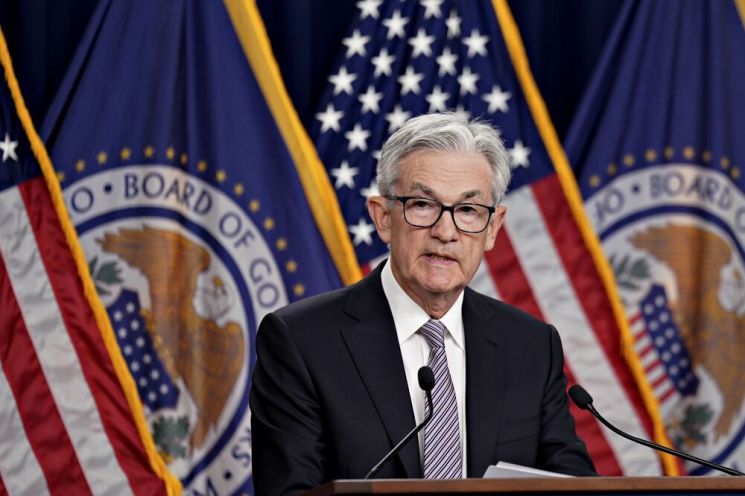
The market is focusing on the FOMC interest rate decision scheduled for 2 p.m. and the subsequent press conference by Chair Powell 30 minutes later. The Fed is widely expected to maintain the current benchmark interest rate at 5.25-5.5%, the highest level in 23 years. The key issue is how hawkish (favoring monetary tightening) Powell’s remarks will be during the press conference. With inflation remaining persistently strong this year, the delay in Fed rate cuts is becoming a foregone conclusion. Powell had said in early March that the timing of rate cuts was not far off, but by mid-March, he changed his stance, stating that it might take longer than expected to be confident that inflation is easing. The market anticipates that Powell may withdraw the forecast of three rate cuts this year, which he hinted at during the March FOMC, and may even mention that rate hikes remain an option.
Chris Senyek, strategist at Wolfe Research, said, "We expect the FOMC and Powell’s press conference to reflect the hawkish shift from two weeks ago. However, in the medium term, growth and employment outlooks will have a greater impact on the FOMC’s decisions and overall stock market returns."
The labor market and inflation, which are obstacles to the Fed’s pivot (change in direction), remain heated.
According to the U.S. employment report released by private labor market research firm ADP on the day, private sector job creation in April was 192,000. Although this is a slowdown compared to the revised 208,000 in March, it exceeded the market expectation of 179,000. Wage growth has slowed. Wages for workers who have been at the same job for the past 12 months rose 5% year-over-year, marking the smallest increase since August 2021. Employment costs are also rising faster than expected, fueling inflation concerns. The Employment Cost Index (ECI) for Q1, released by the U.S. Department of Labor the previous day, rose 1.2% quarter-over-quarter, surpassing both the 0.9% increase in Q4 last year and the expert forecast of 1.2%.
Strong employment is contributing to persistent inflation. The core Personal Consumption Expenditures (PCE) price index, the Fed’s preferred inflation gauge, rose 2.8% year-over-year in March, exceeding the expert forecast of 2.6%.
The North America Global Bonds Chief at Inside Investment said, "Bond investors will have to wait to reap the benefits of U.S. rate cuts. Everyone expected the Fed to be one of the first central banks to cut rates in this tightening cycle, but now it looks like it will be one of the last."
Although a minority, investors betting on the possibility of rate hikes are gradually emerging. According to the Chicago Mercantile Exchange (CME) FedWatch tool, the federal funds futures market is currently pricing in a 0.5% probability that the Fed will raise the benchmark interest rate by 0.25 percentage points at the September FOMC meeting. This was 0% just a week ago.
On April 3, after the FOMC meeting, the U.S. Department of Labor will release the April employment report. If strong employment continues amid stronger-than-expected inflation, the timing of rate cuts is likely to be further delayed. The market expects nonfarm payrolls in April to increase by 243,000, a significant decrease from 303,000 in March. The unemployment rate for April is expected to remain steady at 3.8%.
U.S. Treasury yields are declining. The 10-year U.S. Treasury yield, a global benchmark for bond yields, fell 3 basis points (1bp = 0.01 percentage points) to 4.64%, while the 2-year Treasury yield, sensitive to monetary policy, remains steady at 5.01%.
International oil prices are falling on expectations of a ceasefire agreement between Israel and the Palestinian militant group Hamas. West Texas Intermediate (WTI) crude oil is down $1.24 (1.5%) to $80.69 per barrel, and Brent crude, the global oil price benchmark, is down $1.19 (1.4%) to $85.14 per barrel.
© The Asia Business Daily(www.asiae.co.kr). All rights reserved.
![Clutching a Stolen Dior Bag, Saying "I Hate Being Poor but Real"... The Grotesque Con of a "Human Knockoff" [Slate]](https://cwcontent.asiae.co.kr/asiaresize/183/2026021902243444107_1771435474.jpg)















