"Reform Difficult Without 1 Trillion Won Government Support"
"Government Medical Policy Package Lacks Substance"
It has been argued that government financial support on the scale of 1 trillion won is essential to improve the training environment for residents.
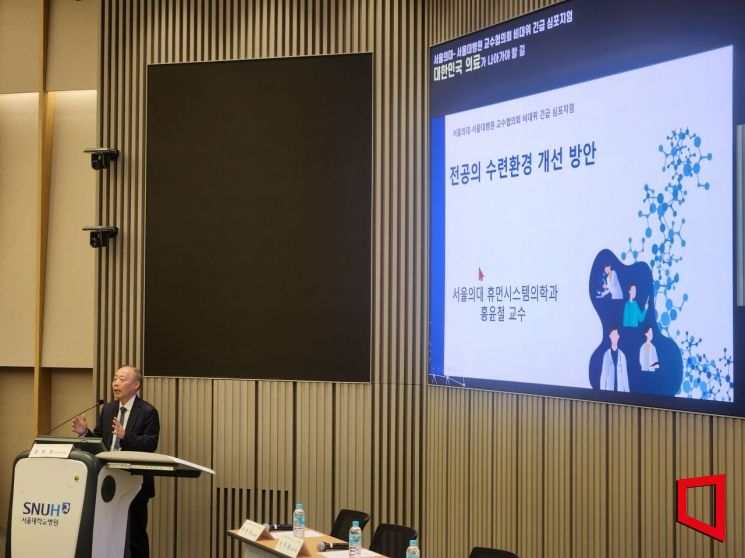 Professor Hong Yoon-chul of the Department of Human Systems Medicine at Seoul National University College of Medicine is presenting at the emergency symposium of the Seoul National University College of Medicine-Seoul National University Hospital Faculty Council Emergency Measures Committee held at 9 a.m. on the 30th.
 Photo by Choi Tae-won peaceful1@
Professor Hong Yoon-chul of the Department of Human Systems Medicine at Seoul National University College of Medicine stated this at an emergency symposium of the Seoul National University College of Medicine-Seoul National University Hospital Faculty Council Emergency Committee held at 9 a.m. on the 30th. Professor Hong said, "The government has set plans to revitalize essential medical care, regional medical care, and public medical care, and financial support is necessary to achieve these goals." He added, "If there are 10,000 residents, supporting training costs of 50 million won each amounts to 500 billion won, and considering the guidance time by specialists, 50% of the wages of 5,000 specialists is another 500 billion won. Unless the government secures financial resources on the scale of 1 trillion won, reforms cannot be realized."
He also explained the appropriateness of government support for professional training costs by saying, "There is a precedent where the government supported the training costs of legal professionals at the Judicial Research and Training Institute."
He further argued that working hours must be reduced to improve the labor environment for residents. He said, "Fundamentally, we must pursue the normalization of medical care. But can a system where residents work 88 hours a week be called normal medical care?" He added, "Many say Korean medical care is excellent worldwide, but I think it was built on the sacrifice of residents."
He pointed out that long working hours also increase the probability of medical errors. Professor Hong said, "When working more than 80 hours a week, the occurrence of medical errors increases by about three times." He added, "The system requires a lot of work, but the responsibility for errors falls on individuals, which also needs to be normalized."
Criticism was also raised regarding the government's essential medical care package. Professor Park Hyung-wook of Dankook University College of Medicine said, "There are many good ideas in the essential medical care package, but it is just written without substance."
He said, "Regarding regional medical care, they talk about regional essential doctor systems, etc. But it is like the case where a local commercial district collapsed after a military base left. Patients flock only to Seoul, and the government is neglecting this." He explained, "The method to establish a safety net for medical accidents is also vague. According to the Medical Accident Handling Special Act, even in essential medical fields, protection is not provided in case of death. If there is no protection for patient deaths, it will be difficult to find doctors willing to engage in essential medical care. It becomes ineffective."
Additionally, he proposed three policies necessary for medical reform: ▲ objectively comparing private and public medical fees in OECD countries with Korea's National Health Insurance fees to overcome the essential medical care crisis based on objective data ▲ promoting to the public that criminal punishment for medical malpractice is almost nonexistent in several major countries ▲ innovating the medical governance structure controlled by non-expert administrative bureaucrats.
© The Asia Business Daily(www.asiae.co.kr). All rights reserved.
![Clutching a Stolen Dior Bag, Saying "I Hate Being Poor but Real"... The Grotesque Con of a "Human Knockoff" [Slate]](https://cwcontent.asiae.co.kr/asiaresize/183/2026021902243444107_1771435474.jpg)















