The Korea Coast Guard has decided to intensify crackdowns on illegal fishing by Chinese vessels near the Northern Limit Line (NLL) in the West Sea during the spring blue crab season (April to June). In particular, the Coast Guard will expand the scope of punishable offenses to strengthen responses to illegal fishing.
According to the Korea Coast Guard on the 30th, although the fishing period for Chinese trap fishing vessels has ended and China’s own fishing moratorium begins on the 1st of next month, leading to a significant decrease in the number of Chinese vessels operating in our authorized fishing waters, around 100 Chinese vessels still fish daily near the West Sea NLL, crossing between South and North Korean waters.
The Coast Guard has increased the number of patrol vessels in the West Sea NLL area from five to six and deployed an additional special enforcement team to Yeonpyeong Island. Furthermore, they plan to strengthen aerial patrols using aircraft radar, which has a much wider surveillance range compared to patrol vessels. The aircraft radar covers approximately 108,000 km² (similar to the area of South Korea), about 70 times larger than the 1,550 km² coverage of patrol vessels.
Starting in 2026, the Coast Guard plans to sequentially launch observation, communication, and search-and-rescue satellites to enhance the surveillance network and gradually increase the use of unmanned aerial vehicles (drones) for monitoring. They are also accelerating the establishment of an MDA (Maritime Domain Awareness) platform that integrates various maritime information to predict and respond to risks in advance.
In addition, through diplomatic channels such as the fisheries-related meeting with China scheduled for May and the Korea-China maritime security agencies meeting, the Coast Guard will notify the Chinese government of the illegal fishing situation and urge self-regulation efforts. In the long term, they also plan to introduce dedicated enforcement vessels to replace small boats, which have faced many restrictions in crackdowns.
Kim Jong-wook, Commissioner of the Korea Coast Guard, stated, "We will respond strictly and firmly according to law and principles to illegal fishing by foreign vessels that threaten fishery resource security and infringe on maritime sovereignty."
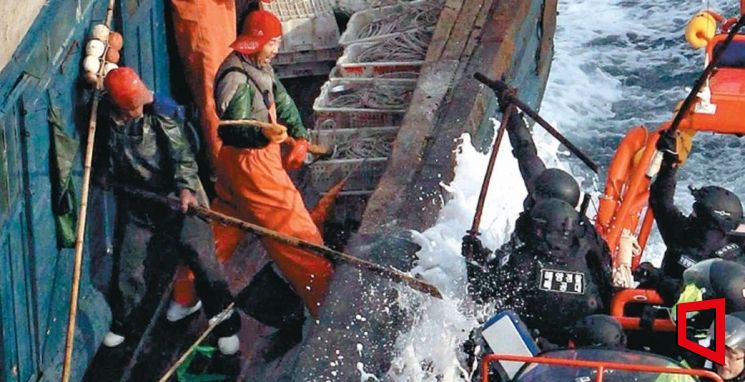 Crew members of Chinese fishing vessels engaged in illegal fishing near the Northern Limit Line (NLL) in the West Sea are resisting by wielding weapons such as metal pipes and hooks against coast guard officers conducting enforcement.
 [Photo by Korea Coast Guard]
Meanwhile, to strengthen responses to illegal fishing by Chinese vessels, starting from the 1st of next month, Chinese vessels engaged in fishing activities in the Exclusive Economic Zone (EEZ) without operating the Automatic Identification System (AIS), which transmits vessel location and speed externally, will also be subject to punishment.
Additionally, vessels that have been modified or expanded differently from the international gross tonnage listed in their documents, or those without relevant certification documents on board, will be included in the scope of punishment. This measure by the Coast Guard is based on the agreements made at the 23rd Korea-China Fisheries Joint Committee held last November.
At that time, both countries agreed that all Chinese vessels fishing in the EEZ must install and operate AIS mandatorily. Furthermore, when applying to fish within the other country’s EEZ, submission of documents related to the vessel’s international gross tonnage is also mandatory.
© The Asia Business Daily(www.asiae.co.kr). All rights reserved.
![Clutching a Stolen Dior Bag, Saying "I Hate Being Poor but Real"... The Grotesque Con of a "Human Knockoff" [Slate]](https://cwcontent.asiae.co.kr/asiaresize/183/2026021902243444107_1771435474.jpg)















