Revision of Fraud Sentencing Guidelines After 13 Years
New Criteria Established by Adding Types of Fraud Crimes
Decision to Be Made in March Next Year Following Public Hearings
The Supreme Court Sentencing Commission is adding voice phishing and insurance fraud to the types of fraud crimes and establishing sentencing guidelines. This is the first revision of the fraud crime sentencing guidelines since they were first established and implemented in 2011, 13 years ago.
According to the Sentencing Commission on the 30th, at the full meeting held the day before, it was decided to newly include telecommunication financial fraud (voice phishing) under the Act on the Prevention of Telecommunications Fraud and insurance fraud within the scope of setting sentencing guidelines for fraud crimes.
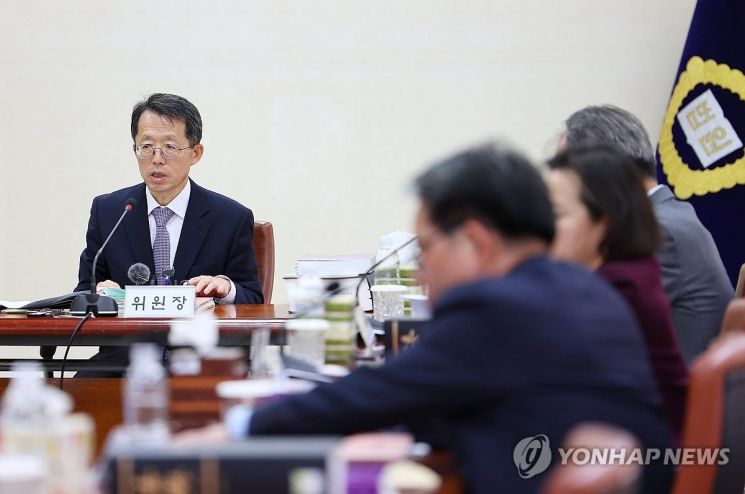 Lee Sang-won, Chairman of the Supreme Court Sentencing Commission, presiding over the 131st Sentencing Commission meeting held on the afternoon of the 29th at the Supreme Court in Seocho-gu, Seoul.
The Commission stated that with the enforcement of the Act on the Prevention of Telecommunications Fraud in November last year, face-to-face deception, which accounts for 64% of voice phishing crimes, was included, and the statutory penalty was raised to "imprisonment for at least one year or a fine equivalent to 3 to 5 times the proceeds of the crime."
Regarding insurance fraud, it was also noted that "from 2018 to 2022, there were 6,209 cases of formal trials (cases referred to formal trial), the highest number among crimes without established sentencing guidelines based on case names."
The Commission plans to revise the recommended sentencing range for the 'organized fraud' type, considering that voice phishing crimes are usually carried out in an organized manner and cause significant damage.
Additionally, reflecting the increase in statutory penalties for violations of the Electronic Financial Transactions Act in 2020, the Commission plans to revise the sentencing guidelines for crimes involving the so-called 'ghost accounts' and comprehensively reorganize the sentencing guidelines related to voice phishing crimes.
The Commission stated, "Since the fraud crime sentencing guidelines have not had their recommended sentencing ranges revised since their establishment and implementation in 2011, it is necessary to reflect changes in crime patterns and public perception due to social and economic changes," adding, "There is a strong demand for tougher punishment for organized fraud types such as voice phishing and jeonse fraud."
With these crimes being added to the fraud crime sentencing guideline types, the overall sentencing for fraud, which is identified as a representative crime causing harm to ordinary citizens, is expected to be strengthened.
Furthermore, considering the growing public interest in animal rights and numerous studies reporting the correlation between animal abuse and interpersonal crimes, the Commission plans to establish sentencing guidelines for animal abuse crimes to eliminate unreasonable sentencing disparities and ensure appropriate punishment commensurate with responsibility.
The Commission will finalize the recommended sentencing ranges, sentencing factors (elements to be reflected in sentencing considerations), and probation criteria through full meetings in August to September this year. Afterward, through public hearings and consultations with related agencies, the final sentencing guidelines are scheduled to be approved in March next year.
Sentencing guidelines serve as a kind of reference for frontline judges when making rulings. While not mandatory, if a judge deviates from them, the reasons must be stated in the judgment.
© The Asia Business Daily(www.asiae.co.kr). All rights reserved.
![Clutching a Stolen Dior Bag, Saying "I Hate Being Poor but Real"... The Grotesque Con of a "Human Knockoff" [Slate]](https://cwcontent.asiae.co.kr/asiaresize/183/2026021902243444107_1771435474.jpg)















