Quantum Dot 3D Structures... Easily Made at Room Temperature
Usable for Quadruple Anti-Counterfeiting and Information Encryption Systems
A technology has been developed that can create three-dimensional quantum dot structures at room temperature.
 Professor Jeong Im-du's team from the Department of Mechanical Engineering and the Graduate School of Artificial Intelligence at UNIST (top row: Professor Jeong Im-du; bottom row, from left: first author researcher Jeon Hong-ryeong, researcher Park Seo-bin).
A research team led by Professor Jeong Imdu from the Department of Mechanical Engineering and the Graduate School of Artificial Intelligence at UNIST (President Lee Yong-hoon) has developed a one-stop perovskite quantum dot stacking manufacturing technology. This technology enables the production of complex 3D shapes, such as the Eiffel Tower, at room temperature without additional heat treatment using quantum dots.
Quantum dots are semiconductor crystals a few nanometers in size that emit light on their own. To create 3D shapes with conventional quantum dot materials, prolonged heating is required. Since quantum dot materials are sensitive to heat, their properties inevitably degrade.
In particular, perovskite quantum dots have excellent luminous efficiency and color tunability. Although research has been conducted to fabricate various structures using these properties, the long heat treatment process used in printing caused degradation of characteristics or deformation of shapes, revealing limitations.
The research team developed a technology that uses hydroxypropyl cellulose (HPC) polymer and volatile solvents in 3D printing of perovskite quantum dots (PQD), allowing quantum dot-polymer layers to be stacked at room temperature.
Hydroxypropyl cellulose was used to ensure stable ink extrusion at room temperature without additional heat treatment. The volatile solvent dichloromethane (DCM) was used to facilitate solvent evaporation, preventing ink clumping and enabling smooth deposition.
The team optimized variables affecting 3D printing, such as the amount of hydroxypropyl cellulose, nozzle speed, and the pressure applied to compress the ink.
Based on this, they were able to print complex structures like pyramids and the Eiffel Tower. Using the three primary colors of light, the structures emitted light corresponding to each ink color.
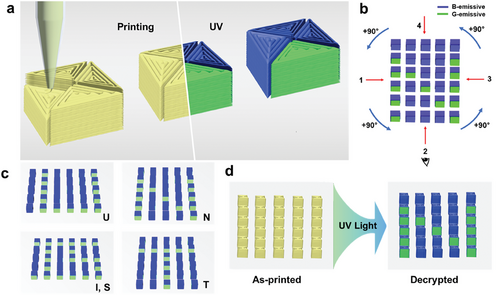
The research team also implemented a quadruple anti-counterfeiting and information encryption system by utilizing the geometric shapes enabled by 3D printing. This system exploits the luminescence properties of perovskite that emit light at specific wavelengths.
Previously limited to two-dimensional patterns, the team fabricated a microarray consisting of 6 by 5 units using the developed technology. When UV light is shone on the block-shaped microarray, the letters U, N, IS, and T appear sequentially as the angle changes. This can be used to create an encryption system improved beyond two-dimensional patterns.
First author Researcher Jeon Hongryeong said, “We simplified the quantum dot 3D printing process to enable stable manufacturing at room temperature,” adding, “It is expected to be applied to enhanced information encryption systems and various optoelectronic printing technologies in the future.”
Professor Jeong Imdu stated, “Through this research, we ensured stable ink deposition while maintaining the photoluminescence properties of perovskite quantum dots without heat treatment or photopolymerization,” and added, “This will contribute not only to anti-counterfeiting and information encryption but also to the expansion of quantum dot-based optoelectronic and energy application fields.”
This research was published online in March in ‘Advanced Functional Materials,’ a journal ranked in the top 5% worldwide in the field. The research was supported by the Ministry of Science and ICT, the National Research Foundation of Korea, and the Institute for Information & Communications Technology Planning & Evaluation.
© The Asia Business Daily(www.asiae.co.kr). All rights reserved.
![Clutching a Stolen Dior Bag, Saying "I Hate Being Poor but Real"... The Grotesque Con of a "Human Knockoff" [Slate]](https://cwcontent.asiae.co.kr/asiaresize/183/2026021902243444107_1771435474.jpg)
















