Urban Railway Line 2, Complex Shopping Mall, 518 50th Anniversary, and More to Watch in 2030
"We Will Pour Flawless Preparation and Effort from Now On to Align with the Great Transition Clock"
Gwangju Mayor Kang Gi-jung declared the ‘2030 Gwangju Grand Transformation Plan.’ Mayor Kang proclaimed 2030 as the ‘Year of Gwangju’s Grand Transformation’ and repeatedly emphasized his role as the ‘designer’ of Gwangju’s municipal administration.
According to Gwangju City on the 29th, Mayor Kang presented a proposal regarding the ‘2024 First Supplementary Budget and Fund Operation Change Plan’ at the 324th extraordinary session of the Gwangju City Council held that day.
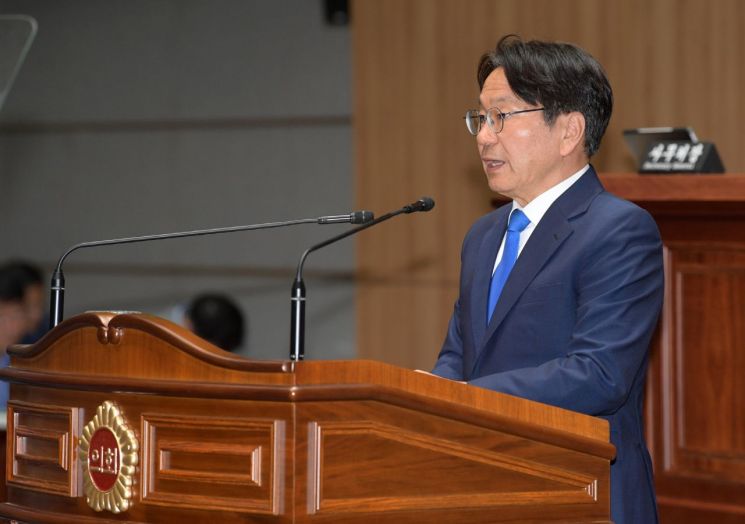
Mayor Kang stated, “The 8th elected administration, which began with a commitment to change and innovation, is already approaching its turning point,” and evaluated, “Over the past 1 year and 10 months, Gwangju’s municipal administration has been a problem solver. We resolved the backlog of 5+1 tasks and organized the tangled interests to lay the foundation for a fresh start.”
He continued, “Right now, Gwangju stands at the center of change, and the clock for Gwangju’s grand transformation is set for 2030,” emphasizing, “In the next two years, our municipal administration must devote all efforts to designing and executing the grand transformation of Gwangju in 2030.”
First, he reviewed achievements such as Gwangju’s representative strategic industries including Artificial Intelligence (AI) and future cars, forest preservation projects like private parks, the Korea’s standard care city realized through Gwangju-style integrated care, and the three major joint projects with Daegu Mayor Hong Jun-pyo: the Special Act on Military Airports, the Special Act on Dalbit Railroad, and the Southern Mega Economic Zone.
As a blueprint for ‘Gwangju 2030,’ he cited ▲the era of 30 million urban users prepared along with the three-set complex shopping malls ▲the ‘Future Car Specialized Complex’ leading the future car industry ▲the ‘Dalbit Railroad’ connecting Gwangju and Daegu within an hour ▲the ‘Urban Railway Line 2’ that will serve as citizens’ transportation ▲and the ‘45% reduction in greenhouse gases’ ahead of the government.
He also mentioned the 50th anniversary of the May 18 Democratic Uprising.
Mayor Kang said, “This year’s 44th anniversary of May 18 is a time to prepare for the 45th anniversary next year and the 50th anniversary in 2030,” adding, “That preparation begins today at the City Council. The ‘Basic Ordinance on the Succession of the Spirit of the May 18 Democratic Uprising in Gwangju,’ which consolidates 12 scattered May 18-related ordinances into one integrated ordinance, is awaiting passage in the plenary session.”
He further stated, “We will complete the long-overdue task of including the May 18 spirit in the preamble of the Constitution together with the 22nd National Assembly starting its term this year, and we are planning a May People’s Festival to make Gwangju’s May a time enjoyed by Korea and the world. Through thorough preparation, we will enable everyone to truly meet the May 18 of ‘us’ at the 50th anniversary in 2030,” he emphasized.
He also said, “Such rapid changes were possible thanks to the active support and cooperation of the City Council,” and added, “To overcome difficult financial conditions, we adjusted the timing of resource allocation for major investment projects and boldly cut projects with low effectiveness, pushing for strong expenditure restructuring. We formulated a budget that reduces where possible and allocates appropriately where necessary, so I ask for your collective wisdom.”
Meanwhile, Gwangju City prepared a 2024 first supplementary budget of 872.7 billion won and submitted it to the Gwangju Metropolitan City Council on the 18th. With this supplementary budget, this year’s budget increased by 872.7 billion won (12.6%) from the original 6.9043 trillion won to 7.777 trillion won.
Gwangju City allocated funds for ▲supporting 난자동결시술비 (Nandadong freezing procedure costs) to strengthen thicker and more detailed life-cycle tailored welfare, expanding the 10 a.m. work start policy for all elementary school parents, and monthly rent support for youth. Also, ▲in the fields of future food sources and protecting local jobs, it included the establishment of an AI cluster, housing rent increases for Gwangju Global Motors (GGM) workers to improve treatment of Gwangju-type jobs, and acquisition tax support for Casper electric vehicle buyers. ▲To realize a better Gwangju, it allocated budgets for free transportation for children and half-price discounts for youth linked with the government’s K-Pass, expansion of facilities for the 2025 World Archery Championships for the disabled, construction of Urban Railway Line 2, and traffic congestion improvements due to the expansion of Honam Expressway.
In addition, ▲it plans to focus budget investment on proactive safety budgets for a safe Gwangju 24/7 all year round and strengthening public health care responsible for citizens’ healthy lives.
In particular, Gwangju City showed a strong will to reduce the budget by sharing the pain to overcome difficult financial conditions through reducing business promotion expenses for the mayor, vice mayor, and others, as well as annual leave compensation for executives at grade 4 and above.
It also improved fiscal soundness by significantly reducing interest burdens from local bond issuance, such as refinancing 266.8 billion won of high-interest (around 5%) financial institution borrowings with low-interest (around 3%) loans, lowering annual interest expenses by 3.7 billion won.
© The Asia Business Daily(www.asiae.co.kr). All rights reserved.
![Clutching a Stolen Dior Bag, Saying "I Hate Being Poor but Real"... The Grotesque Con of a "Human Knockoff" [Slate]](https://cwcontent.asiae.co.kr/asiaresize/183/2026021902243444107_1771435474.jpg)















