577 Billion KRW Imposed Over 4 Years Since 2020
"Reduction Difficult Due to Civil Complaints Concerns"
Local governments in the Seoul metropolitan area, including Seoul, Incheon, and Gyeonggi Province, have paid over 50 billion KRW in penalties over four years due to their failure to control the amount of household waste they generate.
According to the Seoul Metropolitan Landfill Management Corporation on the 27th, the total penalties related to the 'Household Waste Import Quota System' paid by metropolitan area local governments to the corporation from 2020 to last year amounted to approximately 57.7 billion KRW.
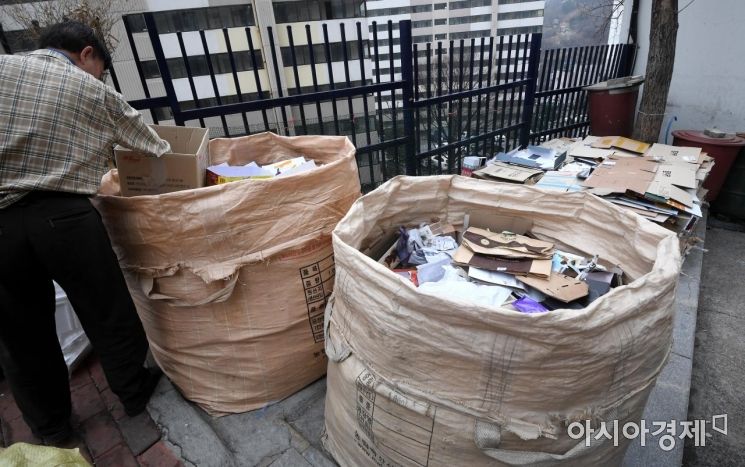 Recyclable waste such as packaging boxes is piled up at a recycling station in an apartment complex in Seoul. Photo by Hyunmin Kim kimhyun81@
The import quota system, implemented in 2020, limits the annual amount of household waste that can be brought into the metropolitan landfill in Seo-gu, Incheon. Local governments must pay penalties if they exceed their allocated quotas.
In the case of last year, a total of 19 local governments, including 12 districts in Seoul and 7 in Gyeonggi Province, brought in more waste than their quotas and were collectively fined about 9 billion KRW.
Among them, Goyang City in Gyeonggi Province bore the highest penalty at 2.9 billion KRW, followed by Gangseo-gu in Seoul with 1.1 billion KRW, Namyangju City in Gyeonggi with 700 million KRW, Guro-gu in Seoul with 600 million KRW, and Gimpo City in Gyeonggi with 500 million KRW.
Currently, the penalty is set at 1.2 to 2.5 times the import fee. These local governments have seen an increase in household waste due to active population inflow from housing development but have been unable to take proactive reduction measures due to concerns over complaints, resulting in fines.
An official from a local government in Gyeonggi Province said, "If there are shortcomings in waste collection, complaints flood in, and there is a lot of negative public opinion against installing incinerators, so we have to be cautious. Even if it burdens the budget, there is no sharp alternative."
Since the 15th, the corporation has been operating a system that allows each local government to check in real time the amount of waste they have brought into the metropolitan landfill to help manage waste import volumes efficiently.
The system shows the total amount of household waste imported by each local government to the metropolitan landfill up to the previous day, import volumes by period, import ratios relative to the total quota, and the status of imposed penalties. Visual data will also be provided starting from July to August.
Meanwhile, Daejeon Urban Corporation is gaining attention for earning an annual profit of 2 billion KRW by selling biogas generated during food waste treatment.
After the direct landfill of food waste was banned, Daejeon Urban Corporation established the Daejeon Bioenergy Center and sells the gas produced during food waste processing as boiler fuel to nearby industrial complexes, achieving a win-win effect.
The Daejeon Bioenergy Center was recognized for its exemplary waste treatment performance and was selected as the best institution in the organic biogasification category in the 2020 Ministry of Environment’s waste treatment business and facility evaluation.
© The Asia Business Daily(www.asiae.co.kr). All rights reserved.
![Clutching a Stolen Dior Bag, Saying "I Hate Being Poor but Real"... The Grotesque Con of a "Human Knockoff" [Slate]](https://cwcontent.asiae.co.kr/asiaresize/183/2026021902243444107_1771435474.jpg)
















