Sharing Discount Information for McDonald's, Domino's Pizza, and More
Franchises 'Reluctantly' Launch Low-Priced Menus
In China, low-priced foods, so-called 'geoji menu' (beggar menu), are booming, especially among the younger generation. Contrary to economic indicators suggesting a recovery in domestic demand, many food service businesses are closing down one after another or reluctantly introducing low-priced dishes.
The boom of 'poor man's meals' leads to the emergence of 'guidelines'... Franchise chains continue to launch low-priced menus
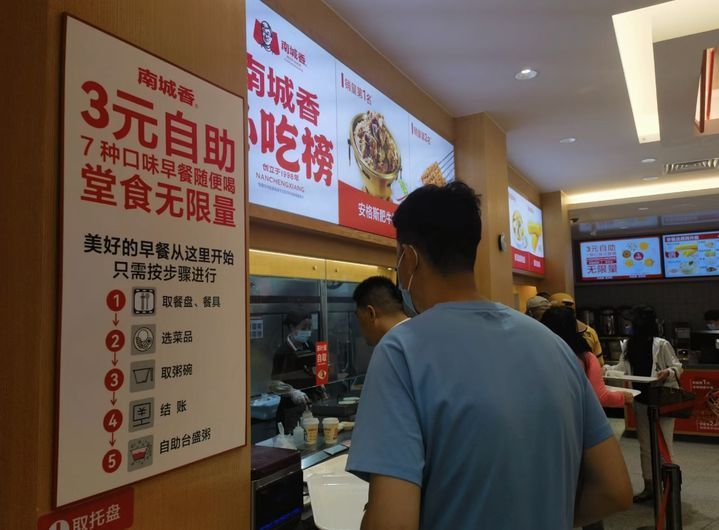 As consumer sentiment contracts and consumers seek cost-effective products, companies are consecutively launching so-called "poor man's meals." Chinese dining company Nanchengxiang has introduced a 3-yuan breakfast buffet menu. [Image source=Baidu]
On the 26th, social networking services (SNS) such as Xiaohongshu in China saw the trend of 'Poor Man's Menu Guidelines.' Instructions like "On Monday, eat a 1+1 set at McDonald's; on Wednesday, get 30% off at Domino's Pizza; on Thursday, receive the Crazy Thursday discount at KFC; on Friday, eat half-price burgers at Burger King" are circulating.
Local media such as Taiwan's Central News Agency reported on this phenomenon, saying, "As the tendency to prioritize cost-effectiveness (performance relative to price) grows stronger, the 'Chonggui (窮鬼) set' is becoming very popular in China." Chonggui means 'beggar' or 'poor person,' and recently in China, it refers to franchise restaurant menus that can be eaten with the least amount of money. Amid economic difficulties, low-priced menus are trending among the younger generation in China. In response, franchise companies are also launching menus targeting this demographic.
A representative example is McDonald's globally recognized '1+1 set.' This product allows customers to choose two desired menu items at a fixed price of 13.9 yuan (about 2,600 won). At the end of last year, when prices were soaring, McDonald's China raised prices on all products by 3%, but the 1+1 set price remained unchanged. This was due to a flood of demands from Chinese consumers to keep the 1+1 set price unchanged despite the price hike.
IKEA started 'Crazy Friday,' which cuts the price of some menu items in half while maintaining the same portion size. Additionally, Nanchengxiang, a chain food service company with over 100 stores only in Beijing, launched a breakfast buffet product priced at 3 yuan (about 560 won), offering unlimited servings of seven menu items including porridge, hot pot soup, tofu, and milk. Korean food company Michun also introduced a product allowing unlimited rice consumption for just 3 yuan.
Foreign media explained, "Amid economic recession and sluggish consumption, Chinese people have started to carefully budget their dining out expenses, and the food service industry is forced to offer subpar menus to survive."
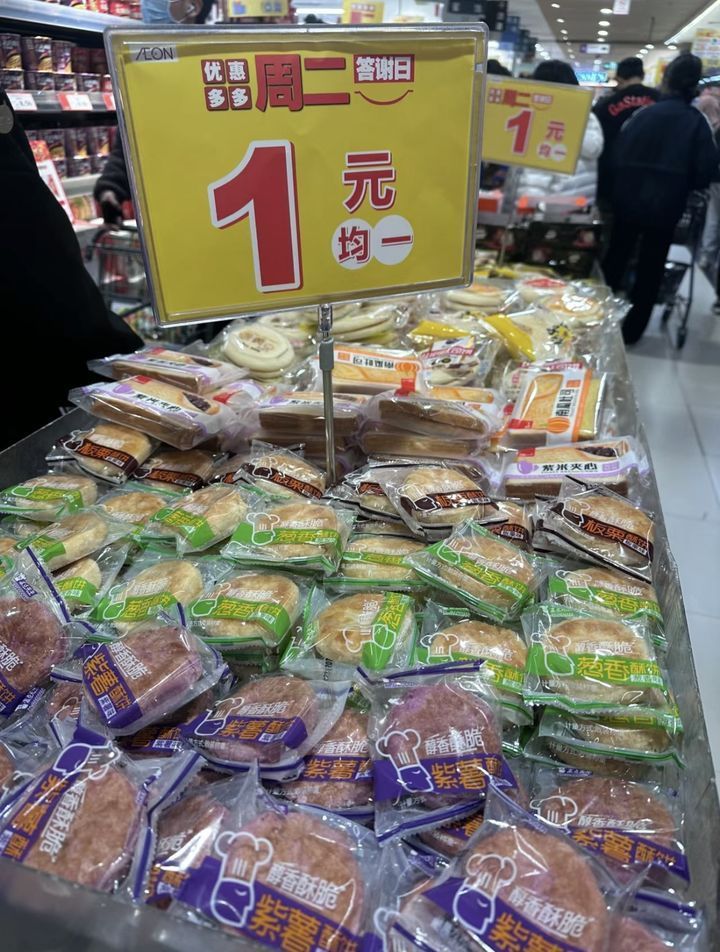 As 'poor man's meals' gain popularity among young Chinese seeking cost-effectiveness, the 'poor man's meal guidelines' are spreading on Chinese social networking services (SNS). [Image source=Captured from Xiaohongshu]
'Domestic demand recovery' outlook uncertain... Highest number of food service business closures since the spread of COVID-19
In reality, contrary to economic indicators suggesting a recovery in domestic demand, food service businesses in China are closing down one after another. According to the National Bureau of Statistics of China on the 17th, China's economic growth rate in the first quarter of this year recorded 5.3%. Surpassing market expectations (4.6~4.8%) by a wide margin, some interpreted this as a sign of recovery in consumer sentiment.
However, in the first quarter of this year, 459,000 food service businesses closed in China, a sharp increase of 232.6% compared to the same period last year. Meanwhile, 731,000 food service businesses opened during this period, a 34.4% decrease compared to the previous year. Furthermore, last year, about 1.36 million food service businesses closed in China. Media reported this is estimated to be the highest number since the spread of COVID-19 began in 2020. Wu Wonder, an analyst at China’s Caitong Securities, explained, "Consumption is generally concentrated on holidays," adding, "On regular days, relatively rational and conservative consumption patterns are strengthening." He analyzed that the popularity of low-priced menus among Chinese people is a similar trend.
© The Asia Business Daily(www.asiae.co.kr). All rights reserved.
![Clutching a Stolen Dior Bag, Saying "I Hate Being Poor but Real"... The Grotesque Con of a "Human Knockoff" [Slate]](https://cwcontent.asiae.co.kr/asiaresize/183/2026021902243444107_1771435474.jpg)
















