Repeated Parliamentary Standstill... "No Work, No Pay" Criticism
Even with Late Opening, Monthly Salary of 13 Million KRW Paid per Lawmaker
There is growing criticism that the principle of 'no work, no pay' should be applied to the salaries of National Assembly members. Even if the term of the National Assembly begins without finalizing negotiations on the formation of the leadership, including the election of the Speaker and standing committee chairs, the Assembly is effectively in a 'business suspension' state. It is considered inappropriate for lawmakers who do not engage in legislative activities to receive monthly salaries exceeding 12 million KRW.
Members of the Assembly receive their salaries even if the Assembly cannot convene due to conflicts over the formation of the leadership. This year, the monthly salary of a National Assembly member is about 13 million KRW, 1.7% higher than last year. If the Assembly opens one month late, 3 billion 9 hundred million KRW of taxpayers' money will be spent on the salaries of 300 lawmakers who are not working. The average 'business suspension days' for the 14th to 21st National Assemblies is 45 days. If the formation of the leadership for the first half of the 22nd National Assembly takes as long as the average period (45 days), each lawmaker will receive 19.5 million KRW without performing any legislative activities. Calculated for 300 members, about 5.8 billion KRW of public funds will be wasted.
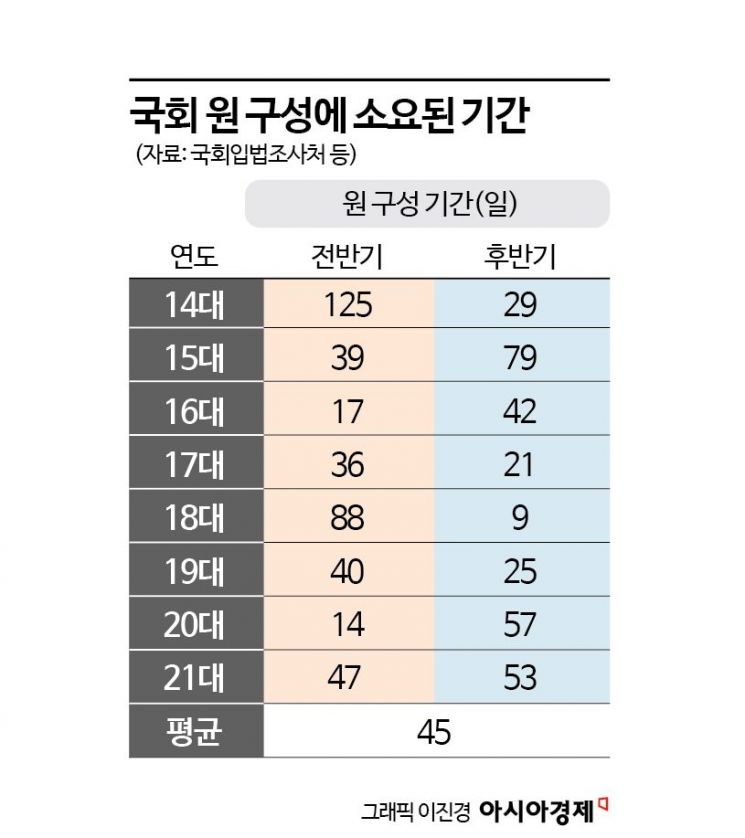
Delays in forming the leadership due to failure to finalize negotiations on the distribution of standing committee chair positions between the ruling and opposition parties have been repeated. The main issue is the distribution of standing committee chairs. Standing committee chairs are called the 'real power holders' of the National Assembly because they have the authority not only to propose agendas but also to process them. In particular, the position of Chair of the Legislation and Judiciary Committee is highly coveted by each party. Bills that have passed the review of the relevant standing committee must undergo systematic and detailed examination by the Legislation and Judiciary Committee before being submitted to the plenary session, so the authority and role of the Chair of this committee are significant.
There are concerns that the 22nd National Assembly may also face a legislative vacuum due to delays in forming the leadership. This is due to a standoff between the ruling and opposition parties over the Chair of the Legislation and Judiciary Committee. The Democratic Party believes it must retain the chairmanship to secure momentum for legislative initiatives. During the 21st National Assembly, several laws pushed by the Democratic Party, such as the Grain Management Act, the Yellow Envelope Act, the Nursing Act, and the Broadcasting Three Acts, were all blocked and delayed in the Legislation and Judiciary Committee, which was chaired by Kim Do-eup of the People Power Party at the time. The Democratic Party plans to pursue special investigation laws related to Chae Sang-byeong and Kim Geon-hee in this Assembly, which also fall under the jurisdiction of the Legislation and Judiciary Committee.
However, the People Power Party is uncomfortable with the Democratic Party's ambition to simultaneously hold the positions of Speaker, Chair of the Steering Committee, and Chair of the Legislation and Judiciary Committee. Kim Do-eup, Chair of the Legislation and Judiciary Committee, expressed discomfort, saying, "The Democratic Party cannot hold both the Speaker and the Chair of the Legislation and Judiciary Committee." This is why concerns about a 'business suspension' due to difficulties in forming the leadership have emerged more than a month before the opening of the 22nd National Assembly. According to National Assembly customs, the Chair of the Steering Committee is usually from the largest party in the Assembly, and the Chair of the Legislation and Judiciary Committee is from the second-largest party.
As delays in forming the leadership have been repeated, there have been calls to return salaries. The latter half of the 21st National Assembly began its term on May 30, 2022, but due to conflicts over leadership formation, negotiations were only completed on July 22 of the same year. The Assembly was unable to convene for 53 days. At that time, Democratic Party lawmaker Lee Won-wook proposed, "Costs increase by 422,369 KRW per lawmaker per day, and a ghost Assembly that cannot form its leadership should declare 'no work, no pay' and return salaries," but the return of salaries did not materialize.
There have been past cases where lawmakers returned their salaries in response to unfavorable public opinion regarding their pay. When the 18th National Assembly was delayed in opening in 2008, 33 lawmakers from the Grand National Party collected an average of 7.2 million KRW per person in salaries and donated it to children suffering from malnutrition. Four years later, the 19th National Assembly was also delayed due to confrontation between the ruling and opposition parties. At that time, the Saenuri Party resolved in a party meeting to return all salaries, donating a total of 1.36 billion KRW to the project for recovering the remains of fallen soldiers. In 2016, when the Assembly opened two days later than the legal deadline, 38 lawmakers from the People's Party returned two days' worth of salaries to the National Assembly Secretariat.
© The Asia Business Daily(www.asiae.co.kr). All rights reserved.
![Clutching a Stolen Dior Bag, Saying "I Hate Being Poor but Real"... The Grotesque Con of a "Human Knockoff" [Slate]](https://cwcontent.asiae.co.kr/asiaresize/183/2026021902243444107_1771435474.jpg)















