Interview with the 9th KPCA New Association President
"Until about 10 years ago, standardized semiconductors were used, but now, as customized products have increased, packaging is also increasingly demanded to be customized. In the process of developing new structures, designs, and materials, collaboration among various companies is essential."
Choi Si-don, chairman of the Korea PCB & Semiconductor Packaging Industry Association (KPCA), said this during an interview with Asia Economy on the 26th, discussing the recent trends in the packaging industry. Having assumed the position of chairman last month, he emphasized, "This phenomenon will intensify further in the future," adding, "Like Taiwan and Japan, there should be many close collaboration cases within the domestic industrial field."
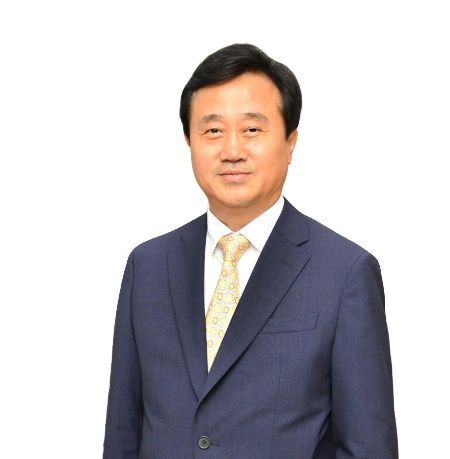 Choi Si-don, 9th President of the Korea PCB and Semiconductor Packaging Industry Association (KPCA) /
 [Photo by KPCA]
Packaging belongs to the post-process in semiconductor manufacturing. If the front process involves drawing circuits on a silicon wafer, the post-process refers to the overall packaging work of cutting the chips based on the circuits and placing them on printed circuit boards (PCBs) to electrically connect them. Recently, as attempts to bundle multiple chips during the packaging stage to maximize performance have increased, the importance of the technology has grown.
Chairman Choi explained, "With the increasing demand for artificial intelligence (AI) and other applications, the demand for semiconductor performance improvement is high. As the process moves to 3 nanometers (nm, one billionth of a meter) and 2 nm, there are limits to miniaturizing circuits in the front process, so packaging has become the trend. For multiple chiplets placed on the PCB during packaging to work well, a lightweight and compact PCB is needed, so there are many technical challenges in this area as well."
Recently, there has been an increasing number of industry development attempts to make substrates using glass instead of silicon. Glass substrates have smooth surfaces that facilitate fine circuit implementation and possess strong characteristics against heat and bending. Several companies, including Samsung Electro-Mechanics, LG Innotek, and SKC (subsidiary Absolis), have jumped into developing glass substrates. Equipment, related materials, and process technology development for making glass substrates are also in full swing.
Chairman Choi said, "Having been in the semiconductor industry for over 40 years, I feel that the pace of recent technological changes is faster compared to the past," adding, "Although it will take time until commercialization, the material shift to glass substrates is an inevitable wave." He continued, "I believe there will be many challenges that companies will need to solve together during this process."
KPCA plans to provide a platform to strengthen industry cooperation going forward. Chairman Choi emphasized, "The semiconductor supply chain is extremely complex, and even looking at PCBs alone, materials and equipment are connected, and the structure extends down to second- and third-tier partners. As cooperation is increasingly required, it is the association’s role to look into what issues these parties are struggling with and provide assistance."
Chairman Choi is a semiconductor expert who worked at Samsung Electronics DS Division (Semiconductor) from 1983 to 2010, covering memory semiconductor design and post-process tasks. Since 2011, he has served as CEO of STECO and Symtek, and this year, he was appointed chairman of Symtek Holdings. Last month, he began his external activities by becoming the 9th chairman of KPCA.
© The Asia Business Daily(www.asiae.co.kr). All rights reserved.
![Clutching a Stolen Dior Bag, Saying "I Hate Being Poor but Real"... The Grotesque Con of a "Human Knockoff" [Slate]](https://cwcontent.asiae.co.kr/asiaresize/183/2026021902243444107_1771435474.jpg)















