Four-Way Race: Woo Won-sik, Jeong Seong-ho, Jo Jeong-sik, Chu Mi-ae
Park Ji-won: "'I Will Support the Democratic Party' Is Not Politics"
The neutrality principle of the Speaker of the National Assembly, who represents the Republic of Korea's legislature and serves as its head, is being shaken. This is due to candidates within the Democratic Party of Korea continuously making statements that threaten the Speaker's duty of 'political neutrality.'
Currently, the candidates for Speaker within the Democratic Party are summarized as a four-way race among elected representative Chu Mi-ae, and Assembly members Cho Jung-sik, Jung Sung-ho, and Woo Won-shik. The controversy over the Speaker's neutrality began with elected representative Chu Mi-ae. On the 11th, Chu emphasized on a radio show, "Just as green onions are neither left-wing nor right-wing, the Speaker of the National Assembly is neither left-wing nor right-wing, but that does not mean neutrality." This was interpreted to mean that she could lend her strength as Speaker to pass reform legislation promoted by the Democratic Party. In fact, Chu added, "Looking at the last National Assembly, various reform bills were stalled or had their substance removed by the Speaker's hand under the pretext of finding compromises, which was unfortunate."
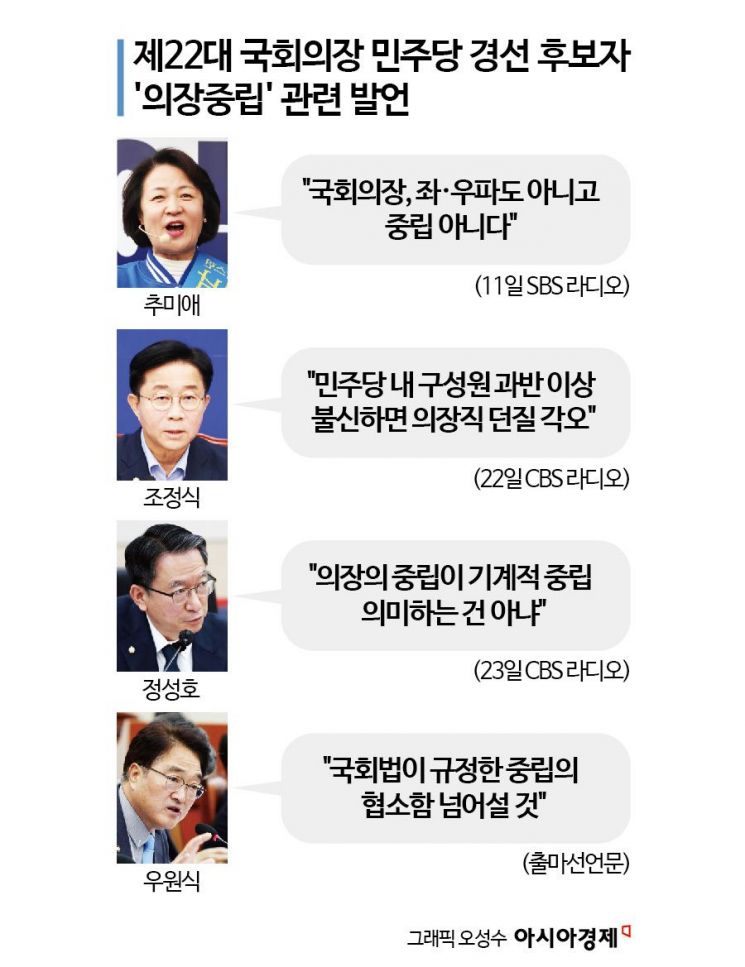
Six-term Assembly member Cho Jung-sik made even more explicit remarks that seemed to prioritize 'Myeongshim (明心, meaning the heart of Lee Jae-myung, the party leader)' over the Speaker's neutrality. On the 22nd, Cho said on CBS radio, "When the Speaker is someone who works well in harmony with Lee Jae-myung and the party, they can fight properly and lead the National Assembly effectively when producing results."
Jung Sung-ho, a key pro-Lee figure, appeared on the same radio show the next day, the 23rd, and went so far as to say, "The Speaker's neutrality does not mean mechanical neutrality." Jung also stated, "When no agreement is reached between the ruling and opposition parties, isn't it natural to follow the majority party's position according to the democratic principle of majority rule?" This implies that if cooperation is difficult and major bills cannot pass, power will be given to the majority party, the Democratic Party. Woo Won-shik also said in his declaration of candidacy the previous day, "I will go beyond the narrow neutrality stipulated by the National Assembly Act."
As the Speaker candidates repeatedly make remarks that downplay the duty of political neutrality, criticism is mounting both inside and outside the political sphere. Park Ji-won, elected Assembly member from Mokpo, Jeonnam, appeared on a radio show the day before and said, "The spirit of the law is the neutrality of the Speaker, and emphasizing this is politics," adding, "'I came from the Democratic Party, so I will only support the Democratic Party' is not politics." Cho Eung-cheon, Supreme Council member of the Reform New Party, also warned, "The Democratic Party primary candidates are shaking the status of the Speaker of the National Assembly, who ranks second in the national protocol, from its roots."
Choi Joon-seon, emeritus professor at Sungkyunkwan University School of Law, told Asia Economy in a phone interview, "The National Assembly Act clearly states the duty of neutrality for the Speaker, and only then can democracy be realized and grow," adding, "Candidates openly declaring they will side with one party can be called anti-constitutional remarks that will cause great disappointment to the public."
© The Asia Business Daily(www.asiae.co.kr). All rights reserved.
![Clutching a Stolen Dior Bag, Saying "I Hate Being Poor but Real"... The Grotesque Con of a "Human Knockoff" [Slate]](https://cwcontent.asiae.co.kr/asiaresize/183/2026021902243444107_1771435474.jpg)















