Wholesale Price of Kim Increased 57% in One Year
Carrots Up 57%, Spinach 69%, Cucumbers 47% ↑
Rice Also 7.56% More Expensive Than Last Year
As the price of gimbap, a representative commoner's food, continues to rise, seaweed is being pointed out as a major factor behind the price increase. The surge in seaweed prices has led to higher gimbap prices. However, it is understood that the cost proportion of seaweed in gimbap prices is only around 3%. Analysis suggests that the rise in gimbap prices is more significantly influenced by the consecutive increases in the costs of other ingredients rather than seaweed.
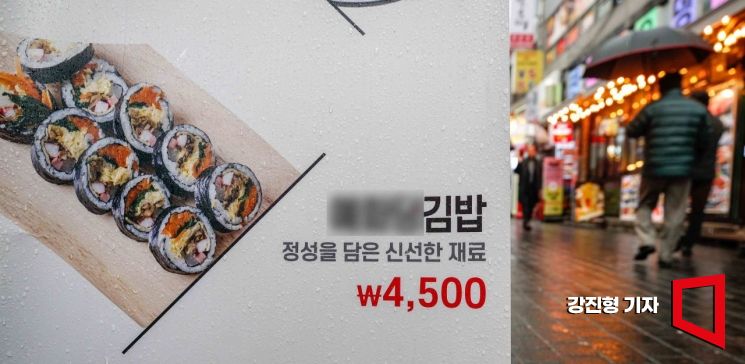 The price of gimbap, a representative commoner's food, is showing an upward trend. According to the Korean Agro-Fisheries & Food Trade Corporation (aT) dining industry portal 'THE Dining,' the average price of one roll of gimbap in Seoul last month was 3,323 won. This is a 23% increase compared to 2,692 won in March 2021, three years ago. Photo by Kang Jin-hyung aymsdream@
According to the Korean Agro-Fisheries & Food Trade Corporation (aT) dining industry portal 'THE Dining', the average price of one roll of gimbap in Seoul last month was 3,323 won. This is a 23% increase compared to 2,692 won in March 2021, three years ago. Gimbap prices have been on a continuous upward trend since surpassing 3,000 won for the first time in August 2022. According to the Statistics Korea National Statistical Portal (KOSIS), the consumer price index for gimbap last month was 130.67, which is 5.3% higher than the previous year.
Some attribute the sharp rise in seaweed prices as the key factor behind the increase in gimbap prices. Recently, due to abnormal weather and red tides in Japan, the raw seaweed used as the raw material for seaweed has suffered a poor harvest, leading to increased demand for Korean raw seaweed in various regions and a significant jump in seaweed prices. According to the aT Agricultural Products Distribution Information System, the wholesale price of one pack (100 sheets) of dried seaweed used in gimbap was 10,440 won as of the 25th. This is a 57.54% increase compared to the same period last year (6,627 won). Retail prices have also risen sharply. The price of dried seaweed per 10 sheets was 1,011 won on April 25 last year, rising to 1,304 won in one year, an increase of 28.98%.
However, there are opinions that it is excessive to view the recent rise in seaweed prices as the sole culprit for the increase in gimbap prices. A Ministry of Oceans and Fisheries official explained, “There are about 10 ingredients inside gimbap,” and “the cost proportion of seaweed in gimbap is about 3%.” The official added, “While it is true that seaweed prices have risen due to strong exports from Korea recently, the price surge should also be seen as influenced by the sharp increases in other raw materials such as spinach and carrots.”
In fact, the prices of major ingredients used in gimbap have been rising steeply. The wholesale price of carrots, one of the main ingredients in gimbap, was 87,000 won for 20 kg as of the 25th, a sharp increase of 57.65% compared to 55,187 won in the same period last year. It also rose more than 17% compared to a month ago (74,097 won). Rice prices have also risen considerably. The wholesale price of 20 kg of rice was 50,100 won as of the 25th, up 7.56% from 46,580 won the previous year. According to the Statistics Korea National Statistical Portal (KOSIS), the producer price index for spinach surged 69.8% year-on-year, and cucumbers rose 47.9%.
Meanwhile, the Ministry of Oceans and Fisheries plans to promote a ‘seaweed supply stabilization plan’ as attention to seaweed prices has increased. The ministry intends to implement related policies to secure stable domestic supply in response to seaweed export demand. A representative measure is the plan to develop a new 2,700-hectare aquaculture farm starting in July to expand seaweed production.
An official from the Ministry of Oceans and Fisheries stated, “We will develop new sea areas to increase the production of seaweed (raw seaweed) used as the raw material for dried seaweed,” adding, “Until now, new licenses for aquaculture operators have been basically frozen due to concerns about oversupply, but we have decided to proceed with additional development considering seaweed price stabilization.” In addition, the ministry plans to stabilize seaweed prices by applying tariff quotas on dried seaweed and seasoned seaweed processing companies to reduce their burden.
© The Asia Business Daily(www.asiae.co.kr). All rights reserved.
![Clutching a Stolen Dior Bag, Saying "I Hate Being Poor but Real"... The Grotesque Con of a "Human Knockoff" [Slate]](https://cwcontent.asiae.co.kr/asiaresize/183/2026021902243444107_1771435474.jpg)















