KISA '2023 Internet Industry Regulation White Paper'
Most Regulations in OTT and Cultural Content Industries
Evaluation Score 20... Lack of Understanding of New Industries
Among the 139 internet industry regulatory bills proposed in the National Assembly last year, only 10% were completed. Considering that the overall bill processing rate in the 21st National Assembly is 30%, this is a very low level.
Evaluations of the bills revealed a generally low understanding of the internet industry and the use of ambiguous terms, which lowered the processing rate. The requirement that only 10 members of the National Assembly need to sign to propose a bill was also pointed out as a cause of 'hasty legislation.'
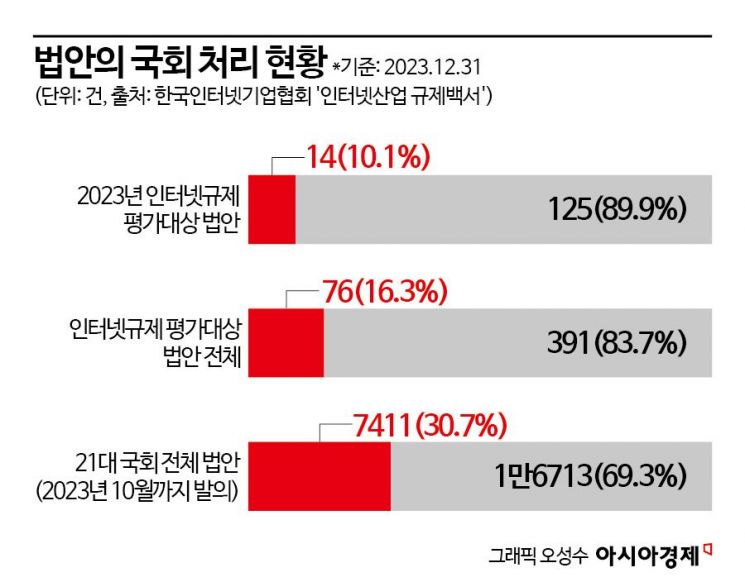
According to the '2023 Internet Industry Regulation White Paper' recently published by the Korea Internet Corporations Association (KICA), 139 internet industry regulatory bills were proposed over one year from November 2022 to October 2023.
Only 1 to 2 out of 10 bills processed by the National Assembly
Of the total 139 bills, more than half?81 bills (58.3%)?contained regulatory content that broadly targeted the platform industry or a wider scope significantly affecting the platform industry. The remaining 48 bills targeted specific sectors within the platform industry.
The largest share was taken by the cultural content industry, including Over-The-Top (OTT) online video services (11 bills), followed by telemarketing and distribution sectors (10 bills), fintech (10 bills), virtual assets (6 bills), and artificial intelligence (5 bills).
Among the 139 internet regulatory bills, only 14 bills (10%) were submitted to the plenary session and completed processing. Of these 14 bills, one was approved with amendments, and the remaining 13 were discarded reflecting alternative proposals. KICA checked the number of internet regulatory bills processed in the 21st National Assembly and found that as of the end of last year, only 16.3% (76 bills) of the total had been processed. This level did not even reach the average processing rate of all bills in the 21st National Assembly (30.7%).
KICA viewed the current requirement that a bill can be submitted with the consent of only 10 or more members of the National Assembly as problematic. In fact, among the 459 internet regulatory bills proposed by members in the 21st National Assembly, 288 bills (62.7%) secured only the minimum consent of 10 to 11 members. Consent from 20 to 49 members was obtained for 20 bills (4.4%), and only 3 bills (0.7%) had consent from 50 or more members.
Insufficient term definitions... Legislative evaluation score of 20
KICA’s legislative evaluation is reviewed by the 'Internet Industry Regulation Legislative Evaluation Committee,' composed of 10 external experts. The legislative evaluation conducted on the 139 bills proposed last year resulted in an average score of 20 out of 100, which is relatively low.
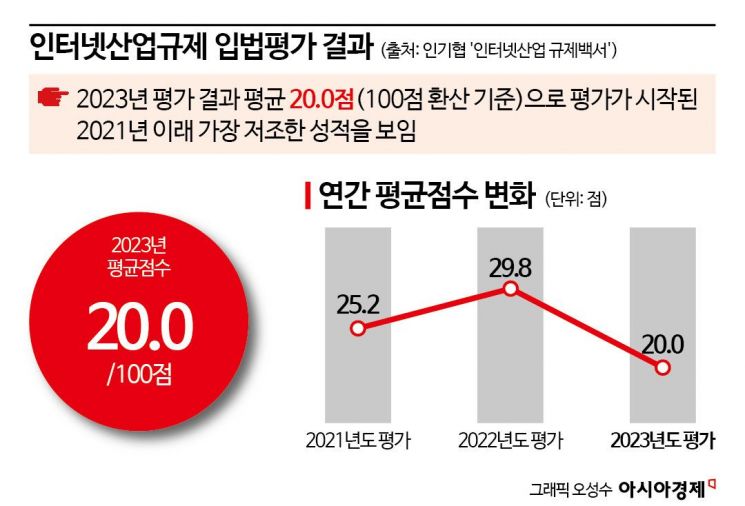
The evaluation criteria included △term definitions (28 points) △constitutional compliance (18.4 points) △understanding of industry and technology (16.2 points) △administrative convenience (20.8 points) △jurisdictional issues (26.6 points) △possibility of self-regulation (15.7 points), with scores declining in all categories compared to the previous year. KICA pointed out, "Despite regulatory proposals being steadily discussed in the 21st National Assembly, there is a low understanding of the internet industry and foundational technologies, and regulatory proposals lacking constitutional compliance are being introduced."
The OTT, cultural content, and AI sectors were particularly evaluated as having insufficient term definitions. This demonstrated that the bills failed to properly define concepts related to industries and terms that have emerged as mainstays in the digitalized society.
An example is the 'Telecommunications Business Act Amendment' proposed by Yoon Young-chan of the Democratic Party in September 2022. This bill prohibits global OTTs such as Netflix and YouTube from refusing to enter into network usage agreements with incumbent telecommunications operators like KT, SK Broadband, and LG Uplus, or from refusing to pay fair compensation. However, there is no specific standard for 'fair compensation,' which can be interpreted arbitrarily, and concerns were raised that issues such as trade friction with the United States and regulatory burdens on Korean OTTs expanding overseas were not considered.
Even the Ministry of Science and ICT stated regarding this bill, "Defining refusal to pay fair compensation as a prohibited act is inconsistent with the market practice where contracts are autonomously made between operators," and expressed concern that "it could broadly affect cases where contracts are smoothly concluded without compensation disputes."
KICA stated, "While discussions on existing bills are delayed, a flood of bills lacking substantive improvements has emerged." They added, "As legislative activities targeting the internet industry are active, we expect more sophisticated and expert bills year after year, but the opposite results continue."
© The Asia Business Daily(www.asiae.co.kr). All rights reserved.
![Clutching a Stolen Dior Bag, Saying "I Hate Being Poor but Real"... The Grotesque Con of a "Human Knockoff" [Slate]](https://cwcontent.asiae.co.kr/asiaresize/183/2026021902243444107_1771435474.jpg)
















