Q1 GDP Growth at 1.6% 'Below Expectations'
Core PCE Inflation Up 3.7%
Rising Treasury Yields... "Only One Rate Cut Expected This Year"
Yellen: "US Economy Still Strong... Inflation on Decline Path"
Although the US growth rate in the first quarter of this year slowed more than expected, inflation was found to have accelerated. Despite the economy cooling due to accumulated high-intensity tightening, prices have increased at a faster pace, raising fears of stagflation (rising prices amid economic slowdown). The market now expects the Federal Reserve's (Fed) rate cut timing to be delayed from September to November or December. Treasury yields surged, and the New York stock market fell sharply.
US Q1 Growth Rate Falls Short of 1.6% Forecast... Inflation Rebounds

According to the US Bureau of Economic Analysis (BEA) on the 24th (local time), the preliminary real gross domestic product (GDP) growth rate for the first quarter was recorded at an annualized rate of 1.6% quarter-on-quarter. This marked a significant slowdown compared to the revised 3.9% in the fourth quarter of last year and fell well below expert forecasts. Earlier, Bloomberg predicted a 2.5% GDP growth rate for Q1, while the Wall Street Journal (WSJ) and Dow Jones expected 2.4%. The growth rate declined as consumer and government spending slowed. Consumer spending, which accounts for two-thirds of the US economy, increased by 2.5% in Q1, falling short of the market forecast of 3%.
On the other hand, inflation remained hot despite the benchmark interest rate rising to 5.25-5.5%, the highest level in 23 years. The core personal consumption expenditures (PCE) price index, which excludes volatile food and energy prices and shows the underlying trend of inflation, rose 3.7% in Q1, exceeding the forecast of 3.4%. The core PCE inflation rate for January and February was revised upward, and the March increase is also expected to have rebounded. The core PCE price index is the inflation indicator most closely watched by the Fed. Inflation in the services sector, excluding housing and energy, rose 5.1%, doubling the rate from the previous quarter.
Jim Beard, Chief Investment Officer (CIO) at Plante Moran Financial, said, "The combination of slowing growth and sticky inflation undoubtedly increases whispers of potential stagflation risk," adding, "This will potentially make the Fed's mission more complicated."
"Only One Rate Cut Expected This Year"
As inflation continues to soar, the market's expectations for the timing of rate cuts are again being pushed back. According to the Chicago Mercantile Exchange (CME) FedWatch, the federal funds futures market on this day reflected a 32% chance that the Fed will cut rates by at least 0.25 percentage points at the July Federal Open Market Committee (FOMC) meeting, down from 44% the previous day. The probability of a 0.25 percentage point or more rate cut in September fell from 69% the previous day to 59% on this day. Investors initially expected six rate cuts this year after Fed Chair Jerome Powell signaled a pivot at the December FOMC last year, but some now speculate that there may be only one cut in November or December, or possibly none at all.
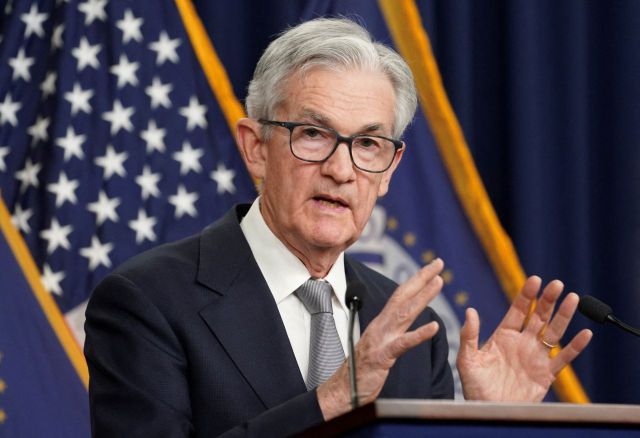
Washington-based policy analysis firm LH Meyer predicted that the Fed will cut rates once at the December FOMC meeting. This is a further delay from their earlier revision from three cuts starting in June to two cuts starting in September. An LH Meyer analyst said, "We expect inflation to still be heading toward 2%, and the Fed is moving toward rate cuts, with cuts expected this year," but added, "However, the number of cuts this year is moving toward fewer."
There are also views that there may be no rate cuts this year. Olu Sonola, Chief US Economist at global credit rating agency Fitch, said, "If growth continues to slow gradually and inflation rises strongly in the wrong direction again, rate cuts by the Fed this year will increasingly seem impossible."
Yellen: "US Economy Still Strong... Inflation on a Downward Path"
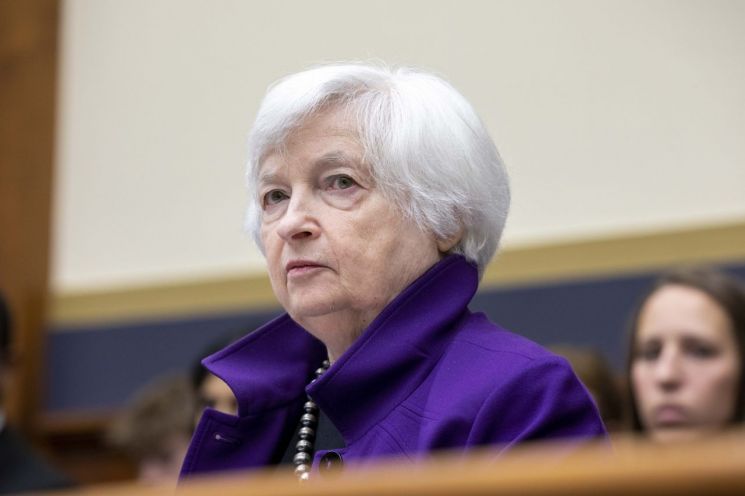
Meanwhile, US Treasury Secretary Janet Yellen expressed the view that the US economy remains strong and inflation will ease to more normal levels. In an interview with foreign media on the day, regarding Q1 GDP growth and the core PCE price index, Yellen said, "Looking at the fundamentals, it is consistent with inflation continuing to decline to normal levels," adding, "There is no reason for unemployment to rise to lower inflation. The data shows me that inflation is on a downward path." She continued, "What I pay most attention to is the strength of consumer spending and investment spending," adding, "These two components of final demand matched last year's growth rate, showing the fundamental strength of a sustained and strong US economy." She also suggested that the Q1 growth rate could be revised upward.
The market is focusing on the March PCE price index to be released on the 26th and the FOMC scheduled from the 30th of this month to the 1st of next month. With Chair Powell effectively signaling a delay in rate cuts due to inflation concerns, it is expected that the FOMC will provide clues about the future path of interest rates.
Meanwhile, after the release of Q1 GDP and inflation indicators on this day, Treasury yields surged and the New York stock market fell across the board. The 2-year Treasury yield, sensitive to monetary policy, briefly surpassed 5% during the session and is currently at 4.99%, up 5 basis points (1bp = 0.01 percentage points) from the previous trading day. The 10-year US Treasury yield, a global bond yield benchmark, rose 5 basis points to around 4.7%. Both the 2-year and 10-year yields are at their highest levels since November last year. The three major New York stock indices all declined. The Dow Jones Industrial Average fell 0.98%, while the S&P 500 and Nasdaq indices dropped 0.46% and 0.64%, respectively.
© The Asia Business Daily(www.asiae.co.kr). All rights reserved.
![Clutching a Stolen Dior Bag, Saying "I Hate Being Poor but Real"... The Grotesque Con of a "Human Knockoff" [Slate]](https://cwcontent.asiae.co.kr/asiaresize/183/2026021902243444107_1771435474.jpg)

















