Interview at the Korean Institute of Chemical Engineers Conference on the 25th
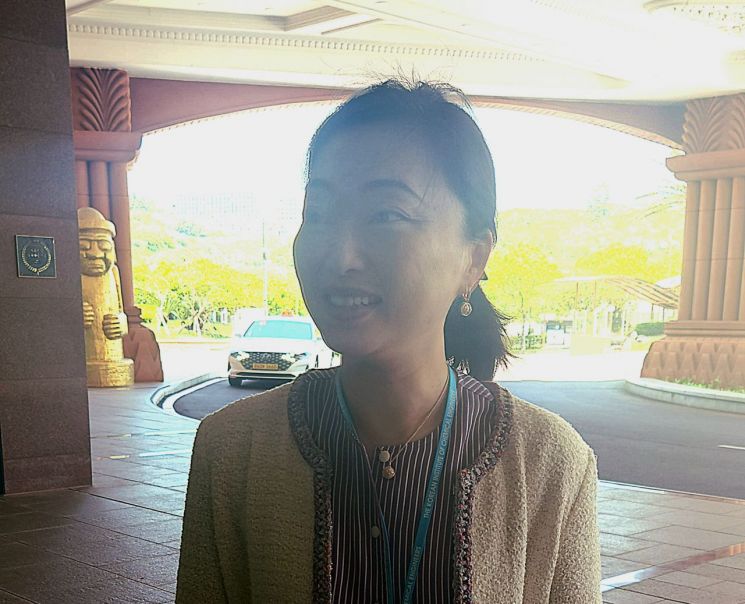 Professor Shirley Meng of the Pritzker Department of Molecular Engineering at the University of Chicago, USA, is being interviewed by a reporter at the Korean Institute of Chemical Engineers Spring Conference held on the 25th at the Jeju International Convention Center. Photo by Donghoon Jung
Shirley Meng, a world-renowned expert in the battery field and a professor at the University of Chicago, USA, cited Korea as a country with great strengths in the commercialization of solid-state batteries.
On the 25th, at the Korean Institute of Chemical Engineers conference held at the Jeju International Convention Center, Professor Shirley Meng of the Pritzker Department of Molecular Engineering at the University of Chicago told reporters, "Korea has a very significant advantage in the commercialization of solid-state batteries," adding, "Not only can they manufacture battery equipment and install facilities, but they also possess know-how for mass production."
Professor Meng is recognized as a global authority in the field of solid-state batteries. She has authored over 300 research papers in the battery field, including the 2021 collaboration with LG Energy Solution on 'room-temperature operated long-life solid-state batteries.' She has served as a senior scientist at the Argonne National Laboratory under the U.S. Department of Energy (DOE) and has been selected as a fellow of the American Association for the Advancement of Science.
Solid-state batteries refer to batteries composed entirely of solid materials. The electrolyte, which transfers ions between the cathode and anode, is replaced with a solid instead of a liquid. Solid electrolytes are more resistant to shocks and damage compared to liquids and also act as partitions, allowing for the minimization or elimination of separators. This enables the battery to be lighter or to increase energy density by adding more cathode active material in the freed-up space.
Samsung SDI, a domestic battery cell manufacturer, announced its mass production plan for 2027 at 'InterBattery' last month and stated that it will finalize detailed mass production plans within the first half of this year. Previously, Toyota, a complete vehicle manufacturer, was known to be the closest to mass-producing solid-state batteries, but Samsung SDI is now specifying its mass production timeline. LG Energy Solution and SK On have also announced plans for commercialization around 2030. Professor Meng said, "Samsung excited people this year with its solid-state mass production plan," adding, "Although it will take some time due to the different production system from conventional lithium-ion batteries, I believe it will eventually be commercialized. I am very optimistic."
The weakness of solid-state batteries, considered next-generation batteries, is their high production cost. The core material, solid electrolyte, is currently priced hundreds of times higher than conventional electrolytes. This has led to skepticism about the feasibility of mass production. Professor Meng said, "Over the past decade, the price of solid electrolytes has dropped to about one-fifth," explaining, "This is because more companies like Solid Power in the U.S. are establishing mass production systems, and I believe prices will continue to decrease."
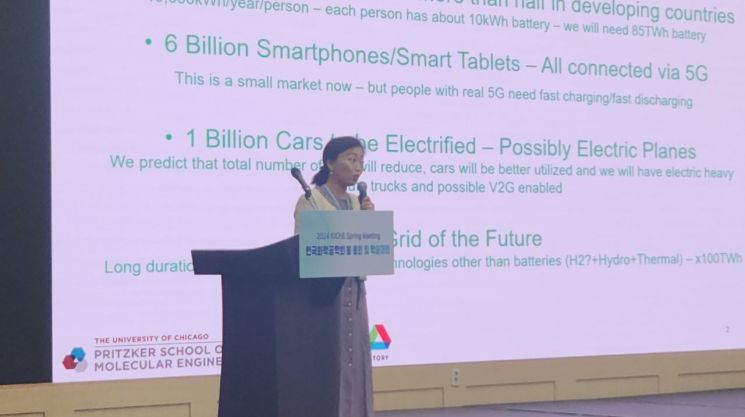 Professor Shirley Meng of the Pritzker Department of Molecular Engineering at the University of Chicago is delivering a keynote speech at the Spring Conference of the Korean Institute of Chemical Engineers held on the 25th at the Jeju International Convention Center. Photo by Donghoon Jeong
He viewed solid-state batteries as a premium version of the battery platform. Professor Meng emphasized, "Mid- to low-priced cars do not need vehicles that can travel 500 miles (about 800 km) on a single charge, but high-end cars do." He continued, "In the early stages of solid-state battery commercialization, they will be used in small IoT (Internet of Things) products like the Apple Watch, but eventually, they will be used in electric vehicles," adding, "Thanks to the high energy density, I believe it will provide automakers with an opportunity to completely redesign electric vehicles."
Invited as a keynote speaker at the Korean Institute of Chemical Engineers Spring Conference, Professor Meng emphasized next-generation battery technologies such as solid-state batteries and sodium batteries. He said, "It is important for people to recognize that batteries are no longer disposable items, and to reduce carbon emissions, developing long-life batteries is necessary rather than recycling. They should be able to be charged at least 10,000 times," adding, "Lithium-ion batteries are not suitable for environmentally friendly future batteries, and sodium batteries and solid-state batteries will be the next-generation batteries."
© The Asia Business Daily(www.asiae.co.kr). All rights reserved.
![Clutching a Stolen Dior Bag, Saying "I Hate Being Poor but Real"... The Grotesque Con of a "Human Knockoff" [Slate]](https://cwcontent.asiae.co.kr/asiaresize/183/2026021902243444107_1771435474.jpg)

















