Production Decrease Due to Late March Cold and Late April Frost Damage
No Sharp Temperature Drop Expected Until Early May
This year, the blooming of major fruits such as apples, pears, and peaches has proceeded smoothly, indicating favorable growth conditions. The government expects that if weather conditions remain good, there will be no significant disruption to apple production.
The Ministry of Agriculture, Food and Rural Affairs announced on the 25th that the major fruit trees, including apples, pears, and peaches, are currently growing well without any cold damage.
According to the ministry, last year, abnormal high temperatures in March, when fruit trees begin to grow with flower bud sprouting, caused blooming to occur 2 to 15 days earlier than usual (April 11?27), between March 29 and April 23. Subsequently, cold damage during the blooming period, such as flower bud death and poor fruit set caused by late March low temperatures and late April frost, was a major factor in reduced production.
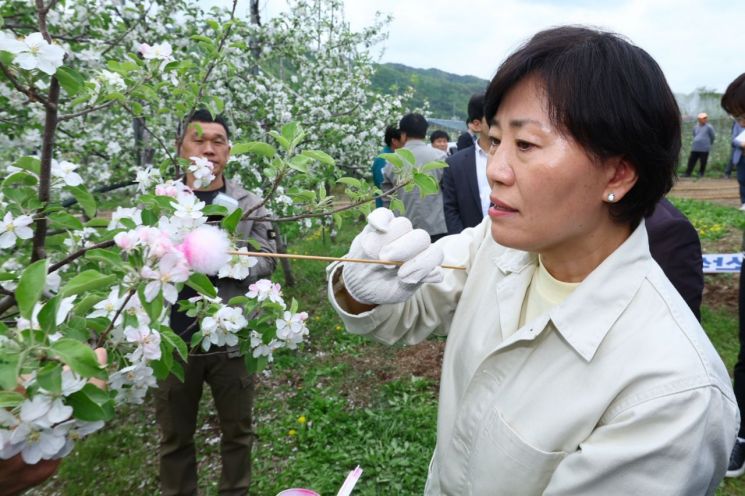 Song Mi-ryeong, Minister of Agriculture, Food and Rural Affairs, visited apple farms and the Fruit Pollen Bank at the Agricultural Technology Center in Mungyeong, Gyeongbuk, on the 21st to inspect the supply status of fruit pollen and the actual conditions of apple growth management.
The average temperature in March this year (7.2℃) was slightly higher than the usual average (6.5℃) but lower than last year (9.7℃). Blooming periods vary by region, occurring 2 to 14 days earlier than usual, but are analyzed to be 4 days earlier or 8 days later than last year. However, unlike last year, there have been no sudden abnormal low temperatures or frost so far this year, and no sharp temperature drops are expected until early May.
Looking at major fruit crops, apples are currently in full bloom, and blooming is progressing smoothly nationwide. Park Yeon-sun, Secretary General of the Korea Apple Association, said, "This year's growth and blooming are at a normal favorable level, and if weather conditions remain good, we expect no major disruptions in apple production."
However, some farms have reported a slight decrease in the amount of blooming compared to usual. The Ministry of Agriculture, Food and Rural Affairs estimates this is due to poor flower bud differentiation caused by last year's adverse weather conditions. Most apple trees cultivated domestically produce 300 to 500 flower buds per tree. A ministry official explained, "Considering that apple growers perform thinning (removing flowers to achieve an appropriate fruit set) and fruit thinning (removing excess fruits to leave only an appropriate amount) to leave about 100 to 150 fruits per tree for better marketability, experts believe this is not a significant problem," adding, "We are guiding farmers to adjust fruit set through thinning and fruit thinning to prevent production disruptions."
Pears began full bloom around April 4, and artificial pollination for stable fruit set has been completed, with normal fruit setting underway. Peaches, which had poor yields last year, also bloomed normally from early April, and thinning work is currently in progress.
To proactively manage tree conditions this year, the Ministry of Agriculture, Food and Rural Affairs formed and is operating a 'Fruit Tree Growth Management Council' since January, involving the Rural Development Administration, local governments in major production areas, the NongHyup (National Agricultural Cooperative Federation), and commodity self-governing bodies. Through this council, growth conditions such as weather and blooming periods are monitored, and preventive measures against cold damage are regularly checked in fruit production areas, including timely application of cold damage prevention agents, early installation of disaster prevention facilities, and removal of fire blight ulcers.
Additionally, on the 25th, the ministry held the third inspection meeting of the Fruit Tree Growth Management Council to review the potential impacts of recent frequent rainfall on fruit tree growth and discuss measures such as timely notifications for pesticide application and strengthening on-site guidance to prepare for risks like pests and diseases.
Park Soon-yeon, Director of Distribution and Consumption Policy at the Ministry of Agriculture, Food and Rural Affairs, stated, "We plan to proactively inspect and manage risk factors at each growth stage so that the public can enjoy fruits, including apples, without burden this year," adding, "To establish a stable fruit production base in response to climate change in the long term, we will also steadily implement the 'Fruit Industry Competitiveness Enhancement Plan' announced on the 3rd."
© The Asia Business Daily(www.asiae.co.kr). All rights reserved.
![Clutching a Stolen Dior Bag, Saying "I Hate Being Poor but Real"... The Grotesque Con of a "Human Knockoff" [Slate]](https://cwcontent.asiae.co.kr/asiaresize/183/2026021902243444107_1771435474.jpg)















