"Residents and Medical Associations Must Join as Members"
Medical Community: "Special Committee Cannot Resolve Current Situation"
The Presidential Commission on Medical Reform (the Commission) officially launched on the 25th and held its first meeting. While the medical community has expressed the need for a different form of discussion and announced their intention to abstain from the Commission, Chairman Noh Yeon-hong of the Medical Reform Special Committee urged the participation of doctors and resident organizations.
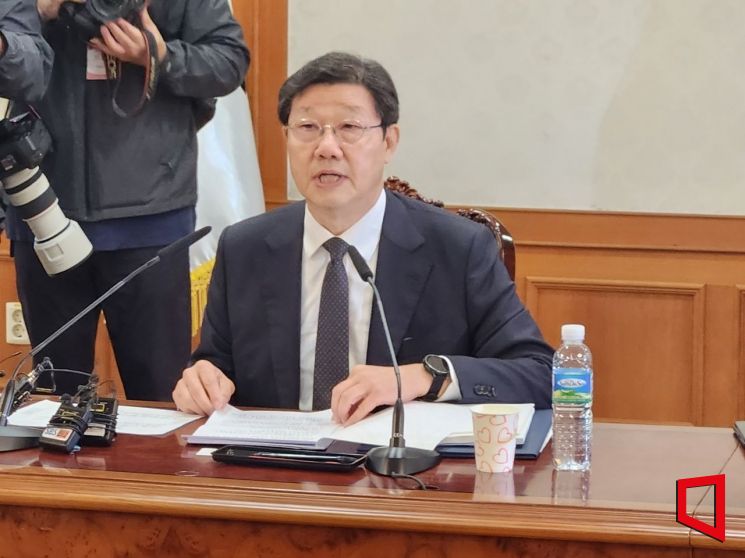 No Yeonhong, Chairman of the Presidential Special Committee on Medical Reform, is delivering an opening remark at the special committee meeting held at 10 a.m. on the 25th at the Government Seoul Office in Jongno-gu, Seoul. Photo by Choi Taewon peaceful1@
The Commission held its first meeting at 10 a.m. at the Government Seoul Office in Jongno-gu, Seoul. The Commission plans to discuss issues such as reforming the training environment for residents, restructuring the compensation system for essential medical services, improving the management and system of non-reimbursable and indemnity insurance, improving the medical delivery system to alleviate concentration in large hospitals, and establishing a safety net and compensation system for medical accidents. According to the Ministry of Health and Welfare, the first meeting is expected to cover major agenda items and the operation plan of the Commission.
However, direct discussions on the scale of medical school admissions are not expected to take place within the Commission. Park Min-soo, the second vice minister of the Ministry of Health and Welfare, said in a phone call on the day, “The Commission will discuss institutionalizing periodic reviews of medical school quotas,” adding, “The Commission will not discuss the medical school quotas themselves.”
Chairman Noh Yeon-hong stated in his opening remarks, “The crisis in regional and essential medical care stems from complex structural problems in our country’s medical system that have not been resolved for a long time,” and added, “Medical reform is not limited to the healthcare environment but is also related to education, regional issues, science and technology, and society as a whole.”
He continued, “We are well aware that legislation and financial investment must accompany the creation of a medical environment where both patients and doctors can feel secure,” and added, “Although it will be difficult to resolve the complex problems that have not been realized despite long-standing policy attempts in the short term, I will do my best together with the Commission members to contribute to the development of the healthcare system.”
He also urged the medical community, which had announced its intention to abstain from the Commission, to participate. He said, “I hope that residents and doctor organizations, who are the main parties in medical reform, will promptly join the Commission as members and work together to improve the structural problems of our country’s medical system.”
The Commission consists of 20 private members, including Chairman Noh Yeon-hong, president of the Korea Pharmaceutical and Bio-Pharma Manufacturers Association, 15 members recommended by 10 provider organizations and 5 consumer organizations, and 5 experts, as well as heads of 6 central government agencies. The term of office is one year.
Provider organizations participating include the Korean Hospital Association, Korean Association of Small and Medium Hospitals, Council of National University Hospitals, Korean Pharmaceutical Association, Korean Nurses Association, Korean Oriental Medicine Association, and Korean Dental Association. Consumer organizations include the Korea Patient Group Federation, Korea Consumer Agency, Korea Employers Federation, Saerogochim Workers’ Council, and Citizens’ Coalition for Economic Justice. Additionally, five experts in healthcare, economics, and law, as well as government members including the ministers of the Ministry of Economy and Finance, Ministry of Education, Ministry of the Interior and Safety, Ministry of Justice, Ministry of Health and Welfare, and the chairman of the Financial Services Commission, also participate in the Commission.
However, the medical community, including the Korean Medical Association and the Korean Intern Resident Association, declared their non-participation in the Commission, leading to criticism that the Commission is only half complete. Kim Seong-geun, the Korean Medical Association’s emergency committee media spokesperson, announced on the 20th the intention to abstain from the Commission, stating, “The Commission is a committee that physically cannot resolve the current situation, so discussions should be held in a different form of organization,” and “We have continuously expressed that committees such as the doctor number estimation committee should be operated separately on a one-to-one basis.”
The Korean Intern Resident Association also maintains its stance of non-participation in the Commission. A representative of the association said, “We have no intention of participating in the Commission,” and added, “Looking at the composition of the Commission, from the medical community’s perspective, it can only be seen as an unreasonable negotiation forum.”
Medical school professors also hold the view that before the Commission, the Korean Medical Association and the Korean Intern Resident Association should be called to the negotiation table. Bang Jae-seung, an emergency committee member of the Seoul National University College of Medicine Professors’ Association, said, “I do not think the Commission will function properly without the Korean Medical Association and the Korean Intern Resident Association,” and added, “The government should stop pushing forward next year’s medical school quota increase policy, which is being forced for the sake of government pride regardless of the deaths of the public, patients, and doctors, and call the Korean Medical Association and the Korean Intern Resident Association to the negotiation table.”
Kim Chang-su, chairman of the National Association of Medical School Professors, criticized the Commission, saying it is “an organization like the Red Guards during China’s Cultural Revolution era.”
© The Asia Business Daily(www.asiae.co.kr). All rights reserved.
![Clutching a Stolen Dior Bag, Saying "I Hate Being Poor but Real"... The Grotesque Con of a "Human Knockoff" [Slate]](https://cwcontent.asiae.co.kr/asiaresize/183/2026021902243444107_1771435474.jpg)















