Designated as Treasure Along with 'Namwon Daeboksa Temple Bell'
Master Kang Sehwang Admired It as a 'Divine Brushwork'
"Demonstrates Uniqueness and Creativity in the History of Painting"
The 'Kim Hongdo-style Seowonajipdo folding screen,' which presented a new model of Seowonajipdo folding screens, and the 'Namwon Daeboksa Bronze Bell,' which inherits the Goryeo style, are designated as treasures. The Cultural Heritage Administration announced on the 25th that after collecting opinions from various sectors for over two months and undergoing a review by the Cultural Heritage Committee, the designation was finalized.
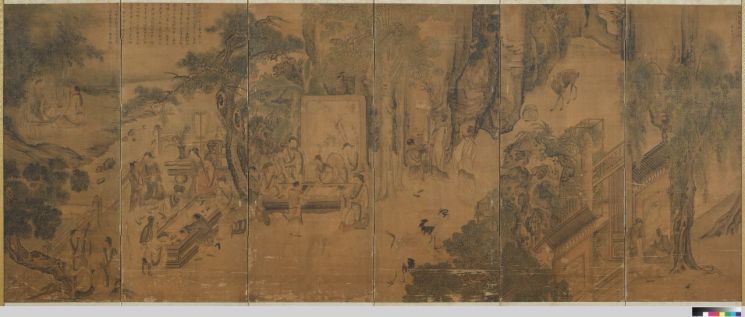
The former is a six-panel folding screen completed in the 2nd year of King Jeongjo's reign in the Joseon Dynasty (1778). It is housed at the National Museum of Korea. The theme is 'Seowonajip (西園雅集).' It depicts the literary and artistic activities enjoyed by Wang Seon, the son-in-law of Emperor Yingzong of the Northern Song Dynasty (king's son-in-law or princess's husband), along with several literati such as So Sik, Lee Gongrin, and Mi Bul in the courtyard of a house in the capital Kaifeng in 1087.
The imagery borrows from the works of Gu Yong (1509?1551) of the Ming Dynasty, which were introduced to 17th-century Joseon. However, the background elements such as willow trees, rocky cliffs, and pine trees are painted with bold brushstrokes, giving the scene vividness. It was reborn as a Joseon Seowonajipdo by incorporating auspicious symbols like deer and cranes.
On the upper parts of the 5th and 6th panels, there is a 14-line inscription by Kim Hongdo's (1745??) teacher, Kang Se-hwang (1713?1791), recording the production background and appreciation. It praises the folding screen, completed in September 1778, and lauds his disciple as a 'divine brush.' The Cultural Heritage Administration evaluated it as "a valuable literary resource that helps understand Kim Hongdo's artistic world."
This work represents the ahhoe (雅會, literary gatherings) culture that flourished in the late Joseon period and is an important piece in art history as a dated work (with a record of production year) that confirms Kim Hongdo's painting style at that time.
It is also noteworthy that it presented a new model of the Seowonajipdo folding screen, which was popular at the time. The Cultural Heritage Administration explained, "It localized and recreated a painting style originating from China," and added, "It is an important standard showing the uniqueness and creativity of the painting history of that time, thus holding high artistic and historical value."
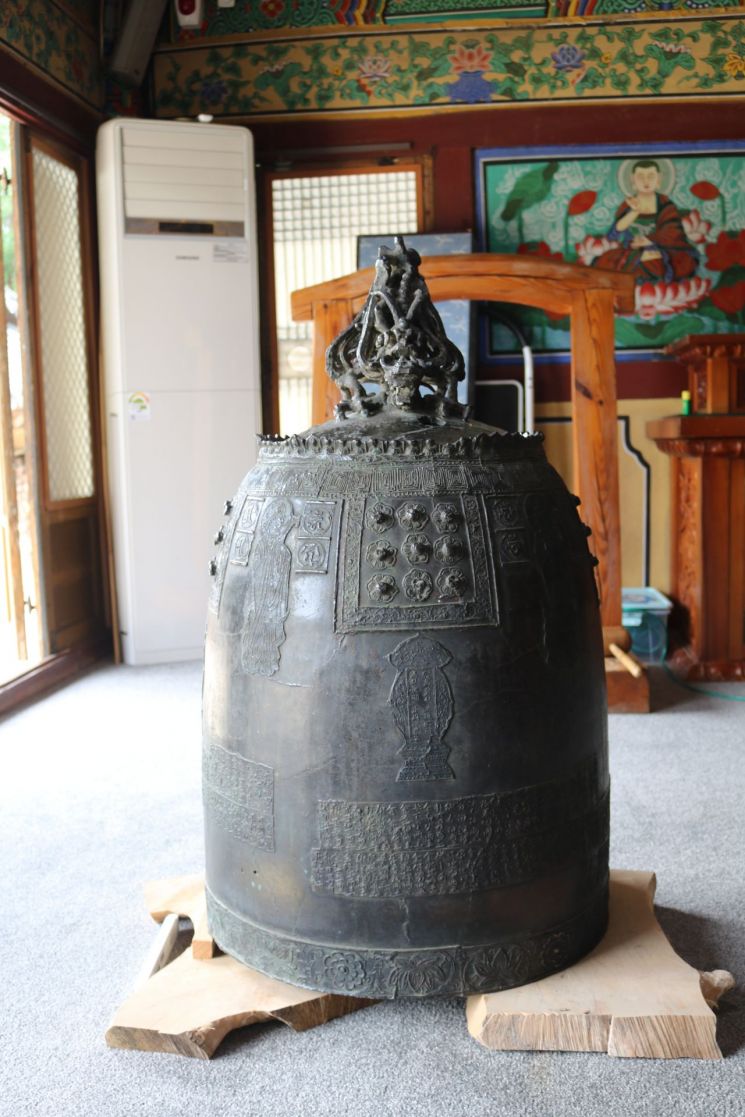
The Namwon Daeboksa Bronze Bell is a bronze bell jointly made by Jeongwoo and Shinwon in the 13th year of King Injo's reign in the Joseon Dynasty (1635). The bell's body bears a jujonggi (a record containing the maker, materials, etc.), which reveals detailed production background. It is presumed that it was originally made to be enshrined at Yeongwonsa Temple, but since that temple was abolished, it was relocated to the currently enshrined Namwon Daeboksa Temple.
Jeongwoo and Shinwon were monk bell casters (鑄鍾匠) who were actively working in Gyeonggi-do, Chungcheong-do, and Jeolla-do, where reconstruction projects were underway in the 17th century. The Daeboksa Bronze Bell is their early work. It clearly inherits the Goryeo Dynasty bronze bell style. Representative examples include the standing lotus petal band decoration (立狀蓮瓣文帶) on the bell's shoulder?the decorative boundary between the top plate and the shoulder?and the standing bodhisattva figure descending on clouds.
The Cultural Heritage Administration added, "The depiction of figures on the standing lotus petal band, staged like a scene of yeonhwahasaeng (蓮花下生, the Buddhist concept that all beings are born from lotus flowers in the Pure Land), and the wonpae (prayer plaques used in Buddhist rituals) expressing wishes for the propagation of Buddhism, reflect the period's characteristics and the artist's individuality." They further evaluated, "The style and activity process of Jeongwoo and Shinwon, as well as the various histories inscribed on the jujonggi, give it great historical and academic value."
© The Asia Business Daily(www.asiae.co.kr). All rights reserved.
![Clutching a Stolen Dior Bag, Saying "I Hate Being Poor but Real"... The Grotesque Con of a "Human Knockoff" [Slate]](https://cwcontent.asiae.co.kr/asiaresize/183/2026021902243444107_1771435474.jpg)
















