US "What Exactly Is Russia Hiding?"
Russia "A Political and Foolish Agenda"
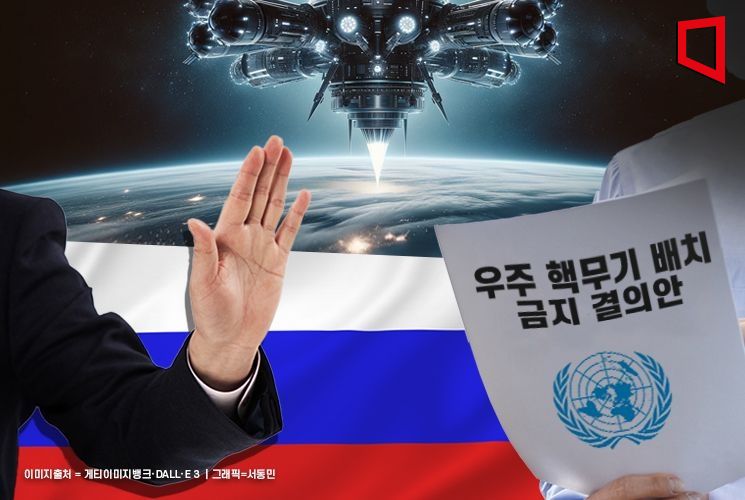
Russia exercised its veto power at the United Nations Security Council (UNSC) against a resolution proposed by the United States to ban the deployment of nuclear weapons in outer space. While the U.S., which has raised suspicions about Russia's development of anti-satellite weapons, strongly opposed the veto, Russia condemned the U.S., calling it a political agenda. With the 1967 Outer Space Treaty, which prohibited the arms race in outer space, effectively weakened, there are concerns that the conflict between the U.S. and Russia could extend into space.
According to the New York Times (NYT) on the 24th (local time), at the UNSC meeting held at the UN headquarters in New York that day, a resolution proposed by the U.S. and Japan to ban the competition for the use of weapons of mass destruction and dangerous nuclear weapons in outer space was vetoed by Russia. The resolution was supported by 13 of the 15 UNSC member states, but was ultimately rejected as Russia, a permanent member, opposed it and China abstained.
The U.S. government strongly opposed Russia's veto. Linda Thomas-Greenfield, U.S. Ambassador to the UN, said immediately after the UNSC vote, "Russian President Vladimir Putin said he had no intention of deploying nuclear weapons in outer space, but Russia's veto raises questions about whether it is hiding other intentions," adding, "It is incomprehensible that they vetoed a resolution that simply reaffirms existing rules."
Preventing the deployment of weapons of mass destruction in outer space is already included in the 1967 international treaty signed by the U.S., Russia, and others, known as the Outer Space Treaty.
The U.S. criticized Russia, saying there is no reason for Russia to veto a resolution that merely confirms compliance with this treaty.
However, Russia condemned the resolution itself as stemming from the U.S.'s political intentions. Vasily Nebenzya, Russia's Ambassador to the UN, called it a "very political and foolish agenda," stating, "We want to ban all kinds of weapons from being deployed in outer space. We will draft our own resolution to maintain peace in space and discuss it with the council members."
Subsequently, Russia, together with China, proposed an amendment to permanently prevent all countries from deploying weapons in outer space or using force threats there, but this proposal was also rejected by the UNSC. With both the U.S. and Russia's proposals rejected, concerns have been raised that the foundation of the Outer Space Treaty itself is significantly shaken.
Earlier, both the U.S. and Russia had stated they were in talks to discuss the ban on deploying nuclear weapons in space. On the 11th, Sergey Ryabkov, Deputy Foreign Minister of Russia, said, "We have thoroughly presented our views at all levels, and there should be no weapons or offensive weapons in space."
Concerns about Russia's use of anti-satellite weapons, raised by U.S. and Western intelligence agencies, are expected to further spread. Earlier in February, the U.S. government warned that Russia is developing nuclear weapons for anti-satellite purposes and could carry out electromagnetic pulse (EMP) attacks against satellites in outer space.
© The Asia Business Daily(www.asiae.co.kr). All rights reserved.
![Clutching a Stolen Dior Bag, Saying "I Hate Being Poor but Real"... The Grotesque Con of a "Human Knockoff" [Slate]](https://cwcontent.asiae.co.kr/asiaresize/183/2026021902243444107_1771435474.jpg)















