Achievements Beyond Existing Synthesis Conditions and Size Constraints
Potential Applications in the Quantum Field Also Discovered
The common belief that diamonds are produced under high temperature and high pressure conditions has been overturned by a domestic research team. It has also been confirmed that diamonds can be utilized in the quantum field.
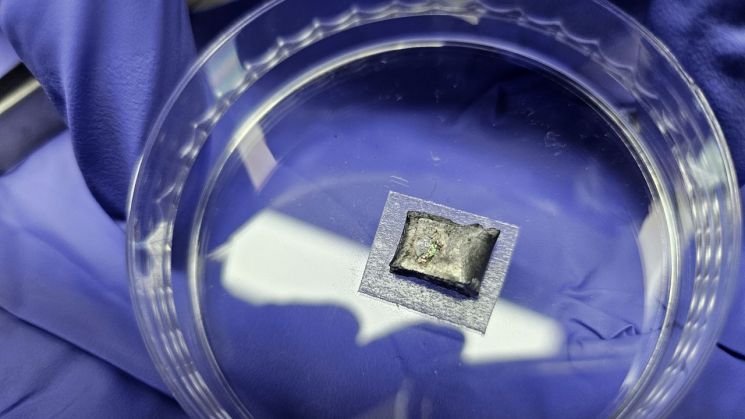
The research team led by Rodney Luoof, head of the Multidimensional Carbon Materials Research Group at the Institute for Basic Science (IBS, President Noh Do-Young), announced on the 25th that they have succeeded for the first time in the world in synthesizing diamonds at atmospheric pressure (1 atm), an everyday environment, using a liquid metal alloy composed of gallium, iron, nickel, and silicon.
Diamonds are not only gemstones but also have excellent thermal conductivity, hardness, and chemical resistance, making them highly useful as heat conductors in electronic devices, heat dissipation devices that prevent temperature rise in semiconductors, cutting tools, and more.
However, synthesizing such diamonds is quite challenging. Most diamonds are synthesized only under high temperature conditions close to 1300°C to 1600°C and high pressure conditions 50,000 to 60,000 times that of standard atmospheric pressure (1 atm). The size of synthesizable diamonds is also limited to about 1 cubic centimeter.
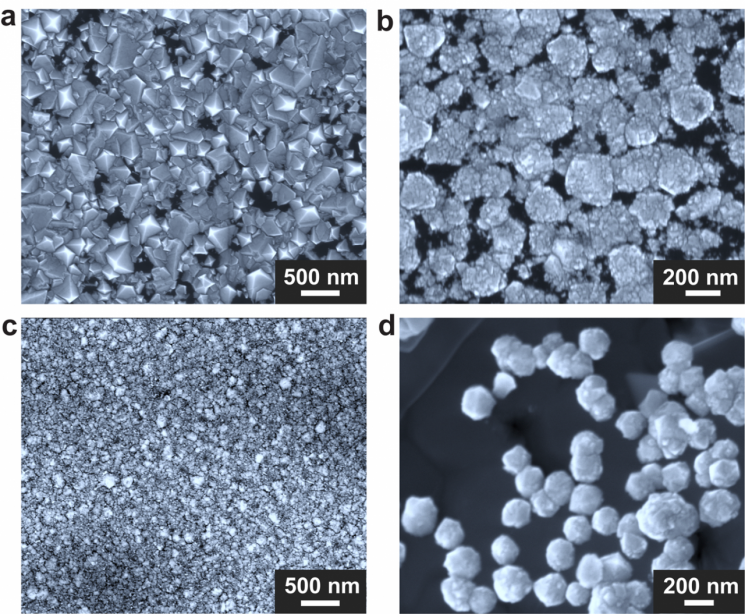
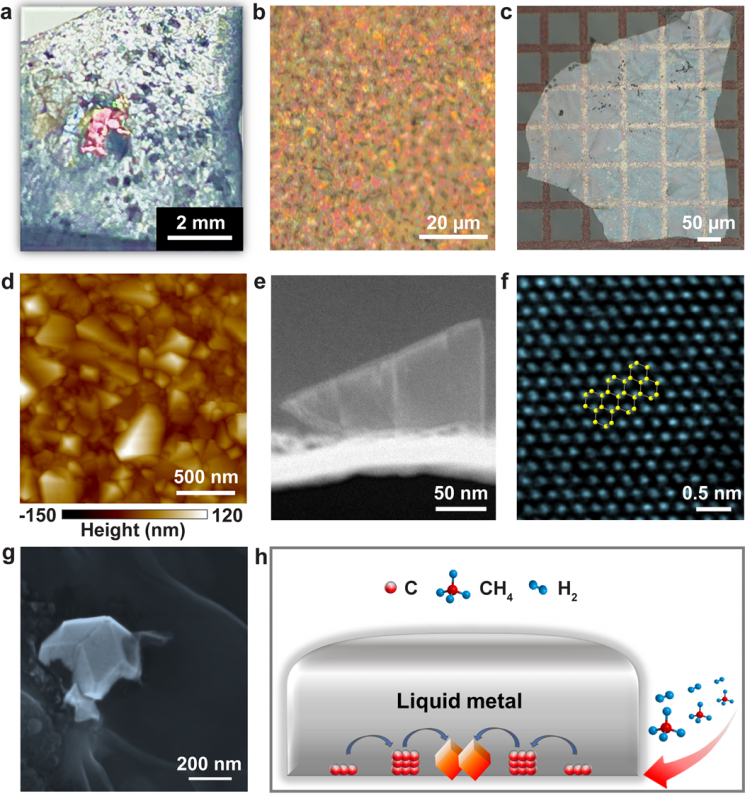
The IBS research team broke these constraints and synthesized diamonds for the first time at a temperature of 1025°C and a pressure of 1 atm.
Additionally, through an experiment called ‘photoluminescence spectroscopy,’ which analyzes the wavelength of light emitted when light is shone on a material, the team discovered a ‘silicon vacancy color center’ structure within the diamond. This structure is where silicon, one of the components of the liquid metal alloy, is inserted between the carbon-only diamond crystals.
At this time, the silicon vacancy color center structure possesses quantum-scale magnetism, resulting in high magnetic sensitivity and exhibiting quantum phenomena (quantum characteristics). This is expected to be applied in the future to the development of nanoscale magnetic sensors and the quantum computing field.
Co-corresponding author Research Fellow Seong Won-Kyung stated, “Based on this research result, it has become possible to produce diamonds more easily and in larger sizes. We will open the way to synthesize diamonds under broader experimental conditions by finding ways to replace the components of the liquid metal alloy with other metals,” expressing expectations for follow-up research.
 Rodney Ruoff, Director of the Multidimensional Carbon Materials Research Group (Co-corresponding Author)
Rodney Luoof, the research group leader, said, “We have acquired the fundamental technology for diamond synthesis that can be directly applied to major industries such as semiconductors and mechanical industries. It is expected that Korea will rapidly expand applications and lead related industries in the future.”
The research results were published online on the 25th at 0:00 (Korean time) in the world’s most prestigious international journal, Nature (IF 64.8).
© The Asia Business Daily(www.asiae.co.kr). All rights reserved.
![Clutching a Stolen Dior Bag, Saying "I Hate Being Poor but Real"... The Grotesque Con of a "Human Knockoff" [Slate]](https://cwcontent.asiae.co.kr/asiaresize/183/2026021902243444107_1771435474.jpg)


















