The government expressed reluctance to pass the amendment to the "Special Act on Support for Jeonse Fraud Victims and Housing Stability (Special Act)," which includes a 'prior relief, subsequent recovery' plan, citing difficulties in fair value assessment of properties involved in jeonse fraud and securing the necessary funds. It particularly emphasized the need for further discussion and opinion gathering, as the scale of financial input could reach trillions of won.
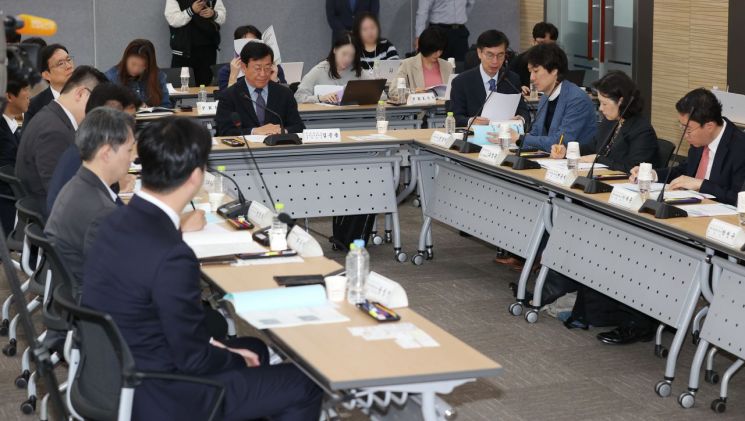 On the morning of the 24th, at the LH Seoul Regional Headquarters in Gangnam-gu, Seoul, Kim Myung-soo, Deputy Director of Research at the Korea Research Institute for Human Settlements (fourth from the left), is speaking at a forum on the achievements and challenges of supporting victims of jeonse fraud. / Photo by Yonhap News
On the 24th, Lee Jang-won, Head of the Jeonse Fraud Victim Support Division at the Ministry of Land, Infrastructure and Transport, said at the "Jeonse Fraud Victim Support Achievements and Challenges Forum" held at the Korea Land and Housing Corporation (LH) Seoul Regional Headquarters in Gangnam-gu, Seoul, "If the current trend continues, the number of victims is expected to rise to 36,000 by May next year, when the special act on jeonse fraud expires," adding, "Assuming an average jeonse deposit of 140 million won per person, the cost would approach 5 trillion won."
This estimate is based on data from about 15,000 individuals recognized as victims by the Jeonse Fraud Victim Support Committee. Lee explained, "This figure is a simple sum of deposits and does not represent a fair value assessment (appraisal value of deposit return claims). It is an estimate based on multiple assumptions."
The 'prior relief, subsequent recovery' approach refers to public institutions such as the Housing and Urban Guarantee Corporation (HUG) purchasing deposit return claims first to refund part of the deposit to victims, then claiming reimbursement from landlords or recovering funds by selling the jeonse fraud properties (through auctions or public sales). Jeonse fraud victims have demanded this approach since the enactment of the special act, but the government has drawn a line, stating there is no precedent for compensating losses arising from private contracts.
Currently, the amendment containing the 'prior relief, subsequent recovery' provision was directly submitted to the plenary session following a unilateral resolution by the opposition party in February. After the opposition's landslide victory in the April 10 general election, the amendment's passage has gained momentum. The amendment allows jeonse fraud victims to apply for public purchase of deposit return claims. It also includes provisions for the purchasing institution to conduct a fair value assessment. The purchase price is set at least at the priority repayment ratio of the deposit under the Housing Lease Protection Act, ensuring victims can recover at least the priority repayment amount.
Regarding this, the Korea Research Institute for Human Settlements (KRHS) expressed concerns that the victim relief provisions in the amendment are ambiguous and that the government's net fiscal expenditure could increase depending on the purchase price of claims. If claims on jeonse fraud properties are bought at prices above the priority repayment amount but the property’s appraised value is too low, fund recovery becomes difficult. For example, for a Seoul property with a jeonse deposit of 100 million won, if there are senior claims, the appraised value of the deposit return claim could be around 20 million won. According to Seoul’s priority repayment amount (55 million won for small tenants with deposits under 165 million won), 35 million won in fiscal resources would be required.
There is a discrepancy between the government and civic groups regarding the estimated financial scale needed for 'prior relief, subsequent recovery.' The National Countermeasure Committee for Jeonse Fraud and Empty Jeonse Victims and the Civic Society Countermeasure Committee for Jeonse Fraud and Empty Jeonse Issues analyzed that the budget required is 487.5 billion won. This estimate is based on a victim survey conducted independently from August to September last year. They assumed 25,000 victims, a 50% ratio of subordinate tenants who are not eligible for priority repayment and thus cannot recover deposits, and an average deposit loss of 130 million won. If the number of victims is increased to 30,000, the cost could reach up to 585 billion won.
However, the government estimates that the funds required for 'prior relief, subsequent recovery' could reach trillions of won. The amendment allows purchase of deposit return claims not only for subordinate tenants who do not receive priority repayment but for all jeonse fraud victims, making it impossible to limit relief to subordinate tenants. Assuming an average deposit of 130 million won per victim, 30,000 victims, and 30% of the deposit as the prior relief amount, the cost would be 1.17 trillion won.
Yoon Sung-jin, Associate Research Fellow at KRHS, said, "Victim types vary greatly, including those who lost the entire deposit, those with large losses, and those with small losses," adding, "Depending on the victim scale and the special act’s application period, there will inevitably be differences in estimating claim values and recovery rates." He also pointed out, "Since the amendment specifies 'jeonse fraud victims' as the target for prior relief and subsequent recovery, victims of trust fraud or unauthorized contracts may fall into a policy blind spot."
Kim Kyu-chul, Director of the Land and Urban Division at the Ministry of Land, Infrastructure and Transport, said, "It is good that alternatives like prior relief and subsequent recovery are being considered from multiple angles, but whether they can be practically implemented requires thorough discussion and opinion gathering."
© The Asia Business Daily(www.asiae.co.kr). All rights reserved.
![Clutching a Stolen Dior Bag, Saying "I Hate Being Poor but Real"... The Grotesque Con of a "Human Knockoff" [Slate]](https://cwcontent.asiae.co.kr/asiaresize/183/2026021902243444107_1771435474.jpg)















