Decades-Long Change in Vehicle Supply Chains Due to Electric Vehicle Transition
International Affairs Also Impact... Production Facility Relocation Becomes Crucial
'Market Shore' Needed to Move Production Facilities to Final Consumer Countries
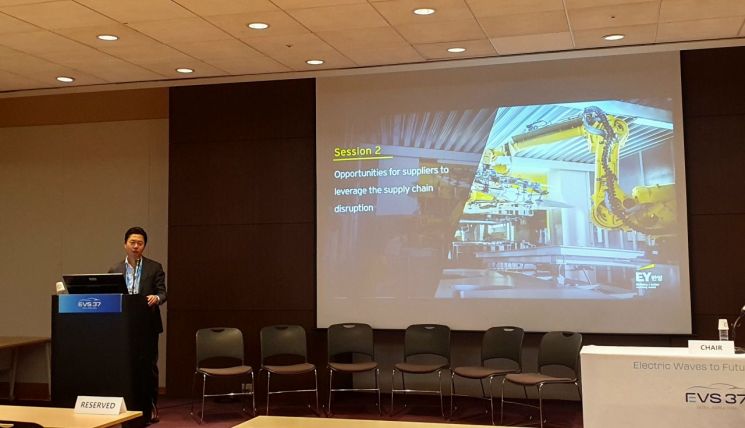
The automotive industry is transitioning from internal combustion engines to electric vehicles (EVs), and as the international geopolitical landscape is being reshaped, supply chain diversification is taking place. There is an analysis that it is necessary to view and respond to this not simply as a crisis but as an opportunity. In particular, the idea of relocating production facilities to the final consumer country, known as 'market-shoring,' is suggested as a viable option to consider.
Youngdae Kwon, a partner at EY Hanyoung, emphasized this on the 24th at the '37th World Electric Vehicle Symposium and Exhibition (EVS37)' held at COEX in Gangnam-gu, Seoul. Partner Kwon stated, "Since the mass production revolution by Ford Motor Company in the early 20th century, the automotive industry has maintained a supply chain that connects parts suppliers, automakers, dealers, and customers for a long time," adding, "This structure, which has been maintained unusually long compared to other industries, has recently begun to change."
He cited geopolitical tensions and the shift to electric vehicles as decisive reasons. Partner Kwon explained, "With elections occurring in the United States and our country, political and international circumstances have changed, and as the proportion of electric vehicles increases, new demand for electronic components has emerged," further stating, "Additionally, the value of infotainment and thermal management systems, which are necessary for both internal combustion engines and electric vehicles, is rising, leading to diversification of the supply chain."
He emphasized the need to view this supply chain transformation as an opportunity rather than a crisis. It is possible to establish suppliers and markets facing shortages as new customers. While adjusting business portfolios, attention should also be paid to relocating production bases to respond to recent uncertainties. A representative example is 'reshoring,' where U.S. manufacturers that had moved overseas are relocating production facilities back to the United States.
Partner Kwon highlighted a new concept called 'market-shoring.' Market-shoring refers to relocating production bases to the final consumer country. Unlike 'near-shoring,' which moves production to neighboring countries, 'off-shoring,' which moves to countries with lower labor costs, or 'on-shoring,' which moves production back to the home country, market-shoring means adapting production to the consumer. However, there are drawbacks. Since it is the final consumer stage country, costs such as labor and electricity may be high, or it may be difficult to secure adequate labor. Regulations may also be stricter depending on the country. Additionally, environmental and construction regulations are complex and strict, requiring acceptance of additional costs.
He explained, "Europe and Japan have large domestic markets, so they have the option to move production facilities to their own countries or demand locations, but the Korean automotive industry mostly has larger overseas markets," adding, "Korean companies can relocate some or all of their production bases to regions where their final customers are located, thereby responding to various regulations that favor domestic production facilities and reducing logistics costs."
© The Asia Business Daily(www.asiae.co.kr). All rights reserved.
![Clutching a Stolen Dior Bag, Saying "I Hate Being Poor but Real"... The Grotesque Con of a "Human Knockoff" [Slate]](https://cwcontent.asiae.co.kr/asiaresize/183/2026021902243444107_1771435474.jpg)















