3,323 KRW in Seoul... 23% Increase from 3 Years Ago
Price Hikes at Franchises like Bareuda Kim Seonsaeng, Kim Ga Ne
Main Cause: Rising Costs of Key Ingredients like Seaweed and Carrots
The price of gimbap, a representative commoner's food, is rising one after another. This is interpreted as a result of the increase in demand for Korean seaweed raw materials, which has driven up the price of seaweed, a key ingredient, along with continued price strength in carrots and other ingredients. As basic gimbap priced in the 4,000 won range becomes common, the difficulties faced by office workers trying to have a simple lunch outside are also increasing.
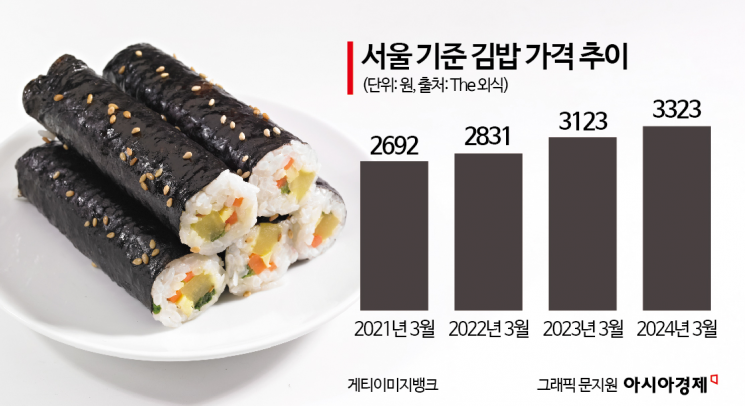
According to the Korean Agro-Fisheries & Food Trade Corporation (aT) dining industry portal 'THE Dining' on the 24th, the average price of one roll of gimbap in Seoul last month was 3,323 won. This is a 23% increase compared to 2,692 won in March 2021, three years ago. The price of gimbap has been on a continuous upward trend since it first exceeded 3,000 won in August 2022.
In particular, the prices of gimbap franchises, which consumers can easily access, are even higher, starting at 4,000 won. Recently, gimbap franchises have been raising their prices one after another. Baruda Kim Seonsaeng raised gimbap prices by 100 to 500 won starting from the 9th. The representative menu item 'Bareun Gimbap' increased from 4,300 won to 4,500 won. Tuna gimbap rose from 5,800 won to 6,300 won, a 500 won increase, and bulgogi gimbap also went up from 6,300 won to 6,500 won, a 200 won increase. Kim Ga Ne Gimbap also raised gimbap prices by 500 to 1,000 won at the end of last year. The representative menu 'Kim Ga Ne Gimbap' increased from 3,900 won to 4,500 won, a 600 won rise, and tuna gimbap rose from 4,900 won to 5,500 won, also a 600 won increase.
The main factor behind the gimbap price increase is the rise in the cost of key ingredients. In particular, the price of seaweed is soaring. According to the aT agricultural product distribution information system, the wholesale price of one pack (100 sheets) of dried seaweed was 10,440 won as of the 23rd. This is a 57.54% increase compared to 6,627 won a year ago.
The rise in seaweed prices is largely due to the explosive increase in demand for Korean seaweed. Recently, seaweed has emerged as an export star product, so much so that it is called the 'black semiconductor.' Moreover, due to abnormal weather and red tides in China and Japan, the raw seaweed material has suffered poor harvests, leading to increased demand for Korean raw seaweed from various regions. Consequently, seasoning seaweed specialists Gwangcheon Kim, Seonggyeong Food, and Daecheon Kim have successively raised seaweed prices.
Among the main ingredients, the price of carrots is also fluctuating wildly. The wholesale price for 20 kg of carrots was 90,080 won as of the 23rd, more than 63% higher than last year's 55,187 won. Just a month ago, it was in the 74,000 won range, so it has risen by more than 21%.
Accordingly, posts considering price increases for items such as gimbap and rice balls containing seaweed flakes are being posted one after another in self-employed communities. One self-employed person said, "Seaweed that used to cost around 7,000 won per pack now exceeds 12,000 won," adding, "We are considering raising gimbap prices." Another self-employed person said, "We apologized to customers but had no choice but to raise prices by 200 to 300 won."
However, there are also complaints about the increase in gimbap prices due to the rise in the price of just one sheet of seaweed. In response, an industry insider explained, "Gimbap is a menu item that requires a lot of labor but has thin margins, so with ingredient costs doubling, we cannot help but consider price increases."
© The Asia Business Daily(www.asiae.co.kr). All rights reserved.


















