"Infringement of Fundamental Rights Due to Insufficient National Climate Measures"
First Public Hearing on Constitutional Complaint
The first public hearing of the constitutional court regarding climate lawsuits claiming that the government's inadequate response to the climate crisis has infringed on the basic rights of the people was held on the 23rd.
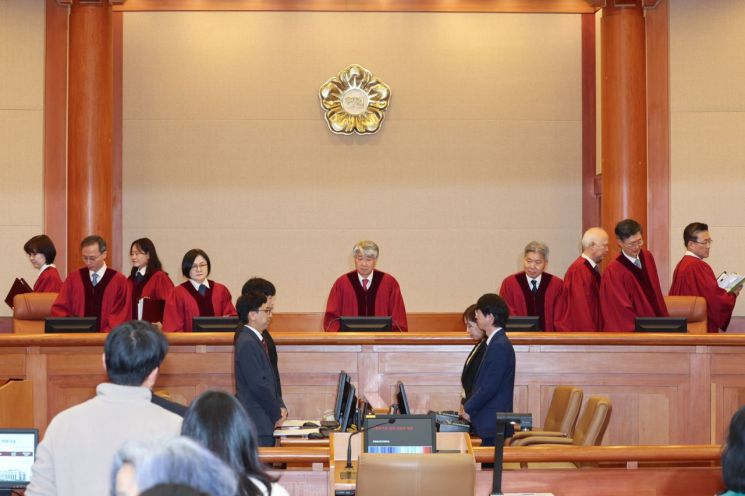 On the afternoon of the 23rd, when Korea's first climate lawsuit was held, Lee Jong-seok, Chief Justice of the Constitutional Court, and the justices entered the Grand Bench of the Constitutional Court in Jongno-gu, Seoul, for a public hearing to determine whether the government's inadequate response to the climate crisis constitutes a violation of fundamental rights.
 [Photo by Yonhap News]
On this day, the Constitutional Court's public hearing combined four climate lawsuits filed by youth, civic groups, and infants at 2 p.m.
At the start of the hearing, Chief Justice Lee Jong-seok referred to the European Court of Human Rights ruling that the Swiss government's response to climate change violated the basic rights of its citizens, stating in relation to the international trend and high domestic interest, "The court will also recognize the importance of the case and the public interest and conduct a thorough examination."
The petitioners argued that the government's overall setting and implementation of mid- to long-term national greenhouse gas reduction targets violated its obligation to protect the basic rights of the people. They emphasized that the Carbon Neutrality Basic Act, which aims to reduce emissions by 40% compared to 2018 levels by 2030, falls short of the Paris Agreement standard (limiting the global average temperature rise to within 1.5 degrees Celsius).
The hearing was held four years after the youth organization 'Youth Climate Action' filed a constitutional complaint in March 2020. Since then, three similar petitions were added, with a total of about 250 petitioners participating.
During the public hearing, the justices focused their questions on the government side. Justice Jung Jeong-mi mentioned the petitioners' claim that specific reduction targets and pathways toward carbon neutrality by 2050 after 2030 have not been concretely established, pointing out, "Wouldn't confusion arise if there are no laws regarding targets after 2030?" Justice Lee Mi-sun also said, "Wouldn't it be reasonable to set reduction targets for 2030 to 2050?"
Justice Moon Hyung-bae noted, "Looking at the government's announcements, the target years and goals keep changing, and they are not consistently calculating and comparing net emissions," adding, "Isn't this why the international community and environmental groups criticize the government's measures as lacking transparency?"
Before the hearing began, the petitioners held a press conference in front of the Constitutional Court in Jongno-gu, stating, "The right to live in a stable climate is the most fundamental aspect of the environmental rights guaranteed by our constitution, and protecting the basic rights of the people is the state's most important duty."
They continued, "Supreme courts around the world are consecutively ruling that failing to set scientifically required reduction targets constitutes a violation of state duties," and urged, "The failure of the National Assembly and government to respond to the climate crisis is leading to infringements on the basic rights of our people and future generations, making the role of the Constitutional Court more necessary than ever."
© The Asia Business Daily(www.asiae.co.kr). All rights reserved.
![Clutching a Stolen Dior Bag, Saying "I Hate Being Poor but Real"... The Grotesque Con of a "Human Knockoff" [Slate]](https://cwcontent.asiae.co.kr/asiaresize/183/2026021902243444107_1771435474.jpg)















