Existence of Blind Spots in US Export Controls
Despite the US advanced semiconductor sanctions, Chinese universities and research institutions have secured artificial intelligence (AI) chips from US semiconductor company Nvidia through third parties such as resellers.
On the 23rd, major foreign media reported that after analyzing hundreds of Chinese bidding documents, it was confirmed that 10 organizations including Chinese universities and research institutes obtained Nvidia's advanced AI chips through servers manufactured by companies in the US, Taiwan, and other countries.
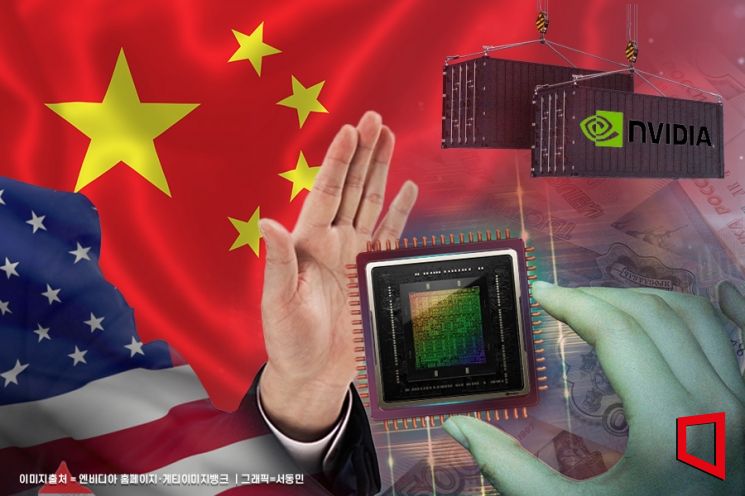
This occurred after the US government implemented stricter export control measures in November last year. It indicates that although the US has strengthened semiconductor export controls to China, regulatory blind spots still exist.
The bidding documents obtained by foreign media were found in a Chinese public database. They relate to items procured by Chinese government agencies between November 20 last year and February 28 this year. The transactions during this period included Nvidia's latest chips.
The server manufacturers used by China to obtain Nvidia chips include US companies Super Micro Computer and Dell Technologies, as well as Taiwan's GIGABYTE Technology.
The US government has prohibited Nvidia and its partners from exporting advanced chips directly or through third parties to China, but purchasing Nvidia chips within China is not illegal.
The Chinese institutions that purchased the chips include the Chinese Academy of Sciences, Shandong Artificial Intelligence Institute, Hubei Earthquake Administration, Shandong University, Xinan University, a technology investment company owned by the Heilongjiang provincial government, a state-owned aviation research center, and a space science center.
The 11 sellers of the chips are lesser-known Chinese retailers. It is unclear whether they sold stockpiled chips from before the export control tightening in November last year or chips obtained afterward.
Nvidia stated that the products were distributed before the semiconductor export controls were tightened last year and that they did not violate US regulations. An Nvidia spokesperson said, "None of our partners appear to have violated export control regulations," adding, "If any products are found to have been resold in violation of US export control regulations, we will work with customers to take appropriate measures."
The server manufacturers also stated that they complied with relevant regulations. Super Micro Computer said it adhered to US government export requirements. Dell Technologies responded, "We have not found evidence that chips were supplied to the Chinese institutions mentioned in the reports, but we will continue to investigate." Taiwan's GIGABYTE stated that it complies with Taiwanese laws and international regulations.
The US Department of Commerce said, "The Bureau of Industry and Security is currently investigating the end uses of chips that are prohibited from export," and added that it will also investigate allegations of violations through paper companies and other means.
© The Asia Business Daily(www.asiae.co.kr). All rights reserved.
![Clutching a Stolen Dior Bag, Saying "I Hate Being Poor but Real"... The Grotesque Con of a "Human Knockoff" [Slate]](https://cwcontent.asiae.co.kr/asiaresize/183/2026021902243444107_1771435474.jpg)















