Housing Permits in Seoul 32% Below Plan
"Rising Construction Costs, High Interest Rates, and Housing Market Stagnation Are Issues"
"Delays in Seoul Redevelopment Projects Due to Different Understandings of Project Methods"
There is a forecast that a housing supply crisis will occur in Seoul as early as two years from now. Although the government has shown intentions to ease supply regulations such as relaxing reconstruction safety inspection regulations and increasing floor area ratios under the Special Act on First New Towns, it is expected that supply will be insufficient due to poor performance in permits and construction starts.
Researcher Kim Ji-hye of the Korea Research Institute for Human Settlements announced a report titled "Analysis of Housing Supply Situation and Stable Housing Supply Strategy" on the 23rd at the government Sejong office, containing these findings.
According to Researcher Kim, last year’s permit performance in Seoul was only 32.0% of the planned amount. In contrast, permit performance in non-capital regions reached 99.3% of the planned volume. Especially, last year’s housing supply performance in Seoul was only 37.7% for permits, 32.7% for construction starts, and 42.1% for completions compared to the average annual performance from 2005 to 2022. Researcher Kim said, "Even if regulations are eased from the supply side, supply performance remains poor, so concerns about supply shortages will materialize in 2 to 3 years."
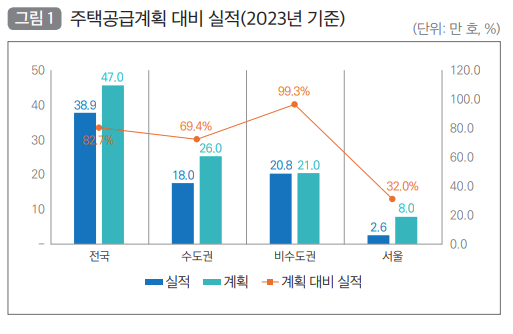 Housing Supply Plan vs. Performance (As of 2023). [Image Source=Korea Research Institute for Human Settlements]
Researcher Kim pointed out that it is difficult to ease regulations from the demand side, which is why housing supply remains low. He said, "The Debt Service Ratio (DSR) regulation internationally recommends lending based on repayment ability, and Korea’s household debt ratio relative to GDP is also high. Ignoring these circumstances, it is difficult for the government to ease regulations from the demand side."
He also viewed that housing prices remain high from the demand perspective. Researcher Kim said, "Even if housing prices have fallen, due to rising construction costs and increased sale prices, housing prices still seem to be high." In this situation, housing demand is unlikely to rise, resulting in sluggish supply.
Additionally, he cited rising construction costs, high interest rates, and market deterioration as major causes of sluggish housing supply in Seoul. Researcher Kim explained, "With high interest rates, financial costs increase, and with rising construction costs, developers and contractors inevitably hesitate to supply. Moreover, in a high interest rate environment, housing demand shrinks. Rising construction costs, high interest rates, and market deterioration lead to reduced profits in housing projects, resulting in decreased supply."
In particular, he said that in Seoul, construction delays in redevelopment projects reduce supply. Redevelopment projects have traditionally been conducted through association methods. However, recently, various methods such as rapid integrated planning and trust methods are being discussed alongside association methods. Researcher Kim said, "In a situation where the burden of contributions increases, there are different understandings among association members regarding redevelopment methods. Such differences in understanding about project methods also cause construction delays."
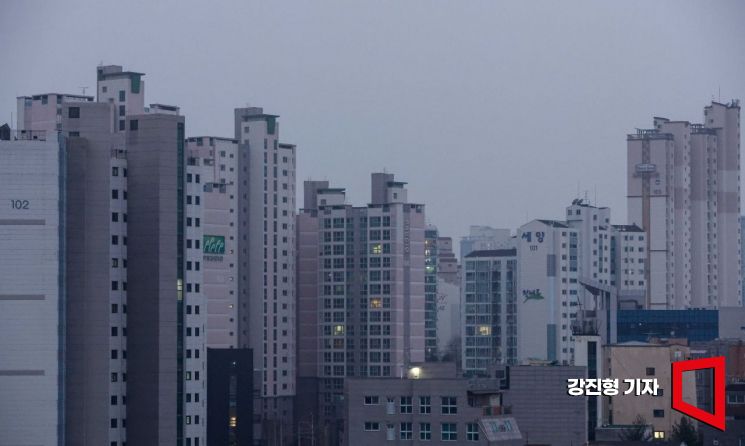
On the same day, Researcher Kim proposed short-term measures such as improving the floor area ratio incentive system for local companies, restructuring projects using REITs, and revitalizing public-supported private rental housing. He said the floor area ratio incentive system should be expanded to include mid-sized contractors. Also, when housing supply projects are not profitable, housing should be supplied using REITs through mixed-use development methods.
In the mid to long term, he said private sector participation should be increased in projects led by the public sector. Due to rising construction costs, high interest rates, and market stagnation, private construction companies find it difficult to proceed with projects. The idea is to encourage construction companies to participate in public-led projects. He also suggested building a comprehensive real estate finance information network to link monitoring data among ministries such as the Ministry of Land, Infrastructure and Transport and the Ministry of Economy and Finance. Through this, monitoring can be conducted by region and project site, enabling management of real estate project financing (PF) risks.
© The Asia Business Daily(www.asiae.co.kr). All rights reserved.
![Clutching a Stolen Dior Bag, Saying "I Hate Being Poor but Real"... The Grotesque Con of a "Human Knockoff" [Slate]](https://cwcontent.asiae.co.kr/asiaresize/183/2026021902243444107_1771435474.jpg)
















