Minjoo Demands Direct Referral of Franchise Business Act and Democratic Merit Act
The opposition parties, led by the Democratic Party of Korea, unilaterally passed a motion demanding the direct referral of the Fair Transactions in Franchise Business Act (hereinafter referred to as the Franchise Business Act) and other bills, which the government and ruling party have opposed, to the plenary session.
On the morning of the 23rd, the opposition parties resolved the motion to request the referral of the Franchise Business Act and the Act on the Treatment of Democratic Patriots (hereinafter referred to as the Democratic Patriots Act) amendments to the plenary session at the National Assembly's Political Affairs Committee full meeting, with all 15 votes in favor out of 15 total votes. This result came from 11 members of the Democratic Party and 4 members from other opposition parties voting in favor. Members of the People Power Party did not attend, and only Kang Min-guk, the committee secretary, appeared to make a procedural statement before leaving.
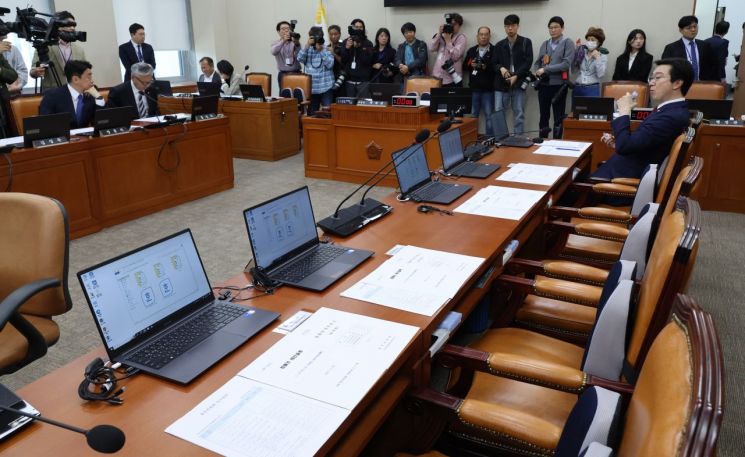 On the 23rd, Committee Chair Baek Hye-ryun is presiding over the plenary session of the National Assembly's Political Affairs Committee. On this day, the Political Affairs Committee, led solely by the opposition party, resolved to directly refer the Franchise Business Transaction Fairness Act and the Act on the Treatment of Democratic Meritorious Persons to the plenary session of the National Assembly. [Image source=Yonhap News]
Both bills had already passed the Political Affairs Committee in December last year but were pending in the Legislation and Judiciary Committee. However, according to the National Assembly Act, if a bill remains pending in the Legislation and Judiciary Committee for more than 60 days, the relevant standing committee can attempt direct referral. The Democratic Party pressed ahead with the demand for direct referral based on this provision.
The government and ruling party oppose both bills. The Franchise Business Act includes provisions granting franchisees collective bargaining rights against the headquarters. If the franchise headquarters refuses to negotiate, the Fair Trade Commission can issue corrective measures, and criminal penalties may follow. The franchise industry opposes this, arguing that it effectively grants labor union powers to franchisees as business operators.
Regarding the Democratic Patriots Act, it is a law that recognizes the families and bereaved families of democracy movement victims and deceased as patriots. The scope is broadened to include cases where no separate 'special law' exists, such as the May 18 Democratic Uprising. The People Power Party criticized it as a "self-benefit law for activist groups," pointing out that it could even recognize those who participated in illegal strikes or anti-government protests as patriots.
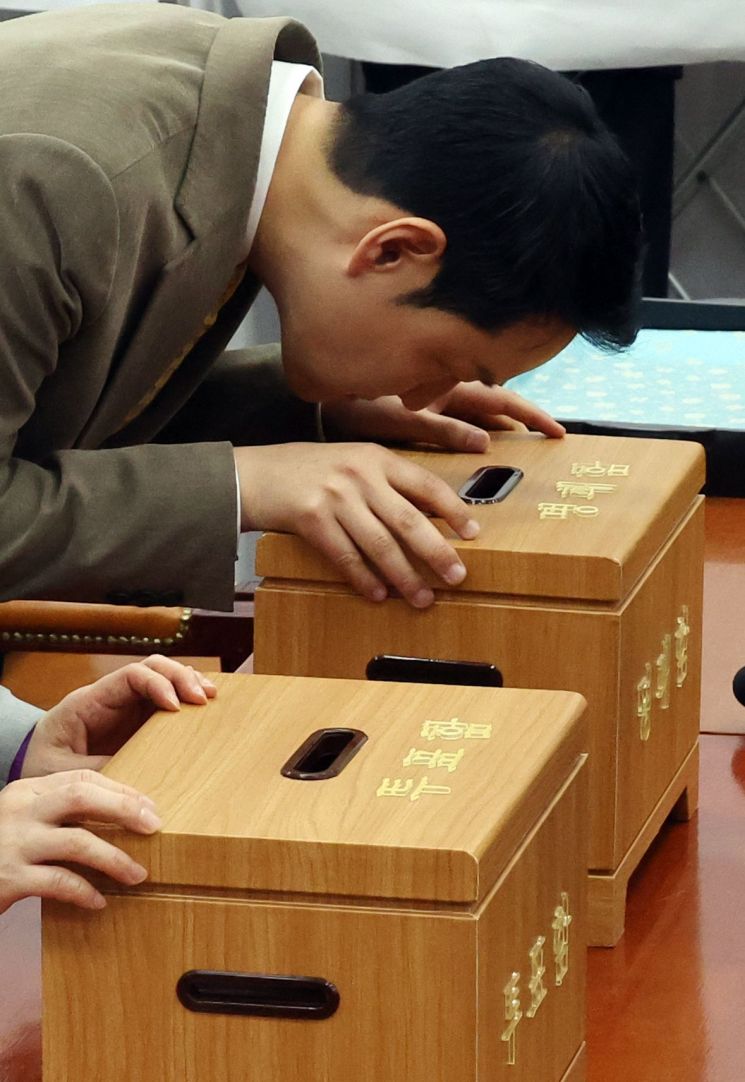 On the 23rd, the National Assembly's Political Affairs Committee, led solely by the opposition party, resolved to directly refer the Franchise Business Transaction Fairness Act and the Act on the Treatment of Democratic Meritorious Persons to the plenary session of the National Assembly. Assembly member Kim Han-gyu, who was the vote counter, is looking into the nameplate box during the vote.
 [Photo by Yonhap News]
Kang Min-guk, a member of the People Power Party, said, "The Democratic Party always talks about prosecutorial dictatorship, but this (demand for direct referral of the bills to the plenary session) is a parliamentary outrage that ignores democracy and legislative dictatorship," adding, "Unilaterally referring bills that require deliberation to the plenary session by the majority party destroys parliamentary principles that value dialogue, compromise, debate, and consensus."
Kang reiterated his criticism, saying, "In the case of the Democratic Patriots Act, it could recognize as patriots those involved in representative public security cases such as the Namminjeon case, which was judged as an anti-state organization, the Dongui University case that took the lives of seven police officers, and those opposing the dissolution of the Korean Teachers and Education Workers Union." Regarding the amendment to the Franchise Business Act, he said, "While the authority of franchisees may increase, it is obvious that multiple unions could form within a single franchise, leading to conflicts between headquarters and franchisees," adding, "How these conflicts will be resolved, and whether there are measures to prevent indiscriminate negotiation requests from franchisees, were not examined at all before passing the full Political Affairs Committee meeting."
Hong Sung-guk, a member of the Democratic Party, said, "Recently, the late Park Jong-cheol's mother, Jeong Cha-soon, passed away," adding, "She did not receive proper recognition for a long time." Hong explained, "The Democratic Patriots Act has been discussed for over 20 years," and "To eliminate controversies pointed out by the ruling party, the scope of support was significantly adjusted, and those convicted under the National Security Act and Criminal Act were excluded."
Meanwhile, the Democratic Party plans to process the bills as soon as they are directly referred during the May extraordinary session of the National Assembly.
© The Asia Business Daily(www.asiae.co.kr). All rights reserved.
![Clutching a Stolen Dior Bag, Saying "I Hate Being Poor but Real"... The Grotesque Con of a "Human Knockoff" [Slate]](https://cwcontent.asiae.co.kr/asiaresize/183/2026021902243444107_1771435474.jpg)
















