Samsung Electronics Responds to AI Demand with 9th Gen V-NAND
Data I/O Speed Improved by 33% Over Previous Generation
Following TLC, QLC Product Mass Production Scheduled for Second Half
Reviving NAND Market... Annual Growth of 24%
Samsung Electronics has become the first in the industry to begin mass production of the 9th generation V (Vertical) NAND flash, a 290-layer NAND flash product. This product is designed to meet the increasing demand for high-capacity and high-performance NAND in the era of artificial intelligence (AI). The NAND market is expected to rapidly grow starting this year, breaking away from its previous stagnation. With competitors such as SK Hynix expected to launch products with over 300 layers next year, Samsung Electronics is being recognized for igniting the NAND competition to secure technological leadership.
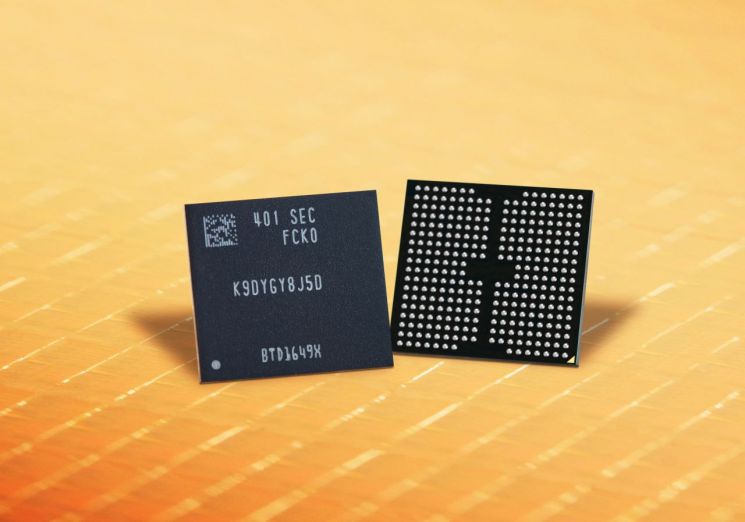 Samsung Electronics' '1 Terabit (Tb) Triple-Level Cell (TLC) 9th Generation V-NAND' product that has started mass production /
 [Photo by Samsung Electronics]
On the 23rd, Samsung Electronics announced the start of mass production of the '1Tb (terabit) Triple-Level Cell (TLC) 9th generation V NAND.' NAND is a type of memory semiconductor, made by stacking storage cells in multiple layers to increase capacity. Depending on how many bits of information are stored in a single cell, NAND types are classified as Single-Level Cell (SLC), Multi-Level Cell (MLC), TLC, and Quad-Level Cell (QLC).
Samsung Electronics implemented the industry's smallest cell size and minimum mold thickness, increasing the bit density (number of bits stored per unit area) of the 9th generation V NAND by approximately 1.5 times compared to the previous 8th generation V NAND. To prevent interference phenomena that can occur when reducing the cell size by decreasing the cell's planar area, technologies for cell interference avoidance and cell lifespan extension were applied, enhancing quality and reliability.
Due to the vertical stacking nature of NAND, the key to strengthening cost competitiveness is to stack layers with minimal processing steps. Samsung Electronics applied a double stack structure to realize the highest number of layers in the 290-layer range. The double stack is a technology that drills the channel hole, which electrically connects the cells, twice. Additionally, the company achieved process innovation by using Channel Hole Etching technology to drill the industry's maximum number of layers in a single step. Channel Hole Etching is a technology that sequentially stacks mold layers and then creates a hole (channel hole) through which electrons move in one go, helping to improve productivity.
The 9th generation V NAND features the next-generation NAND interface 'Toggle 5.1,' boasting a maximum data input/output speed of up to 3.2 Gbps (gigabits per second), a 33% improvement over the previous generation. Through low-power design technology, power consumption has been improved by about 10% compared to the previous generation. The company explains that this will be an optimal solution for customers focusing on reducing energy costs while strengthening environmental management.
Following the TLC-based 9th generation V NAND, Samsung Electronics plans to begin mass production of the 'QLC 9th generation V NAND' in the second half of the year. The company intends to accelerate the development of high-capacity and high-performance NAND required in the AI era.
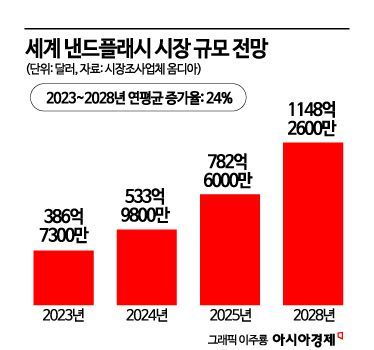
According to market research firm Omdia, global NAND market revenue is expected to grow at an average annual rate of 24%, from $28.7 billion in 2023 to $114.8 billion in 2028. Until last year, the market situation was unfavorable compared to another memory semiconductor, DRAM, causing industry concerns. However, from this year, market revenue is expected to return to an upward trend due to the effects of AI. Omdia stated, "Demand is arising for NAND in AI training and inference," and evaluated that "larger capacity is needed for data storage for large language models (LLM) and inference models."
In the market, as AI server purchases increase, demand for solid-state drives (SSD), which are auxiliary storage devices that store large volumes of NAND-based information, is also rising. SSDs are required to meet high-performance requirements such as data transfer speeds when expanding AI servers. The semiconductor industry expects that inference AI servers require larger storage capacity than training AI servers, so SSD demand may increase further in the future.
Huh Sung-hoe, Vice President and Head of Flash Development at Samsung Electronics Memory Business Division, said, "Through extreme technological innovation, we have improved new product productivity and product competitiveness. We will lead the ultra-high-speed, ultra-high-capacity SSD market responding to the AI era with the 9th generation V NAND."
With Samsung Electronics starting mass production of 290-layer NAND, industry competition is expected to intensify. SK Hynix, the second-largest NAND company, announced the start of mass production of 238-layer 4D NAND in June last year. US-based Micron has introduced 232-layer NAND and began mass production of SSDs based on 232-layer QLC NAND this month.
According to market research firm TrendForce, Samsung Electronics' market share in the fourth quarter of last year rose by 5.2 percentage points from the previous quarter to 36.6%. The company announced at its third-quarter earnings presentation last year that it plans to present a new paradigm with innovative NAND technology, including developing 1000-layer V NAND by 2030. Industry forecasts also suggest that Samsung Electronics may unveil the 400-layer 10th generation V NAND next year. The price of general-purpose NAND products (128Gb 16Gx8) was $4.90 last month, unchanged from the previous month.
© The Asia Business Daily(www.asiae.co.kr). All rights reserved.
![Clutching a Stolen Dior Bag, Saying "I Hate Being Poor but Real"... The Grotesque Con of a "Human Knockoff" [Slate]](https://cwcontent.asiae.co.kr/asiaresize/183/2026021902243444107_1771435474.jpg)
















