Male Full-Time Homemakers Increased by 20,000 in One Year
93% of Employment Growth Attributed to Women
Majority Are Women in Their 30s, College Graduates, and Married
Employment of Men with High School Education or Less Decreased by Over 180,000
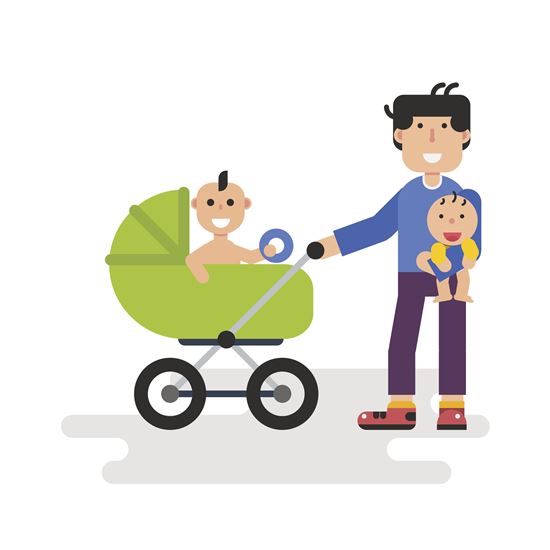
The number of male full-time homemakers has surpassed 200,000 for the first time in history. This is attributed to the expanded participation of women in economic activities, with women accounting for 93% of last year's increase in employed persons.
On the 23rd, the Korea Employers Federation emphasized this in a report titled "Three Characteristics and Implications of Recent Employment Trends," which analyzed data from the Statistics Korea's Economically Active Population Survey.
Women Lead Employment Growth… Male Full-Time Homemakers Reach Record High
The survey results showed that among the 327,000 increase in employed persons last year, 92.7% (303,000) were women. Over the past three years (2021?2023), more than half of the employment growth was driven by women, and this trend continued this year. As of March, the total number of employed persons increased by 173,000, with women increasing by 179,000 and men decreasing by 7,000.
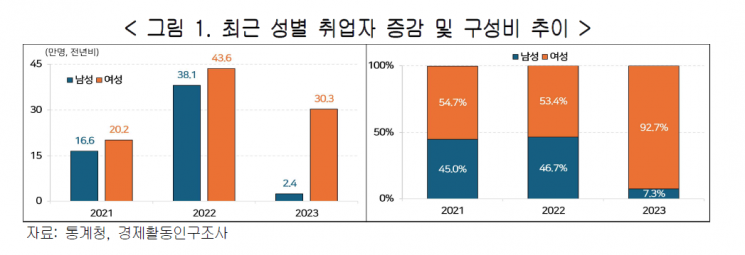
Last year's increase in female employment was led by women in their 30s, those with higher education, and married women. Except for the middle-aged and older groups in their 50s and 60s and above, the only age groups with increased employment compared to the previous year were women in their 30s (+9.2%) and women in their 40s (+1.3%).
Although the increase in female employment was 303,000, the increase among highly educated women (college graduates or higher) was 304,000, which was higher. Employment among low-educated women (high school graduates or below) actually decreased by 1,000. For men, the number of highly educated employed persons increased by 209,000, while the number of low-educated employed men decreased by 185,000.
Among the total increase in female employment, 69.9% (212,000) were married women. It is estimated that the 'secondary worker effect,' where the labor supply of female spouses increases due to worsening employment conditions of male household heads, partially contributed to this.
As women's participation in economic activities expanded, the number of male full-time homemakers responsible for childcare and housework increased. It steadily rose from 155,000 in 2019 to 218,000 last year. This is the first time the number of male full-time homemakers has exceeded 200,000.

Record High in Ultra-Short Working Hours… Youth Employment Also Weak
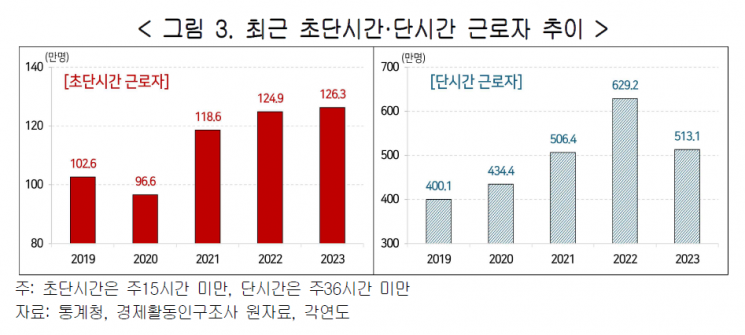
The number of ultra-short working hour employees, working less than 15 hours per week, also increased. Last year, it reached 1,263,000, the highest since the survey began. The number of short-time workers, working less than 36 hours per week, was 5,131,000. This is a decrease of 1,161,000 compared to the record high of 6,292,000 in 2022.
The Korea Employers Federation explained, "The increase in ultra-short working hour employees is partly due to the rise in government-supported jobs for the elderly and others," adding, "It also reflects a considerable extent of 'last-resort measures' by small and micro enterprises and small business owners struggling with the increased minimum wage burden."
Youth employment was also sluggish. From November 2022 to March 2024, youth employment decreased for 17 consecutive months, the longest decline in the past decade. This surpassed the previous record of 13 consecutive months (February 2020 to February 2021) during the COVID-19 period.
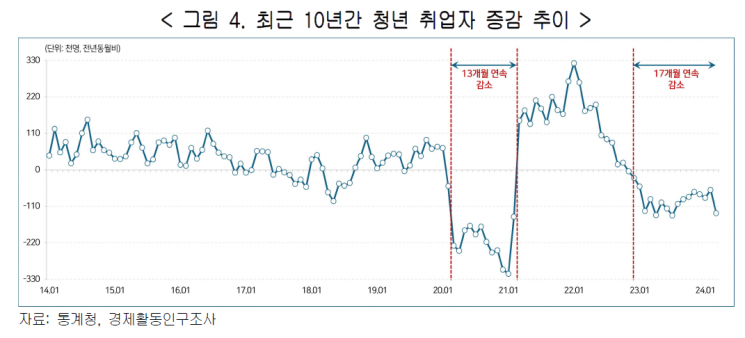
The main reason is interpreted as the decline in the youth population itself. Last year, the youth population decreased by 177,000 compared to the previous year. According to the Korea Employers Federation, 84.8% (83,000) of the decrease in youth employment was due to the population effect.
The Korea Employers Federation emphasized that to increase youth employment, it is necessary to attract young people who have become economically inactive and are living as "hidden unemployed" back into the labor market. The "youth resting population," which had decreased for two consecutive years since 2021, increased by 11,000 to 401,000 last year. The youth resting population refers to young people who answered that they had not sought a job in the past four weeks and were "resting," according to Statistics Korea's survey. The Federation analyzed, "The main reason youth rested was because it was difficult to find the desired job," indicating a mismatch in the labor market.
The Korea Employers Federation stressed the need to pursue uninterrupted labor reforms to stabilize employment across all ages and groups and to create more jobs. Kim Seon-ae, head of the Employment Policy Team at the Federation, emphasized, "To ensure that the positive trend of expanding women's economic participation continues alongside the national agenda of boosting birth rates, it is necessary to significantly strengthen support for work-family balance, such as expanding flexible work systems, fostering a culture of using parental leave and reduced working hours during childcare, and establishing daycare centers near residential areas."
© The Asia Business Daily(www.asiae.co.kr). All rights reserved.
![Clutching a Stolen Dior Bag, Saying "I Hate Being Poor but Real"... The Grotesque Con of a "Human Knockoff" [Slate]](https://cwcontent.asiae.co.kr/asiaresize/183/2026021902243444107_1771435474.jpg)

















