2nd External Economic Advisory Meeting
Discussion on Domestic Impact of Middle East Situation
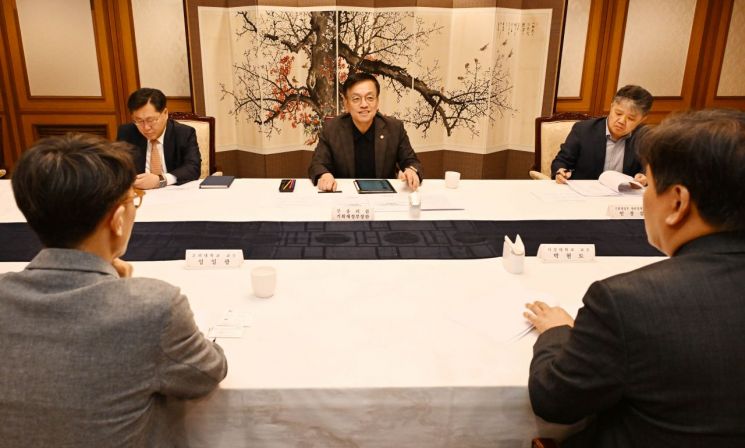 Choi Sang-mok, Deputy Prime Minister and Minister of Economy and Finance, is discussing the outlook of the Middle East situation and its impact on the domestic economy with Middle East and energy experts at an emergency external economic advisory meeting held on the 23rd at the Government Seoul Office in Jongno-gu, Seoul.
Choi Sang-mok, Deputy Prime Minister for Economic Affairs and Minister of Economy and Finance, stated on the 23rd, "We will closely monitor the impact of uncertainties originating from the Middle East on our economy and prepare to respond immediately."
On the morning of the same day, Deputy Prime Minister Choi discussed the outlook of the Middle East situation and its impact on the domestic economy with Middle East and energy experts at the 2nd Foreign Economic Advisory Meeting held at the Government Seoul Office. Attendees included Professor Park Hyun-do from Sogang University, Director Jeong Jun-hwan of the Korea Energy Economics Institute, Director Jang Ji-hyang of the Asan Institute for Policy Studies Middle East Center, and Professor Sung Il-kwang from Korea University.
Presiding over the meeting, Deputy Prime Minister Choi mentioned, "Due to the recent Israel-Iran situation, uncertainty in the global political and economic environment has increased more than ever," and emphasized that they will closely monitor the economic impact of uncertainties from the Middle East and ensure immediate response.
The experts attending the meeting diagnosed that the current Middle East situation, with ongoing conflict between Israel and Hamas and direct clashes between Israel and Iran, is acting as a significant uncertainty factor for the global economy. They urged thorough monitoring of developments and assessment of impacts.
Concluding the meeting, Deputy Prime Minister Choi emphasized, "While proposing continuous communication with experts, we will thoroughly monitor the progress of the Middle East situation and market trends, and respond intensively at the whole-of-government level to prevent any negative impact on the Korean economy."
The Foreign Economic Advisory Meeting was established to seek strategic response measures against the rapidly increasing geopolitical risks and global uncertainties by gathering opinions from domestic and international experts and reflecting them in policy. The first meeting held on the 4th discussed global economic issues and directions for foreign policy.
Meanwhile, on the 22nd (local time), Iranian Foreign Minister Hossein Amir-Abdollahian stated in an interview with NBC that "Iran will not retaliate as long as Israel does not carry out additional attacks against Iran's interests," indicating no plans to respond to Israeli retaliatory strikes. This has led to assessments that the crisis in the Middle East is transitioning to a stabilization phase.
© The Asia Business Daily(www.asiae.co.kr). All rights reserved.
![Clutching a Stolen Dior Bag, Saying "I Hate Being Poor but Real"... The Grotesque Con of a "Human Knockoff" [Slate]](https://cwcontent.asiae.co.kr/asiaresize/183/2026021902243444107_1771435474.jpg)















