Increase in Unsold Units and Delayed Payment of Sale Proceeds
Bad Debt Reflected from 2025, Profitability Decline Inevitable
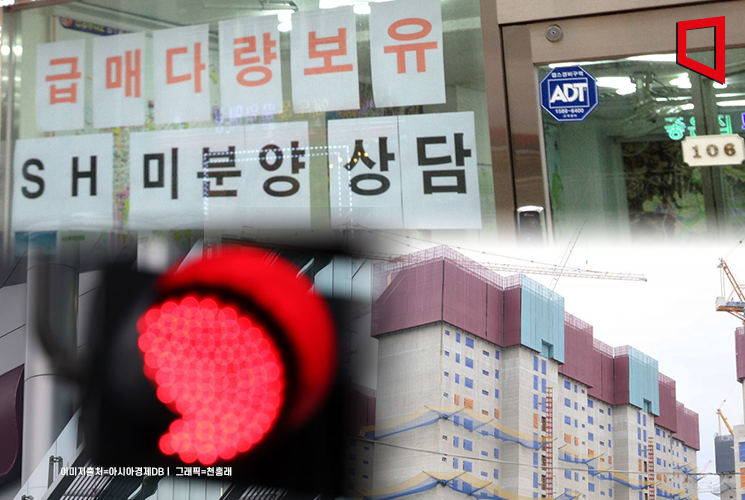
Due to the downturn in the real estate market, construction companies' accounts receivable are increasing. This is the result of a rise in unsold apartments and growing unpaid balances from buyers. Experts warn that the accumulating accounts receivable on construction companies' ledgers could negatively impact their financial structure improvements in the future.
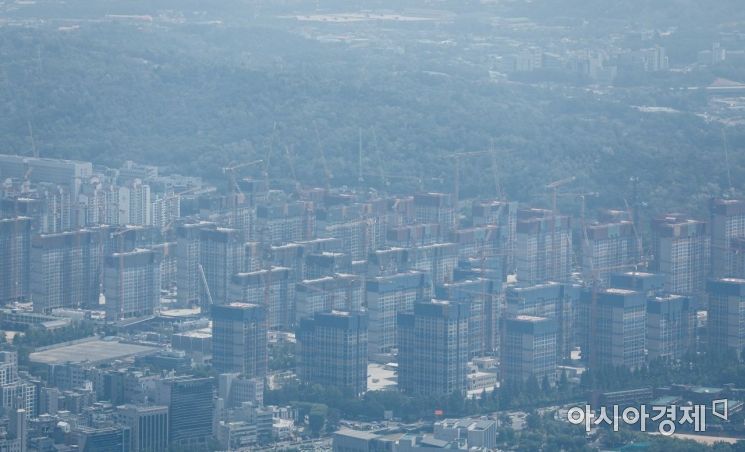 On the 17th, the Dunchon Jugong construction site as seen from Lotte World Tower Seoul Sky in Songpa-gu, Seoul. Photo by Jinhyung Kang aymsdream@
According to the electronic disclosure system on the 24th, GS Engineering & Construction's construction accounts receivable last year amounted to 2.8033 trillion KRW, an increase of 306.5 billion KRW compared to the previous year (2.4965 trillion KRW). Accounts receivable arose at sites such as Brighton, completed in August last year (542.1 billion KRW), and Heukseok Xi, whose construction was completed at the end of February the same year (24.6 billion KRW). There are also accounts receivable at sites scheduled for completion in the first half of this year, including Songdo Xi Crystal Ocean (6.8 billion KRW) and GP3 (6.1 billion KRW). The Iraq Kabala refinery construction project, which was scheduled to be completed by July last year, also recorded accounts receivable of 146.7 billion KRW.
Pre-sale accounts receivable increased more than fivefold to 42.3 billion KRW from 8 billion KRW the previous year. Pre-sale accounts receivable refer to payments not received by construction companies during apartment pre-sale projects. These include interim and final payments, and as accounts receivable increase, the burden on cash flow management also rises.
A GS Engineering & Construction representative explained, "Brighton is currently selling apartments, and we are collecting payments as they come in, expecting to complete the collection of construction accounts receivable within the year. Heukseok Xi's accounts receivable occurred because the sale of reserved land was not completed as of the last standard, but we expect to collect it within the year."
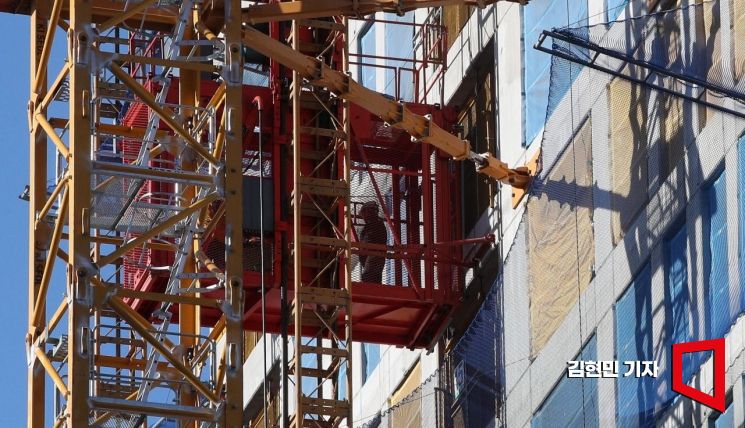 The scene of a reconstruction site at an apartment in Seoul where ready-mixed concrete pouring has been halted. Photo by Hyunmin Kim kimhyun81@
HDC Hyundai Development Company, which mainly operates in the housing business, also saw an increase in accounts receivable. Last year's construction accounts receivable were 721.7 billion KRW, a 57% increase from 459.5 billion KRW in 2022. During the same period, pre-sale accounts receivable rose from 21 billion KRW to 38.1 billion KRW.
Unbilled construction amounts also increased to 858.2 billion KRW from 747.9 billion KRW the previous year. Unbilled construction amounts refer to receivables for construction work past the scheduled completion date but not yet paid by the client. Although these amounts are recorded as assets in accounting, if unpaid, they convert to losses and negatively affect liquidity.
Among the sites where construction is complete but payments have not been received are the Gaepo 1 Complex (Gaepo DH Firstier I-Park) reconstruction site with 41.2 billion KRW. Among regional apartment sites, there are Gunsan Jigok I-Park with 56 billion KRW and Gyeongsan I-Park Phase 1 with 44.3 billion KRW. Gyeongsan I-Park Phase 2 also has unbilled construction amounts of 14.6 billion KRW. This site has started construction, but due to low pre-sale rates and worsening developer management, sales are being canceled and re-sales are necessary.
Among major reconstruction sites in Seoul, Dunchon Jugong reconstruction, scheduled for move-in by the end of this year, has unbilled construction amounts of 292.7 billion KRW, and Jamsil Jinju, whose pre-sale was delayed due to construction cost disputes, has 121.9 billion KRW recorded as unbilled construction amounts.
According to Korea Ratings, out of 700 projects from 17 construction companies, 104 projects have pre-sale rates below 70%. Especially, construction companies with good credit ratings tend to have a higher proportion of non-residential buildings such as officetels, residential hotels, knowledge industry centers, and offices. These projects have been shunned by buyers due to sustained high interest rates and declining profitability.
Pre-sale accounts receivable are also accumulating at sites selling residential hotels. This is due to buyers delaying payment after signing contracts. For example, Asan Baebang Development, a subsidiary of Hanwha Construction and the developer of 'Hanwha Forena Cheonan Asan Station,' recorded pre-sale accounts receivable of 15.9 billion KRW last year, a 54% increase from 10.3 billion KRW in 2022.
Magok MICE PFV, the developer of 'Magok Le West' built by Lotte Construction, saw its pre-sale accounts receivable increase from 2.6 billion KRW in 2022 to 4.7 billion KRW last year. Its net loss also increased from 282.9 billion KRW to 387.5 billion KRW.
Korea Ratings explained, "For projects that started construction in 2022, it is highly likely that bad debt related to unsold units will be reflected around 2025, leading to a significant decline in profitability. With a decrease in new construction starts and no projects to drive profitability improvement, along with rising project financing (PF) costs, the profitability of scheduled projects is also deteriorating. Therefore, even after the real estate market improves, the timing for construction companies' profit recovery may be delayed."
Doosung Kyu, head of the Mokmin Economic Policy Research Institute, diagnosed, "Many sites have stalled due to disputes caused by soaring construction costs, and a vicious cycle continues where rising pre-sale prices lead to declining sales performance. Additionally, with the timing of interest rate cuts delayed, companies are securing funds through overseas orders." He added, "The increase in accounts receivable is just one aspect, and even large construction companies are not exempt from survival issues. This situation could persist for more than three years and may have a negative impact on the entire construction industry."
© The Asia Business Daily(www.asiae.co.kr). All rights reserved.
![Clutching a Stolen Dior Bag, Saying "I Hate Being Poor but Real"... The Grotesque Con of a "Human Knockoff" [Slate]](https://cwcontent.asiae.co.kr/asiaresize/183/2026021902243444107_1771435474.jpg)


















