"Effectively Granting Union-Equivalent Authority"
"Not Compatible with Current Legal System," Painful Struggles Anticipated
As the possibility of the amendment to the "Fair Franchise Transactions Act," which allows franchisees collective bargaining rights, being directly submitted to the final plenary session of the 21st National Assembly increases, strong opposition is emerging from the distribution industry. The franchise industry is considering filing a constitutional complaint if the amendment passes the National Assembly, arguing that it effectively grants the authority of labor unions to self-employed franchisees.
According to the distribution industry on the 22nd, the National Assembly's Political Affairs Committee will hold a plenary meeting at 11 a.m. on the 23rd to present and discuss bills proposed this year, including the amendment to the Monopoly Regulation and Fair Trade Act (Fair Trade Act). The Democratic Party is reviewing a plan to handle the direct submission of the franchise business law amendment to the plenary session at this meeting. A Democratic Party office member of the Political Affairs Committee said, "We are currently finalizing related details" and "The decision will be made with reference to the party's stance."
Earlier, Park Ju-min, the Democratic Party's deputy floor leader, and Min Byung-duk, the party's Small Business Committee chairman, held a press conference on the 17th urging the amendment to the franchise business law to be processed in the 21st National Assembly.
The amendment includes granting collective bargaining rights to franchisees. The Democratic Party integrated nine related amendments to the franchise business law last December and passed them as an alternative proposed by the chairman of the Political Affairs Committee. The bill mainly includes ▲introduction of a registration system for franchisee business organizations ▲negotiation rights of franchisee business organizations with headquarters ▲obligation of franchise headquarters to request consultation with franchisee business organizations ▲hearing procedures when canceling the registration of franchisee business organizations.
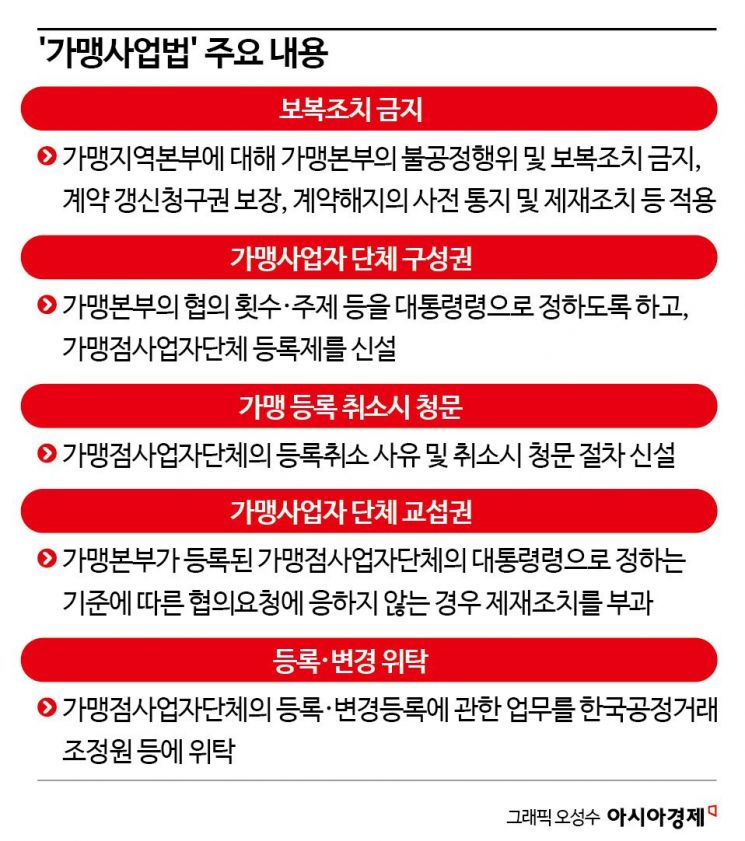
The amendment is currently pending at the National Assembly's Legislation and Judiciary Committee, chaired by the ruling party. According to the National Assembly Act, if a bill passed by a standing committee is not reviewed within 60 days by the Legislation and Judiciary Committee, the Political Affairs Committee, as the relevant standing committee, can directly submit it to the plenary session if more than three-fifths of its members agree. Earlier, the Democratic Party planned to handle the direct submission of the amendment in the Political Affairs Committee in February, but it was canceled due to industry opposition, including a large-scale outdoor rally by the Franchise Association.
The distribution industry is concerned about side effects, saying the amendment is too broad and has many loopholes. In particular, the current franchise business law regards franchisees as business operators, not workers, but the constitution grants the right to organize and collective bargaining only to workers, raising the possibility of constitutional violations. A distribution industry official said, "Giving franchisees the right to organize and negotiate is giving them the rights of labor unions," adding, "Since this contradicts the current legal system, if the law passes, we must file a constitutional complaint."
It is also pointed out that the introduction of a registration system for franchisee business organizations could lead to the creation of multiple business organizations. Another official said, "The criteria for registering business organizations are ambiguous," adding, "If the criteria are lowered, multiple business organizations could be created, effectively allowing multiple unions." In the case of labor unions, even if multiple unions are allowed, wage and collective negotiations are conducted with a representative organization, but under the franchise business law, multiple business organizations would have to negotiate separately on different topics. There are also concerns that the negotiation rights of business organizations could be distorted into a means to pressure headquarters.
Earlier, the Convenience Store Industry Association submitted a statement to the Political Affairs Committee at the end of last year, pointing out ▲that franchisees under the franchise business law are business operators, not workers ▲concerns about franchisee business organizations turning into labor unions ▲frequent changes in franchise contracts ▲concerns about unfair joint actions under the Fair Trade Act. Along with this, the Franchise Federation proposed supplementary measures such as ▲unification of consultation organizations ▲cancellation of registration of illegal business owner organizations ▲disclosure of business owner organization members.
Meanwhile, the Democratic Party is reportedly conducting behind-the-scenes work for the direct submission of the franchise business law to the plenary session. Currently, the Political Affairs Committee consists of 24 members: 11 from the Democratic Party, 7 from the People Power Party, and 6 from non-negotiating groups. For direct submission to occur solely by the opposition party, at least 15 votes, which is three-fifths of the committee members, are required. Among the non-negotiating group members, Kim Jong-min, Yang Jeong-suk, Jo Eung-cheon, and Hwang Un-ha have left the Democratic Party, so even if the amendment is presented to the Political Affairs Committee, it is difficult to predict its passage.
© The Asia Business Daily(www.asiae.co.kr). All rights reserved.
![Clutching a Stolen Dior Bag, Saying "I Hate Being Poor but Real"... The Grotesque Con of a "Human Knockoff" [Slate]](https://cwcontent.asiae.co.kr/asiaresize/183/2026021902243444107_1771435474.jpg)















