1-Year Bond at 3.45%, 5-Year Bond at 3.95% Held Steady
Confidence in Recovery with 5.3% Q1 Economic Growth Rate
China's central bank has kept interest rates unchanged for the second consecutive month, signaling a slowdown in the pace of monetary easing. This move comes as the economy recorded a better-than-expected growth rate of 5.3% in the first quarter, with policy focus shifting towards defending the yuan exchange rate and controlling inflation.
On the 22nd, the People's Bank of China (PBOC), the country's central bank, announced that it would keep the loan prime rates (LPR), which effectively serve as benchmark interest rates, unchanged at 3.45% for the 1-year term and 3.95% for the 5-year term.
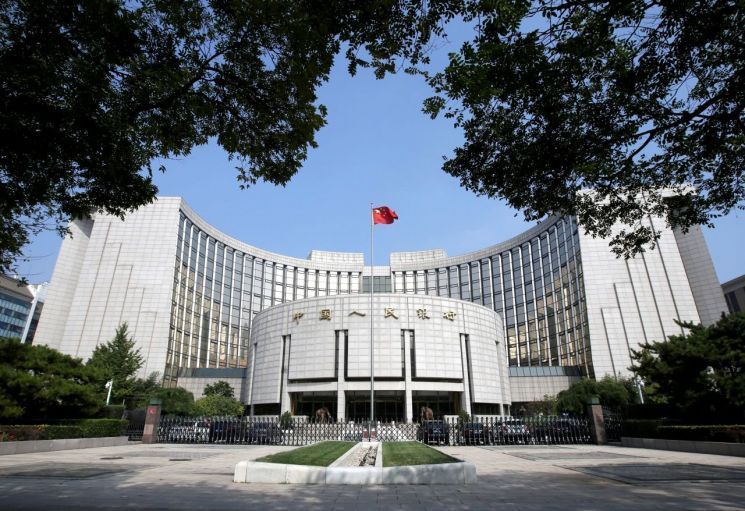
The LPR is calculated by aggregating the lending rates offered to the best customers by 18 designated banks. Local financial institutions use this as a reference for lending, making it the de facto benchmark interest rate in China. The 1-year rate affects general loans, while the 5-year rate influences mortgage loans.
The PBOC lowered the 5-year LPR by 0.25 percentage points from 4.20% in February, but kept both the 1-year and 5-year rates unchanged in March. The 1-year rate has remained steady at 3.45% for eight months since it was cut by 0.1 percentage points from 3.55% in August last year.
On the 15th, the PBOC also kept the Medium-term Lending Facility (MLF) rate, which provides short-term funds to commercial banks for one year, steady at 2.50%, signaling the likelihood of holding the LPR steady as well. Experts at the time assessed that "the current liquidity in the market is sufficient," and that "a reduction in MLF lending could help maintain the balance of supply and demand in the banking system's cash flow."
China's monetary authorities appear to have made this decision considering the recent strengthening economic recovery, falling inflation, and a weakening yuan. On the 18th, Zhou Ran, Director of the Monetary Policy Department at the PBOC, stated, "A comprehensive review and judgment of inflation and real interest rates are necessary in monetary policy," adding, "It is important to prevent a vicious cycle where excessively low interest rates intensify competition and capital outflows, further lowering inflation." Zhou explained, "Over the past two years, nominal interest rates have steadily declined, playing a positive role in promoting overall economic recovery. However, (when interest rates fall) domestic demand weakens and inflation declines simultaneously."
Above all, China's gross domestic product (GDP) growth rate of 5.3% in the first quarter exceeded domestic and international forecasts that predicted growth in the high 4% range, boosting confidence in the economic recovery. This reflects expectations that urgent intervention by monetary authorities is unnecessary and that the current trends of domestic demand and export recovery can continue.
© The Asia Business Daily(www.asiae.co.kr). All rights reserved.
![Clutching a Stolen Dior Bag, Saying "I Hate Being Poor but Real"... The Grotesque Con of a "Human Knockoff" [Slate]](https://cwcontent.asiae.co.kr/asiaresize/183/2026021902243444107_1771435474.jpg)
















