China Blocks WhatsApp and Threads Before 'TikTok Ban' Passes
Experts Say "China Will Take More Measures"
The Wall Street Journal (WSJ) reported on the 21st (local time) that the ‘internet war’ between the United States and China is expected to intensify as the amendment to the TikTok forced sale bill passed the U.S. House of Representatives.
On the 20th, the U.S. House of Representatives passed the amendment to the TikTok forced sale bill in a plenary session with 360 votes in favor and 58 against. The bill stipulates that if ByteDance, the Chinese parent company of TikTok, does not sell TikTok’s U.S. business rights within 270 days, the service will be banned in the United States. The TikTok ban bill is expected to move to the Senate and be voted on this week. President Joe Biden has previously stated that he would sign the bill.
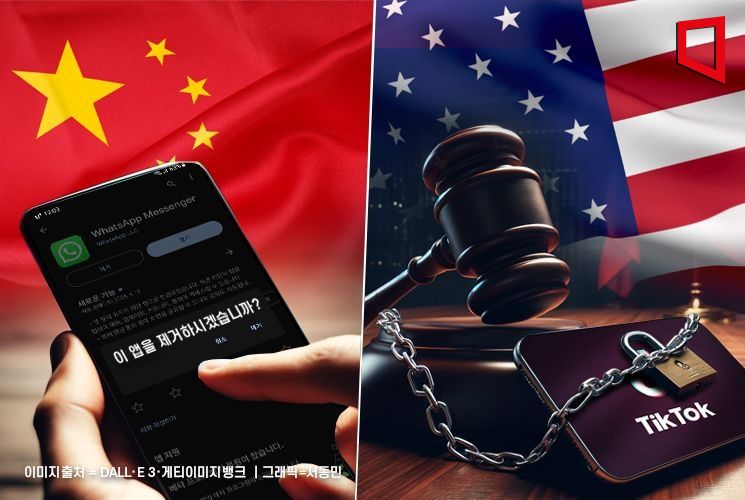
TikTok issued a statement saying, "It is regrettable that the U.S. House of Representatives has once again passed a ban bill that tramples on the freedom of expression of 170 million Americans under the pretext of important diplomatic and humanitarian support."
Regarding the TikTok ban bill, WSJ expressed concerns that it could trigger retaliatory measures from China. On the 19th, Apple announced that the Chinese National Cybersecurity and Informatization Office ordered the removal of Meta’s WhatsApp and Threads from the Chinese App Store due to national security concerns. Telegram and Signal were also removed from the Chinese App Store.
For years, Chinese authorities have blocked the use of Western messaging applications (apps) and social networking services (SNS) such as Facebook, Google, and Twitter through the internet censorship system known as the ‘Great Firewall.’ However, some Chinese users have circumvented this using virtual private networks (VPNs). Foreign media analyze that Chinese authorities have now started blocking these workarounds as well.
Dan Wang, a visiting researcher at Yale Law School’s China Center, said, "The direction is clear. The wall is going up." Regarding China’s removal of WhatsApp and Threads, he added, "If the U.S. pushes through the TikTok ban, it signals that China may take further measures."
The purpose of the U.S. and China forcing the sale of TikTok and blocking WhatsApp and Threads is the same: national security. The U.S. political sphere fears that China could collect information on American users through TikTok or promote China’s stance on sensitive diplomatic issues such as the Israel-Hamas war. Some U.S. lawmakers supporting the TikTok ban argue that banning Chinese apps is fair because Chinese SNS apps are banned in China.
In fact, beyond the TikTok ban bill, the U.S. and China have fiercely competed for technological supremacy. For example, Huawei, a Chinese manufacturer that once ranked first in global smartphone shipments, rapidly declined after being placed on the U.S. sanctions list in 2019, which made 5G smartphone production impossible.
Recently, China has instructed its three major domestic telecom operators to replace foreign-made central processing units (CPUs) by 2027. The global server CPU market is dominated by U.S. companies Intel and AMD, which together hold over 90% market share, effectively targeting these companies.
© The Asia Business Daily(www.asiae.co.kr). All rights reserved.
![Clutching a Stolen Dior Bag, Saying "I Hate Being Poor but Real"... The Grotesque Con of a "Human Knockoff" [Slate]](https://cwcontent.asiae.co.kr/asiaresize/183/2026021902243444107_1771435474.jpg)















