Expanding Competitiveness of Steel and Secondary Battery Materials
Chairman Jang In-hwa of POSCO Group established seven major future innovation tasks focused on expanding competitiveness in steel and secondary battery materials just one month after his inauguration.
After taking office, Chairman Jang launched the ‘POSCO Future Innovation TF’ to thoroughly review the overall management status of the group. Through listening to opinions from related departments and several rounds of discussions, he concretized innovation plans for the major issues facing the group and set innovation tasks based on these plans.
At the POSCO Holdings board of directors' strategy session held on the 19th, Chairman Jang emphasized, "Through the seven future innovation tasks, we will strengthen the competitiveness of core businesses and innovate the overall management system to create a turning point for becoming a top-tier company."
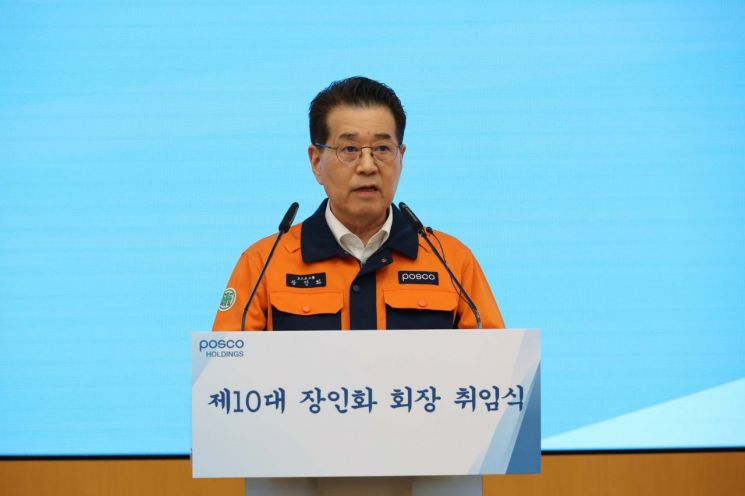
The seven tasks are ▲rebuilding steel competitiveness ▲achieving intrinsic competitiveness and securing innovative technologies in line with the market value of secondary battery materials ▲establishing a responsible management system for business companies and diversifying new business discovery systems ▲innovating fair and transparent governance ▲enhancing employees' ethical awareness and strengthening compliance management ▲fulfilling corporate responsibilities based on principles ▲organizational and personnel reform and establishing a horizontal organizational culture.
The group aims to strengthen the competitiveness of its core businesses, steel and secondary battery materials, to establish its status as a global leading materials company. It also plans to realize a flexible and horizontal organizational culture and restore stakeholders' trust to achieve the new management vision, "Materials Opening the Future, Innovation Toward Top-Tier."
First, in steel, the goal is to secure a super-gap manufacturing competitiveness. To overcome uncertain management conditions such as global oversupply and economic bloc formation, structural innovation in costs will be pursued, and steel facilities will be optimized for profitability, aiming to achieve cost reductions exceeding 1 trillion KRW annually.
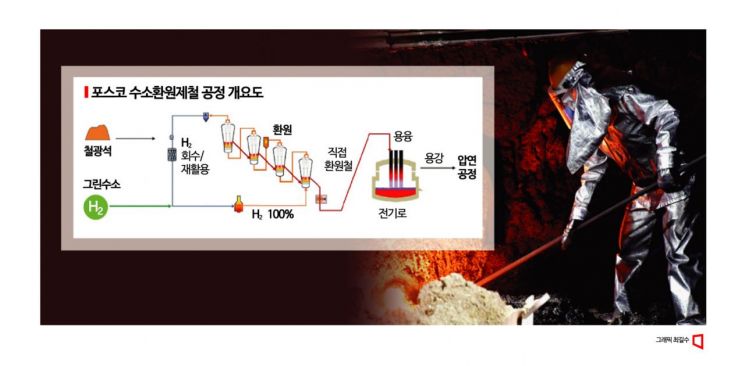
By transitioning to a low-carbon production system through the development of high-grade steel production technology using electric furnaces and the phased expansion of hydrogen reduction steelmaking technology, products with reduced carbon emissions will be launched promptly to capture the low-carbon product market. Stable profits will be secured through a sales portfolio focused on premium products, and a virtuous cycle sales system and coexistence ecosystem will be built by coexisting with excellent customers, where customer growth leads to increased company profits.
The smart factory will be upgraded to an Intelligent Factory integrating artificial intelligence (AI) and robotics technology, and productivity will be increased by expanding its application throughout the order-production-sales process.
For secondary battery materials, a competitive value chain will be completed through active investment in high-quality assets. Core raw material plants such as lithium and nickel, which will enter full-scale mass production this year, will be stabilized early. POSCO Pilbara Lithium Solutions, a lithium hydroxide plant for secondary batteries based on ore lithium completed at the end of last year, has already started commercial production and is steadily ramping up, while the first phase of the Argentina salt lake lithium plant with an annual capacity of 25,000 tons will begin mass production in the second half of this year.
POSCO Holdings stated, "Although the electric vehicle market is experiencing a temporary chasm (slowdown), we are taking this as an opportunity to actively invest in high-quality resources such as lithium salt lakes and mines, thereby advancing our business strategy. We plan to strengthen strategic cooperation with customers to accelerate the commercialization of next-generation materials such as solid electrolytes and lithium metal anodes and to secure future markets."
Additionally, promising businesses specialized in future materials will be intensively discovered and invested in. In particular, mergers and acquisitions (M&A) of promising leading companies will be pursued within three years.
Innovation in corporate culture and management systems will also be accelerated. Capability-based personnel management will be implemented, including expanding promotions for high performers, and communication will be expanded to enhance employee pride and restore trust, such as CEO 100-day on-site accompaniment. As part of management's leading by example, executive salaries will be reduced by up to 20%, and the stock compensation system will be reviewed for abolition.
To enable swift decision-making in group management, the holding company’s organizational restructuring has been carried out, and improvements in various systems such as dress code liberalization and job title reform, as well as changes in working methods including instructions, reporting, and meetings, will be continuously promoted.
From a management system perspective, a fair and transparent CEO and outside director appointment process will be established through the operation of the Governance Improvement TF. The POSCO Clean Committee will be newly established to improve the group-wide compliance management system, and a new ethical management declaration aligned with global standards will actively support the internalization of ethical management among employees.
A POSCO Holdings official said, "Immediately executable tasks will be implemented right away, and large-scale tasks such as transitioning to a low-carbon production system and M&A will be sequentially executed by 2026. To enhance task execution capability and achieve early results, business company presidents or division heads will be responsible for driving the tasks, and the CEO will regularly check progress."
© The Asia Business Daily(www.asiae.co.kr). All rights reserved.
![Clutching a Stolen Dior Bag, Saying "I Hate Being Poor but Real"... The Grotesque Con of a "Human Knockoff" [Slate]](https://cwcontent.asiae.co.kr/asiaresize/183/2026021902243444107_1771435474.jpg)

















