Working from Home in the Philippines... Hourly Wage is 4,100 Won
New York Labor Department "Remote Part-Time Job System is Legal"
Some restaurants in the United States, unable to cope with the soaring minimum wage, are conducting an interesting experiment by hiring remote part-time workers from Southeast Asia. This has sparked reactions praising its novelty as well as criticism for eliminating jobs.
According to the New York Times (NYT), at 'Sansan Chicken' in Long Island City, Queens, New York, a staff member on a monitor screen greets customers at the cash register.
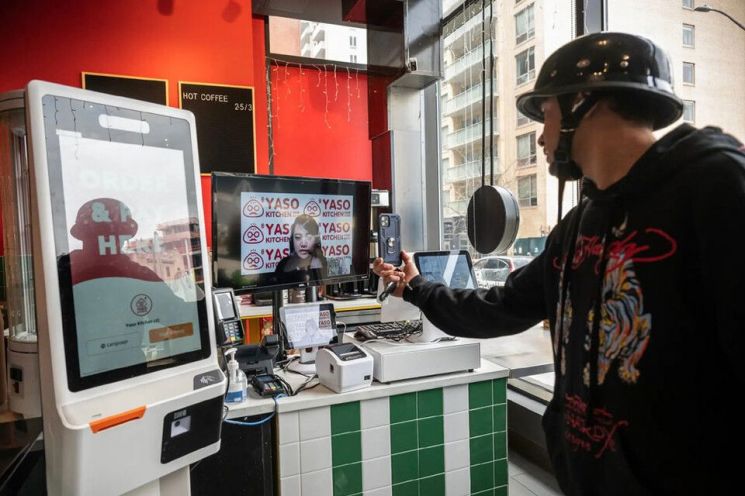 A remote Filipino part-time worker is greeting customers through a Zoom video call at a restaurant in New York, USA.
 [Photo by New York Times]
Customers communicate with the part-time worker on the screen, who smiles brightly and recommends the 'fried chicken sandwich.'
All the part-time workers are working remotely from the Philippines. Although there is a 12-hour time difference between New York and the Philippines, the part-time workers warmly greet customers and explain the menu.
This system was introduced because many restaurants are under pressure due to high rent and rising prices in New York. Currently, the minimum wage in New York City is $16 per hour (about 22,150 KRW). Remote part-time workers receive an hourly wage of $3 (about 4,100 KRW).
If doing similar work in the Philippines, the part-time workers’ wages are about half that amount. Remote part-time workers can also receive tips. Depending on the restaurant, one establishment pays 30% of the total tips received in a day to the part-time workers.
Amber, who is working remotely in New York, majored in business administration at university and has experience working at a fast-food restaurant in the Philippines. She started remote part-time work three months ago and said, "This is my first time working from home."
Rosie Tang, manager of Sansan Chicken, said about the remote part-time system, "It is a way for small businesses to survive," adding, "By saving costs and space, we were able to add a small coffee stand in the store."
According to a spokesperson for the New York State Department of Labor, this remote part-time system is legal. The minimum wage law applies only to "workers physically present" within the geographical limits of New York State.
However, a nonprofit labor organization expressed concern, saying, "Finding a way to outsource work to other countries is very problematic because it will dramatically lower wages in the industry."
There are also predictions that remote cashiers will eventually be replaced by artificial intelligence (AI).
Brett Goldstein, a startup founder and technology expert, said, "Remote employees are definitely a way to reduce costs," but added, "I believe there will be even stranger and more dystopian developments in the future."
He predicted, "Remote employees operate the POS system behind the screen, but perhaps in 6 to 12 months, AI avatars will be able to do the same job."
Customer reactions were mixed. Dan O’Keefe responded, "It’s definitely interesting and unique," but Ismael Oquendo said, "I prefer a regular place that feels like home," adding, "Interaction with people is much better than video."
© The Asia Business Daily(www.asiae.co.kr). All rights reserved.