Gunsan Base Hosts Joint Formation Comprehensive Training... Over 100 Aircraft from 25 Types Deployed
As the press entered the runway of the Air Force Gunsan Base on the 19th, the MQ-9 Reaper, an unmanned attack aircraft of the U.S. Air Force connected to various measurement devices for inspection before sortie, immediately caught attention. Further south on the runway, the suspension bridge structure of the Gogunsan Bridge, a symbol of Saemangeum, was visible in the distance, and in front of it, two F-15K fighter jets of the Republic of Korea Air Force flew by, emitting dazzling flashes.
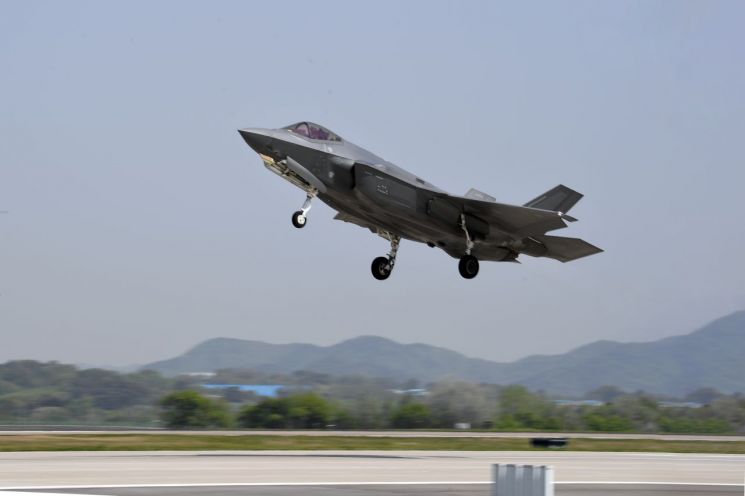 On the 19th, the South Korean and U.S. Air Forces conducted a joint live-fire exercise during the combined squadron comprehensive training at the Pilseung Shooting Range. The photo shows a South Korean Air Force F-35A taking off from the 17th Fighter Wing to participate in the live-fire training. (Photo by the Air Force)
The F-15Ks circled once above Gunsan Base and gently landed on the runway. Following them, U.S. Air Force F-16 fighter jets flew in succession. Unlike the quiet landing of the earlier F-15Ks, the U.S. Air Force F-16s shook their aircraft left and right while attempting to land, then increased thrust, roaring as they flew just above the press several times before finally landing on the runway. The ROK and U.S. Air Force fighters had taken off earlier that morning before the press arrived and successfully completed live-fire air-to-ground training at the Pilsung Firing Range in Gangwon Province before returning to base.
Since the 12th, the ROK and U.S. Air Forces have been conducting the largest-scale “2024 Combined Wing Comprehensive Training” (KFT) until the 26th. The exercise involves about 100 aircraft from both countries' air forces and approximately 1,400 personnel. The fighters returning to Gunsan Base conducted training targeting simulated enemy Transporter Erector Launchers (TELs) at the Pilsung Firing Range. The combined forces performed Emergency Air Interdiction (X-INT) missions, striking targets acquired by Intelligence, Surveillance, and Reconnaissance (ISR) assets in the shortest possible time to preemptively block and neutralize enemy attacks.
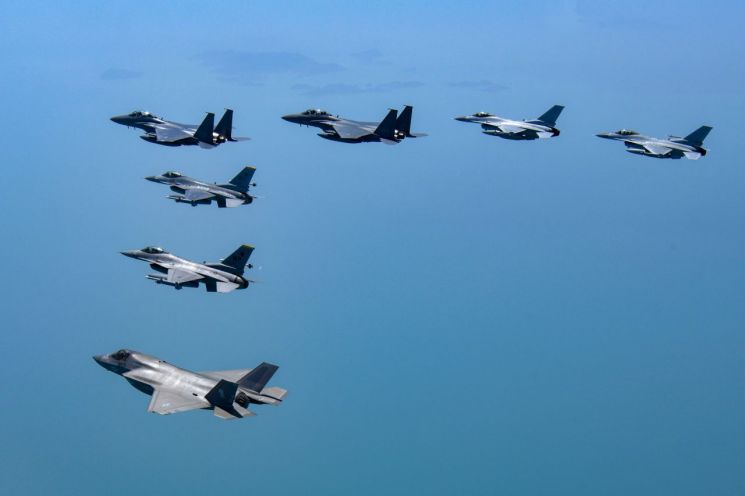 On the 18th, US and South Korean fighter jets performing a mission together over the West Sea airspace. From the left, the flight formation includes one US Marine Corps F-35B, two US Air Force F-16s, two US Air Force F-15Ks, and two US Air Force F-16s. (Photo by the Air Force)
Subsequently, two ROK Air Force F-35A stealth fighters and three U.S. Air Force F-16s assembled in the air and dropped precision-guided bombs GBU-12 on simulated TEL targets at the Pilsung Firing Range, achieving precise strikes. Following this, ROK Air Force FA-50s, KF-16s, KA-1s, and U.S. Air Force A-10s flew in formation over Gunsan Base. These were forces returning after completing large-scale Defensive Counter Air (DCA) missions and other tasks.
An Air Force official explained, “During the training period, the ROK and U.S. Air Forces conduct various tactical exercises such as Air Interdiction (AI), Defensive Counter Air (DCA), Emergency Air Interdiction (X-INT), and Close Air Support (CAS), averaging about 100 sorties per day.”
As the landing of aircraft completing their missions concluded, four U.S. Marine Corps F-35B fighters appeared at the northern end of the runway. The four F-35Bs lined up along the taxiway, passed in front of the press, moved to the southern end of the runway, and shortly after, roared into the sky with powerful engine sounds.
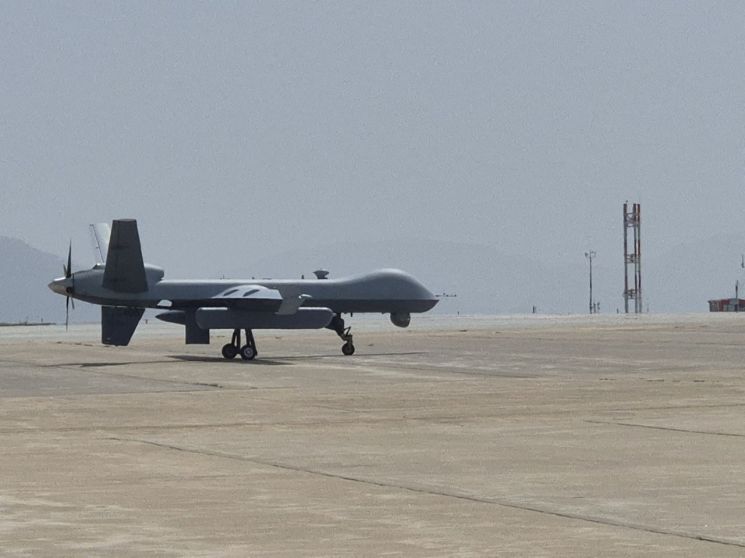 The U.S. MQ-9 Reaper unmanned attack aircraft, participating for the first time in the largest joint air training exercise between the South Korean and U.S. Air Forces, the "Combined Formation Comprehensive Training (KFT)," is moving from the parking area to the runway at Gunsan Air Base on the 19th for sortie. (Photo by the Ministry of National Defense Joint Press Corps)
Following them, the MQ-9 Reaper unmanned attack aircraft silently disappeared into the sky. This was the first time the MQ-9 Reaper, regarded as the most powerful unmanned attack aircraft currently in existence, participated in the KFT. Shortly after, it was reported that the F-35Bs and MQ-9 Reapers that took off successfully completed their mission to neutralize enemy surface-to-air threats through manned-unmanned combined operations.
Additionally, two ROK Air Force KF-16s, one F-15K, two U.S. Air Force F-16s, and one U.S. Marine Corps F-35B participated in training applying complex scenarios to respond to simultaneous infiltration by multiple low- and high-speed aircraft, cruise missiles, and unmanned aerial vehicles, thereby enhancing integrated mission capabilities among 4th and 5th generation fighter aircraft.
Colonel Lee Sang-taek, commander of the 29th Wing and the ROK training control team leader, stated, “The ROK and U.S. Air Forces are fully prepared for combat readiness to immediately repel enemy provocations. Through this training, we demonstrate the powerful combined ROK-U.S. forces and will make every effort to realize a ‘swift, strong, and decisive military.’”
Colonel Michael McCarthy, U.S. 8th Fighter Wing Operations Group Commander and training commander, emphasized, “This training focuses on enhancing alliance capabilities. The ROK and U.S. Air Forces are demonstrating a strong combined force on the ground capable of immediately repelling any enemy provocation.”
Major Kim Sung-jun, an F-35A pilot of the ROK Air Force, said, “Through the training, I experienced close teamwork between ROK and U.S. pilots and confirmed the solid ROK-U.S. alliance. The realistic training has built confidence in overwhelmingly responding to any enemy provocation with assured victory.”
Captain Justin Henry, a U.S. Marine Corps F-35B pilot, shared, “Training with aircraft from different countries at different airfields is a very important process for improving interoperability and joint operational capabilities. It was my first time training with ROK Air Force pilots, and it was a very meaningful and significant experience.”
© The Asia Business Daily(www.asiae.co.kr). All rights reserved.
![Clutching a Stolen Dior Bag, Saying "I Hate Being Poor but Real"... The Grotesque Con of a "Human Knockoff" [Slate]](https://cwcontent.asiae.co.kr/asiaresize/183/2026021902243444107_1771435474.jpg)

















