Middle East Instability Spreads and US Interest Rate Hike Signals Overlap
KOSPI Falls Below 2600
KOSDAQ Also Drops 1%
On the 19th, the domestic stock market experienced significant fluctuations due to overlapping risks from the Middle East and remarks by U.S. Federal Reserve (Fed) officials about interest rate hikes. The KOSPI fell sharply by over 3% during the day as foreigners and institutions consistently sold, but it narrowed the losses before the close and held the 2550 level.
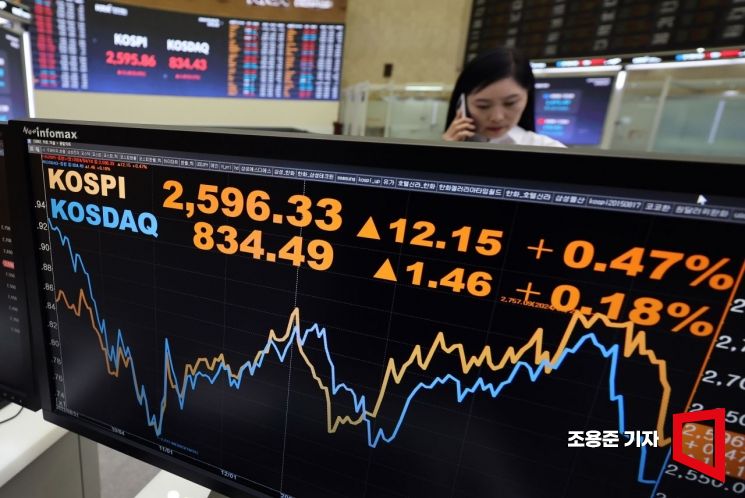 On the 18th, the KOSPI index is displayed at the Korea Exchange PR Center in Yeouido, Seoul, as the KOSPI opened higher, approaching the 2,600 level. On the same day, the won/dollar exchange rate started at 1,380.55 won, down 6.25 won from the previous day. Photo by Jo Yongjun jun21@
On that day, the KOSPI index closed at 2591.86, down 42.48 points (1.63%) from the previous session. The KOSPI briefly broke below the 2560 level in the morning, dropping to 2553.55, but recovered some losses in the afternoon. This was the first time the KOSPI traded at the 2550 level since February 2.
Foreigners and institutions sold 348.8 billion KRW and 655.7 billion KRW respectively, dragging the market down. Foreigners also sold 1.7869 trillion KRW in the futures market, pushing the market into a mixed trend. Only individual investors net bought 925.7 billion KRW.
Rising tensions in the Middle East and hawkish comments from Fed officials about possible rate hikes worsened investor sentiment. On the 18th (local time), some Fed officials made hawkish remarks suggesting that rate hikes are not impossible, causing U.S. Treasury yields to rebound. Additionally, after TSMC’s earnings announcement, U.S. semiconductor stocks underwent a correction, which also negatively affected the market. Furthermore, during the day, foreign media reported that Israeli missiles struck targets inside Iran, escalating Middle East tensions.
As a result, the Korean won to U.S. dollar exchange rate, which had been stabilizing, surged again, briefly reaching the 1390 won level in the morning before closing at 1382.2 won, up 9.3 won.
Lee Kyung-min, a researcher at Daishin Securities, said, "Investor sentiment weakened due to reports of Israel’s attack on Iran, causing a sharp drop to the 2550 level during the session. However, since there were no further signs of escalation, the overly heightened concerns have somewhat eased."
Among the top 10 KOSPI market capitalization stocks, most showed weakness except Hyundai Motor (1.73%) and NAVER (0.94%). SK Hynix (-4.94%), LG Energy Solution (-2.65%), Samsung Electronics (-2.51%), Celltrion (-2.37%), Kia (-1.6%), Samsung Biologics (-1.14%), and POSCO Holdings (-0.9%) all declined.
The KOSDAQ index closed at 841.91, down 13.74 points (1.61%) from the previous day. During the session, the KOSDAQ fell as much as 3.58%, dropping to the 824 level.
Foreigners alone net sold 359.9 billion KRW. In contrast, institutions and individuals net bought 99 billion KRW and 261.4 billion KRW respectively.
Among the top 10 KOSDAQ market capitalization stocks, HLB (2.77%), Rino Industrial (1.48%), and Classys (1.41%) rose. Meanwhile, Enchem (-5.07%), Alteogen (-4.43%), and EO Technics (-3.25%) declined.
© The Asia Business Daily(www.asiae.co.kr). All rights reserved.
![Clutching a Stolen Dior Bag, Saying "I Hate Being Poor but Real"... The Grotesque Con of a "Human Knockoff" [Slate]](https://cwcontent.asiae.co.kr/asiaresize/183/2026021902243444107_1771435474.jpg)















