Financial Services Commission Holds Emergency Financial Market Inspection Meeting
The financial authorities diagnosed on the 19th that the recent increase in volatility in the financial markets, including the decline in stock prices due to the escalation of the Iran-Israel conflict, is largely attributable to temporary external factors. They stated that once external uncertainties such as the situation in the Middle East ease, the domestic financial market is expected to regain a stable trend.
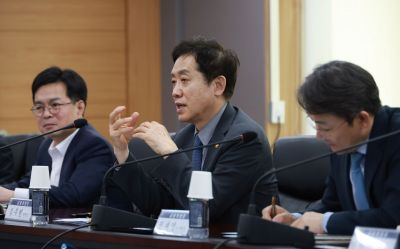
The Financial Services Commission held an emergency financial market inspection meeting on the same day, chaired by Chairman Kim Joo-hyun along with related organizations, and announced, "We will operate an intensive market monitoring system until external uncertainties are alleviated."
On that day, due to the weakening expectations of a U.S. interest rate cut and the news of Israel's retaliatory attacks escalating tensions in the Middle East, volatility in major financial markets, especially in Asia, significantly increased. The Japanese Nikkei index and Taiwan's TAIEX index fell by 2.66% and 3.81% respectively compared to the previous session, and the KOSPI index also dropped by 1.63%.
The attendees evaluated that although external conditions remain unfavorable with expanded uncertainties regarding U.S. monetary policy and the ongoing Middle East crisis, the domestic bond and short-term money markets have maintained relatively stable conditions.
However, regarding the stock market, it was analyzed that the decline in indices was partly due to a global weakening of risk appetite and the burden of strong market conditions differing from other markets.
Chairman Kim said, "Since uncertainties remain regarding global interest rate trends and the development of the Middle East situation, I once again urge thorough preparedness to ensure market stability so that we can respond swiftly to any future developments." He instructed to review crisis response plans for each market and the operation status of market stabilization measures.
Additionally, Chairman Kim stated, "Our economic recovery, centered on exports, is becoming visible, key financial market intermediation functions are operating smoothly, and the government and financial sector have secured sufficient capacity to respond to market volatility caused by external shocks." He urged market participants to respond calmly and rationally to changes in market conditions, emphasizing that the economy and financial markets have built a solid foundation.
Accordingly, the authorities decided to operate an intensive market monitoring system together with related agencies until external uncertainties are alleviated. Furthermore, if necessary, they plan to maintain the best possible response system to ensure that all measures for market stabilization can be executed immediately and swiftly.
© The Asia Business Daily(www.asiae.co.kr). All rights reserved.
![Clutching a Stolen Dior Bag, Saying "I Hate Being Poor but Real"... The Grotesque Con of a "Human Knockoff" [Slate]](https://cwcontent.asiae.co.kr/asiaresize/183/2026021902243444107_1771435474.jpg)















